



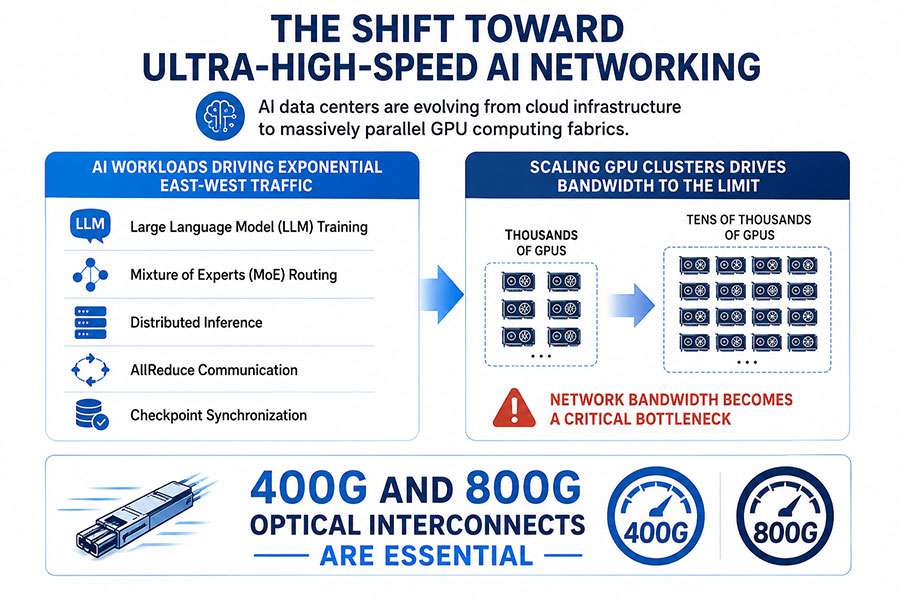
AI data centers are rapidly evolving from traditional cloud infrastructure into massively parallel GPU computing fabrics.
Workloads such as:
Large Language Model (LLM) training
Mixture of Experts (MoE) routing
Distributed inference
AllReduce communication
Checkpoint synchronization
are driving exponential growth in east-west traffic.
As GPU clusters scale from thousands to tens of thousands of accelerators, network bandwidth becomes a critical bottleneck.
This is where 400G and 800G optical interconnects become essential.
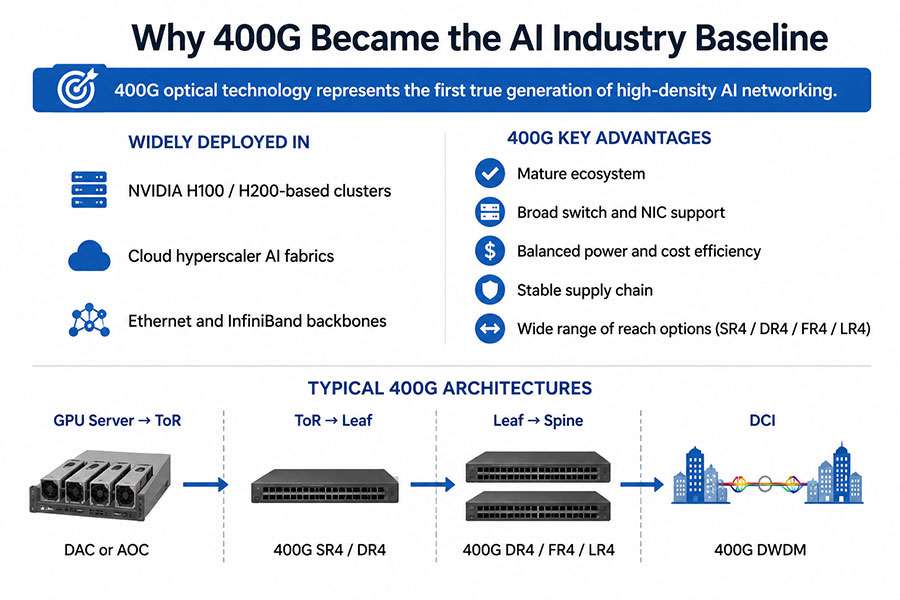
400G optical technology represents the first true generation of high-density AI networking.
It is widely deployed in:
NVIDIA H100 / H200-based clusters
Cloud hyperscaler AI fabrics
Ethernet and InfiniBand backbones
Mature ecosystem
Broad switch and NIC support
Balanced power and cost efficiency
Stable supply chain
Wide range of reach options (SR4 / DR4 / FR4 / LR4)
GPU Server → ToR: DAC or AOC
ToR → Leaf: 400G SR4 / DR4
Leaf → Spine: 400G DR4 / FR4 / LR4
DCI: 400G DWDM
C-LIGHT provides a full range of 400G interconnect solutions:
Optical Modules:
Direct Attach & AOC:
400G QSFP-DD DAC (1–3m)
400G QSFP-DD AOC (5–100m)
These solutions are widely used in AI training clusters, cloud data centers, and high-performance storage networks.
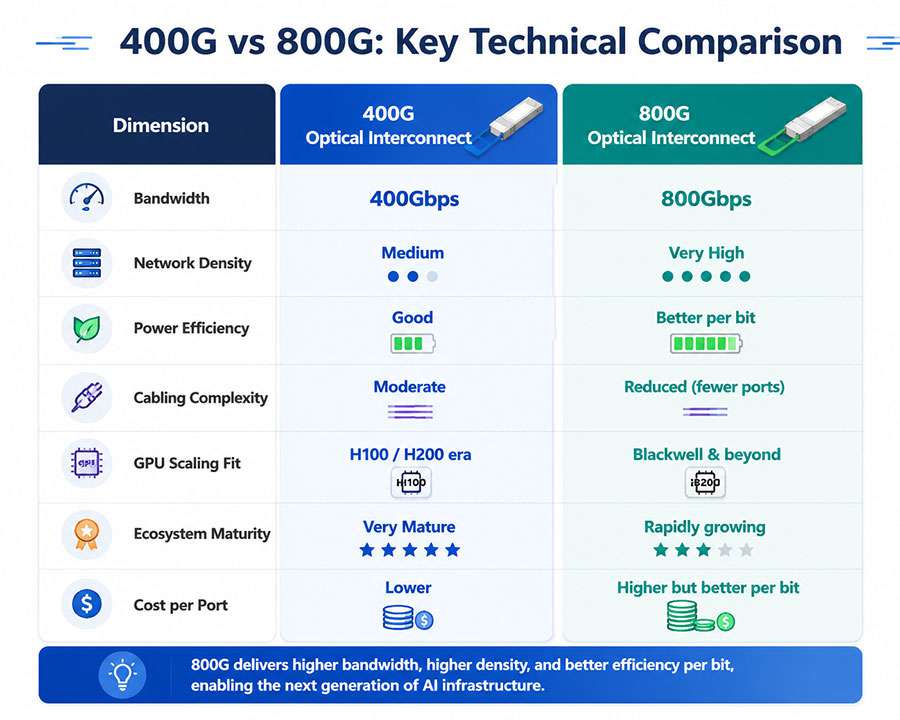
As AI models scale beyond hundreds of billions to trillions of parameters, 400G is no longer sufficient for next-generation GPU fabrics.
800G interconnects are designed to support:
Higher GPU density per rack
Reduced network hops
Lower latency per byte transferred
Improved power efficiency per bit
2× bandwidth of 400G
Better scaling for AI clusters
Reduced switch port count
Improved total cost per bit at scale
Optimized for Blackwell and next-gen AI GPUs
GPU Server → ToR: 800G DAC / AOC
ToR → Leaf: 800G DR8 / AOC
Leaf → Spine: 800G DR8 / 2×FR4
DCI: 800G coherent / DWDM evolution
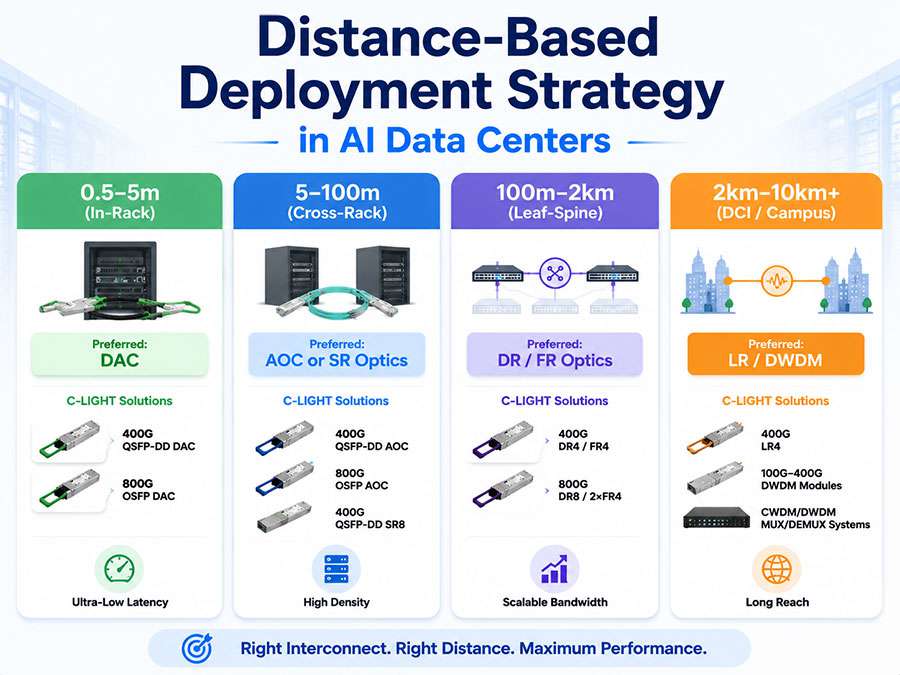
AI infrastructure design is not only about speed—it is about matching the right interconnect to the right distance.
Preferred: DAC
C-LIGHT Solutions:
Preferred: AOC or SR optics
C-LIGHT Solutions:
Preferred: DR / FR optics
C-LIGHT Solutions:
400G DR4 / FR4
800G DR8 / 2×FR4
Preferred: LR / DWDM
C-LIGHT Solutions:
400G LR4
100G–400G DWDM modules
CWDM/DWDM MUX/DEMUX systems
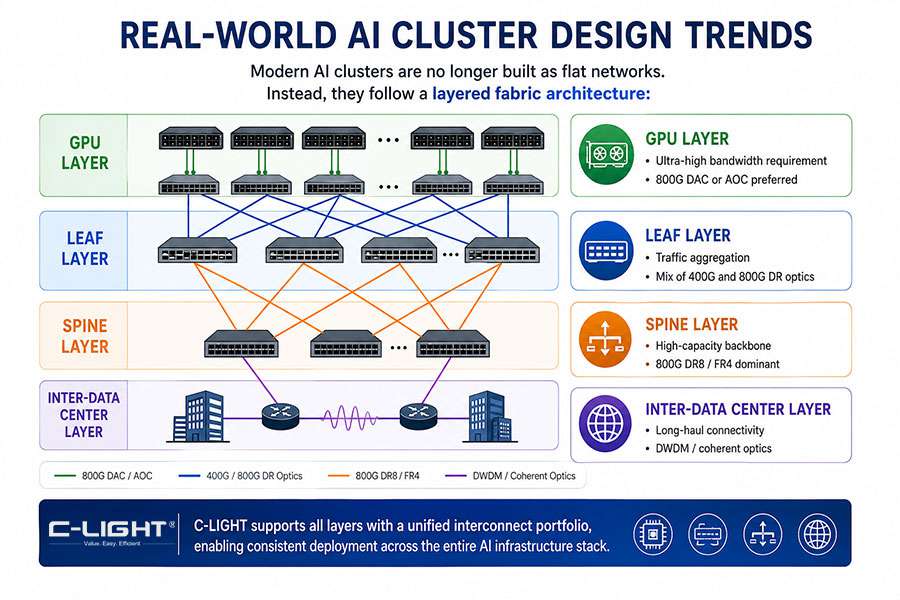
Modern AI clusters are no longer built as flat networks.
Instead, they follow a layered fabric architecture:
Ultra-high bandwidth requirement
800G DAC or AOC preferred
Traffic aggregation
Mix of 400G and 800G DR optics
High-capacity backbone
800G DR8 / FR4 dominant
Long-haul connectivity
DWDM / coherent optics
C-LIGHT supports all layers with a unified interconnect portfolio, enabling consistent deployment across the entire AI infrastructure stack.
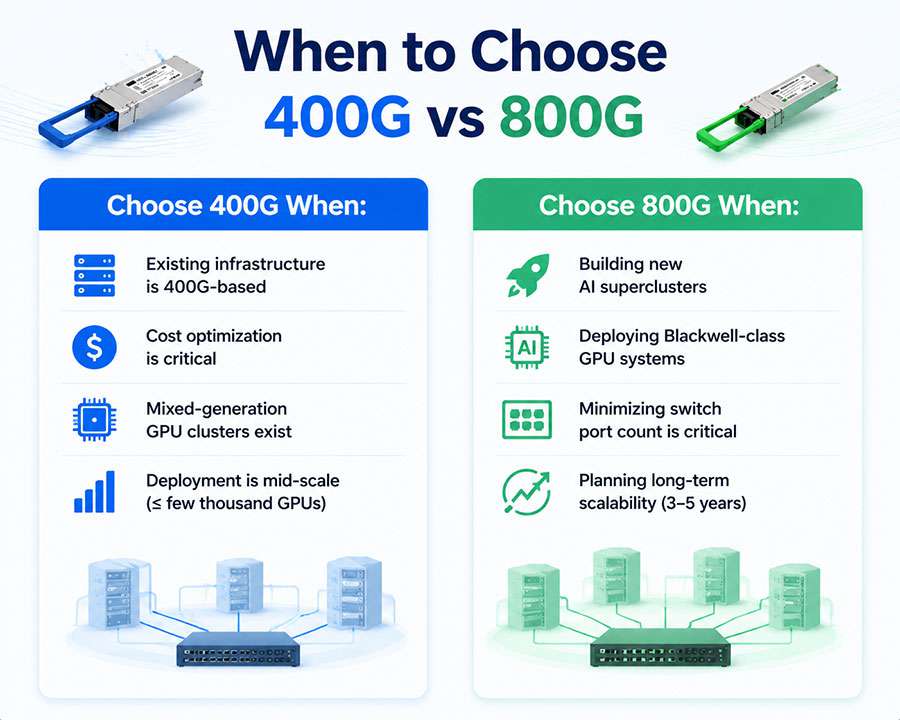
Existing infrastructure is 400G-based
Cost optimization is critical
Mixed-generation GPU clusters exist
Deployment is mid-scale (≤ few thousand GPUs)
Building new AI superclusters
Deploying Blackwell-class GPU systems
Minimizing switch port count is critical
Planning long-term scalability (3–5 years)
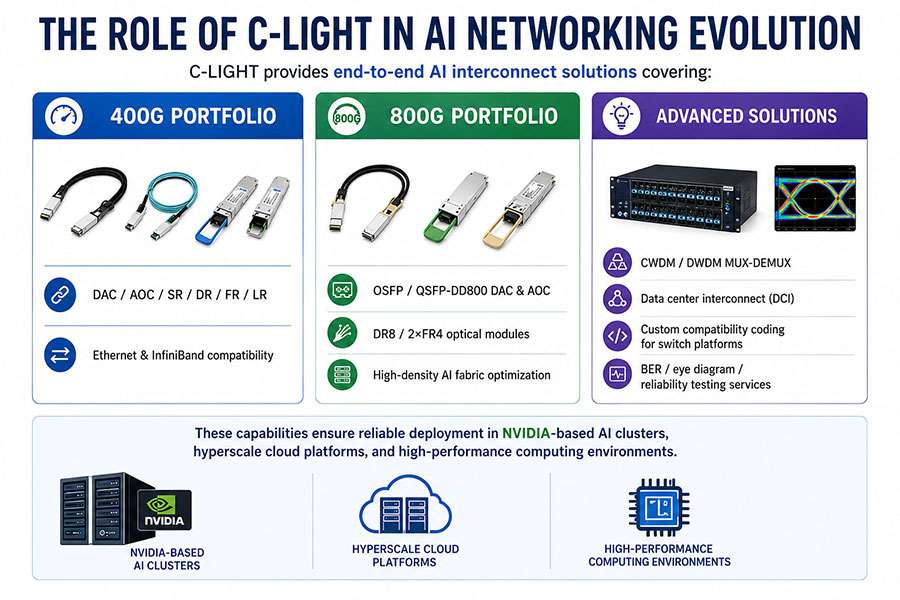
C-LIGHT provides end-to-end AI interconnect solutions covering:
DAC / AOC / SR / DR / FR / LR
Ethernet & InfiniBand compatibility
OSFP / QSFP-DD800 DAC & AOC
DR8 / 2×FR4 optical modules
High-density AI fabric optimization
CWDM / DWDM MUX-DEMUX
Data center interconnect (DCI)
Custom compatibility coding for switch platforms
BER / eye diagram / reliability testing services
These capabilities ensure reliable deployment in NVIDIA-based AI clusters, hyperscale cloud platforms, and high-performance computing environments.
400G and 800G optical interconnects are not competing technologies—they are consecutive stages in AI network evolution.
400G remains the foundation of current AI infrastructure.
800G defines the next generation of GPU-scale AI computing.
The best AI data centers do not choose one over the other—they integrate both strategically.
With a complete portfolio spanning 400G, 800G, DAC, AOC, and optical transceivers, C-LIGHT enables AI operators to build scalable, efficient, and future-ready network architectures for the next era of artificial intelligence.
Answer: The main difference between 400G and 800G optical interconnects is bandwidth capacity and network scalability. A 400G optical solution provides mature high-speed connectivity for current AI clusters and cloud data centers, while 800G doubles the bandwidth per port, enabling higher GPU density, fewer network hops, and improved efficiency for next-generation AI infrastructure.
Answer: 800G optical interconnects are becoming essential for AI data centers because large-scale AI workloads such as LLM training, distributed inference, and GPU cluster communication generate massive east-west traffic. Higher bandwidth helps reduce network bottlenecks, improve GPU utilization, and support next-generation AI computing architectures.
Answer: The choice between 400G and 800G optical transceivers depends on network scale, application requirements, and future expansion plans. 400G is suitable for existing AI clusters, cost-sensitive deployments, and environments with mature 400G infrastructure. 800G is recommended for new AI superclusters, high-density GPU systems, and networks requiring long-term scalability.
Answer: Compared with 400G, 800G optical interconnects provide twice the bandwidth, higher port density, fewer switch ports, and better bandwidth efficiency per bit. These advantages help reduce network complexity and improve total cost efficiency in large-scale AI data centers.
Answer: 400G optical interconnects are widely deployed in AI training clusters, cloud data centers, Ethernet and InfiniBand networks, and high-performance computing environments. Common applications include GPU server-to-ToR connections, ToR-to-leaf aggregation, leaf-to-spine networking, and Data Center Interconnect (DCI).
Answer: 800G optical interconnects are designed for next-generation AI networks, hyperscale data centers, and high-performance computing systems. Typical applications include GPU server connectivity using 800G DAC/AOC, leaf-spine networks using 800G DR8 or 2×FR4 optical modules, and long-distance DCI using advanced optical solutions.
Answer: Yes. 400G and 800G optical solutions are designed to coexist in modern AI data centers. Many networks use a hybrid architecture where 800G is deployed in high-bandwidth layers such as GPU fabrics and spine networks, while 400G continues to support existing infrastructure and cost-effective deployments.
Answer: No. 800G is not replacing 400G immediately but represents the next stage of AI networking evolution. 400G remains an important solution due to its mature ecosystem and broad deployment, while 800G is becoming the preferred choice for large-scale AI clusters, next-generation GPUs, and future-ready data center architectures.
For any questions, please contact us by email or WhatsApp.
Email: sales@c-light.com
WhatsApp: +86 132 6656 7067
