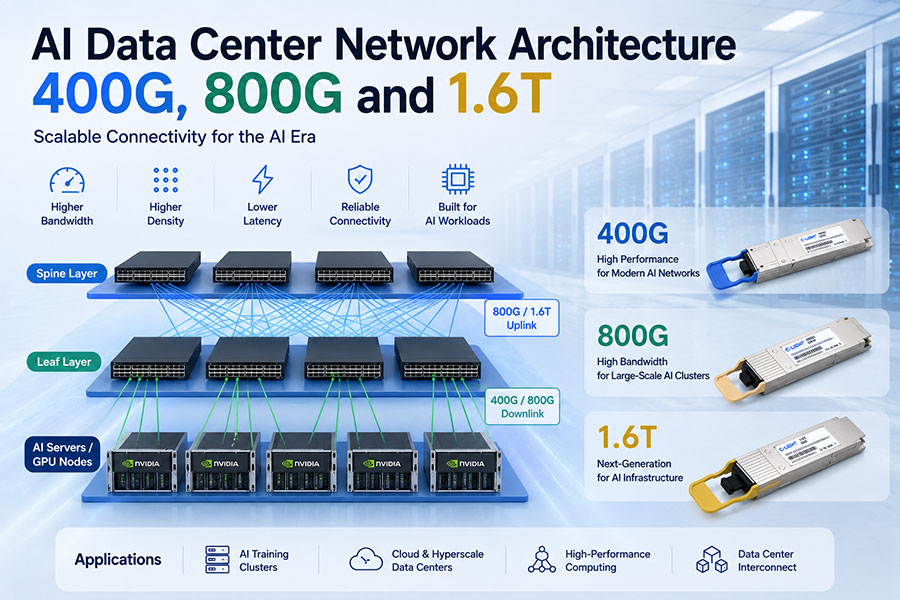

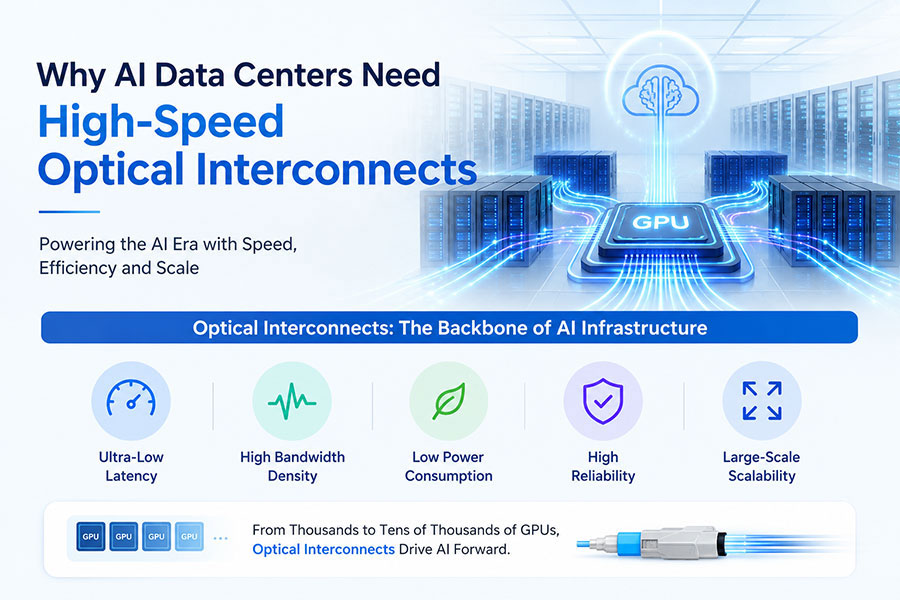
The rapid expansion of AI foundation models and hyperscale GPU clusters has fundamentally changed data center network architectures. Traditional enterprise networks are no longer sufficient to handle massive east-west traffic generated by distributed AI training and inference.
Modern AI data centers require:
Ultra-low latency
High bandwidth density
Low power consumption
High reliability
Large-scale scalability
As GPU clusters continue growing from thousands to tens of thousands of GPUs, optical interconnects have become the backbone of AI infrastructure.
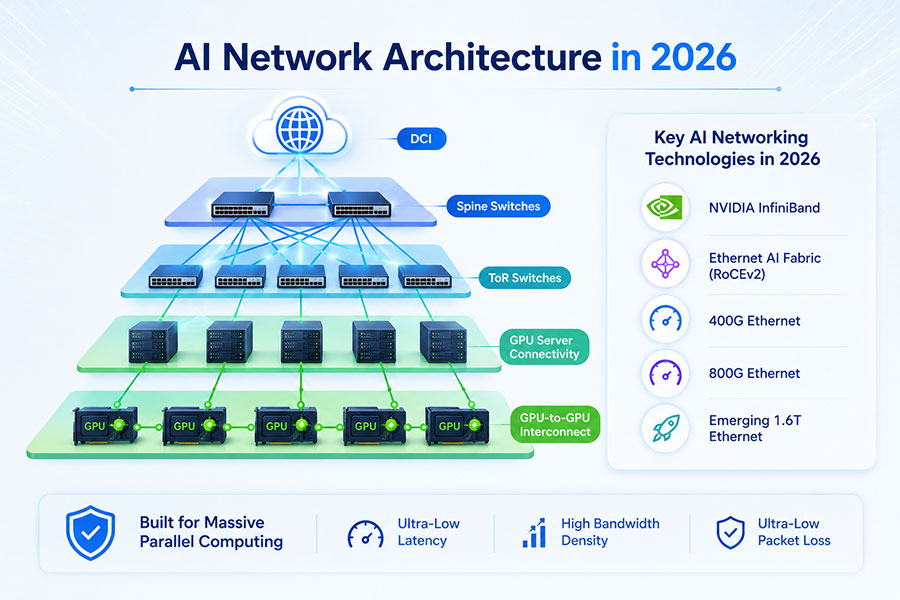
Typical AI networking consists of several interconnected layers:
GPU-to-GPU interconnect
GPU server connectivity
Top-of-Rack (ToR) switches
Spine switches
AI Fabric
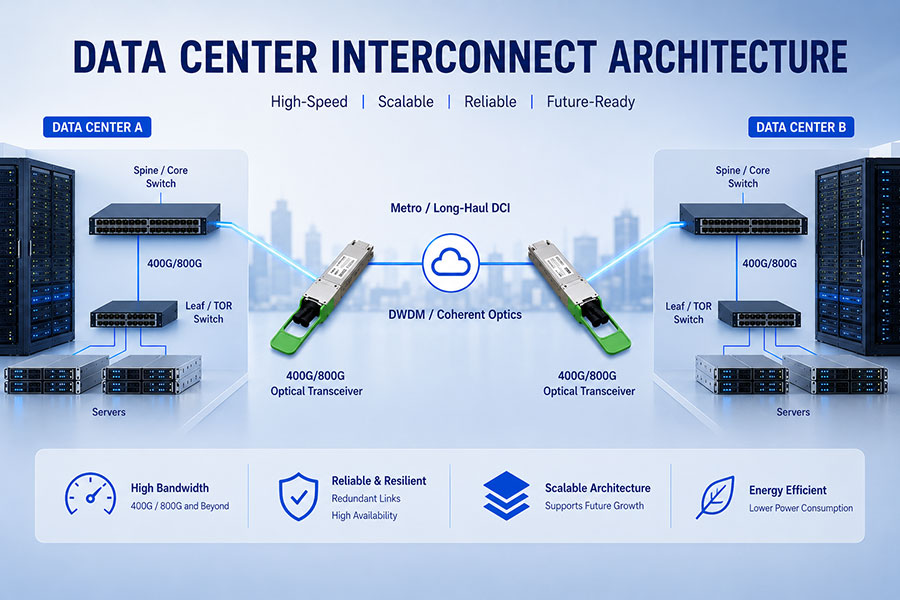
Data Center Interconnect (DCI)
The most common networking technologies include:
NVIDIA InfiniBand
Ethernet AI Fabric (RoCEv2)
400G Ethernet
800G Ethernet
Emerging 1.6T Ethernet
These networks require optical links capable of maintaining extremely low packet loss while supporting massive parallel computing.
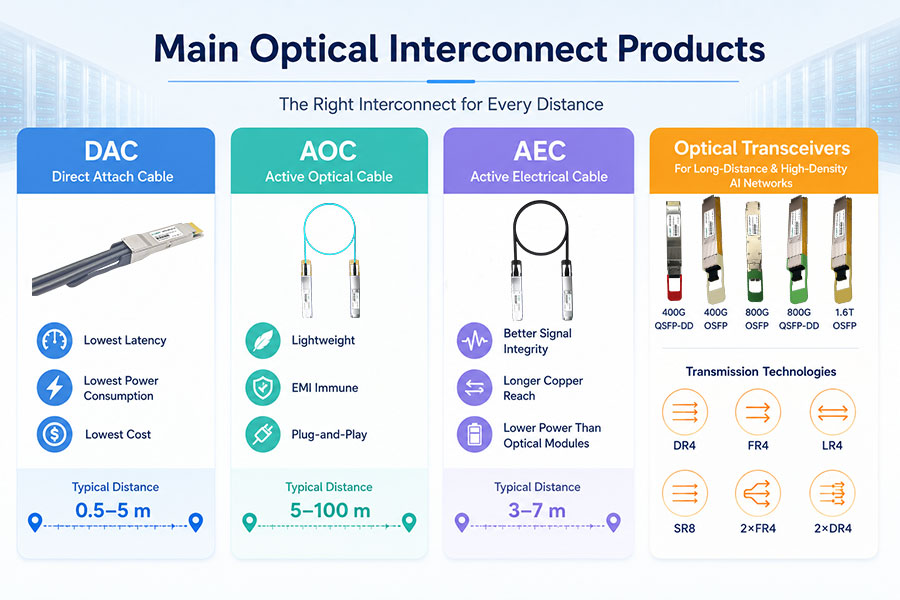
Different transmission distances require different optical interconnect technologies.
Best for short-reach rack-level connections.
Advantages:
Lowest latency
Lowest power consumption
Lowest cost
Typical distance:
0.5–5 m
Ideal for medium-distance server connections.
Advantages:
Lightweight
EMI immune
Plug-and-play
Typical distance:
5–100 m
A growing solution between DAC and optics.
Advantages:
Better signal integrity
Longer copper reach
Lower power than optical modules
Typical distance:
3–7 m
Used for long-distance and high-density AI networks.
Popular products include:
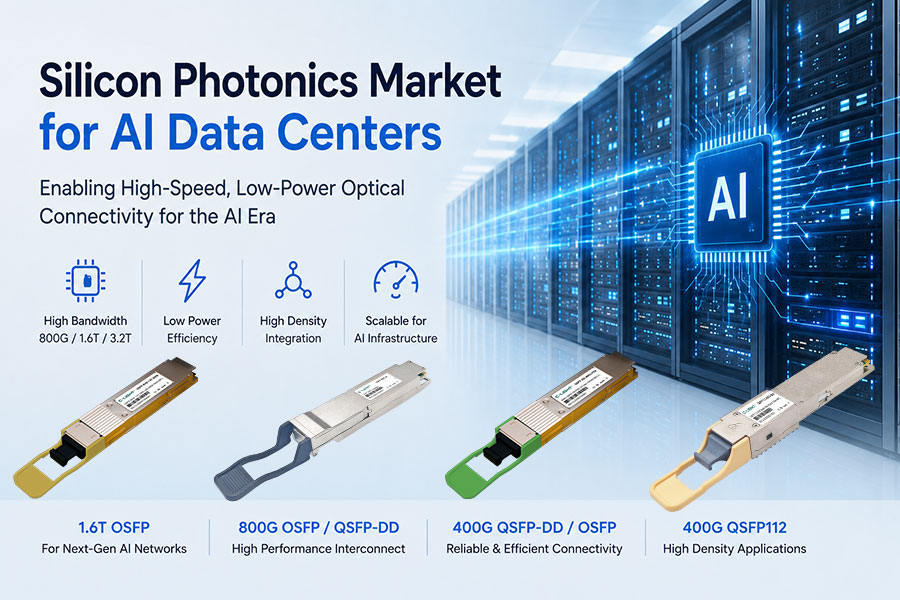
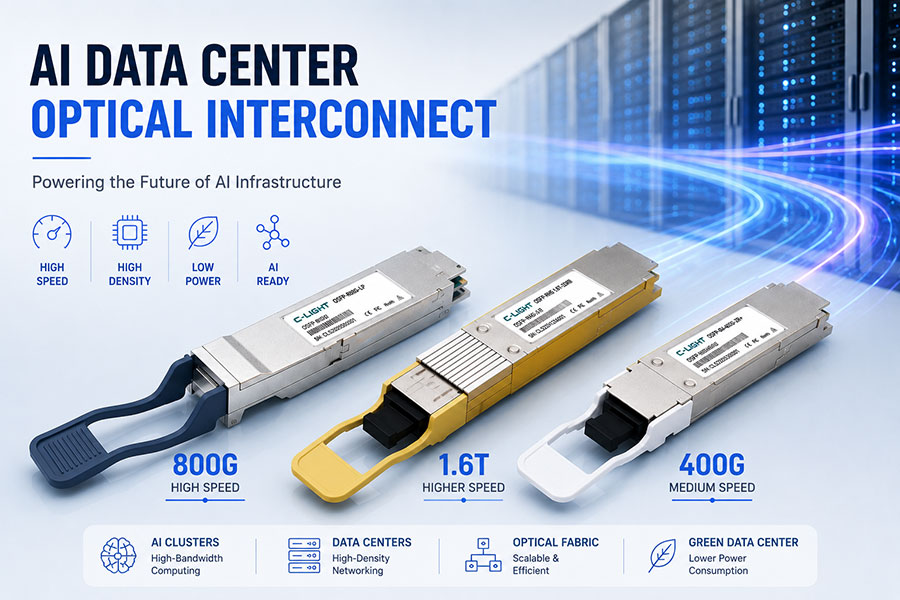
400G QSFP-DD
400G OSFP
800G OSFP
800G QSFP-DD
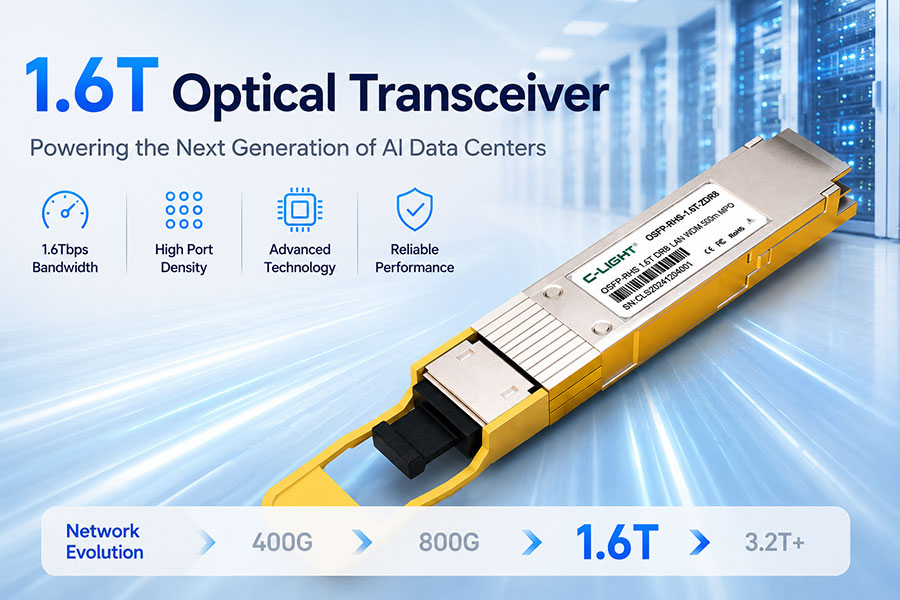
1.6T OSFP
Transmission technologies include:
DR4
FR4
LR4
SR8
2×FR4
2×DR4
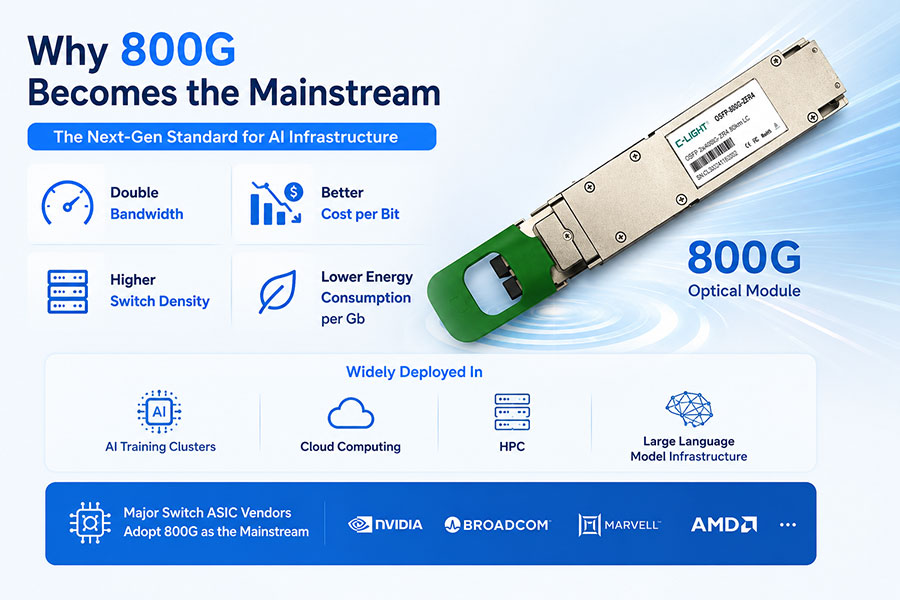
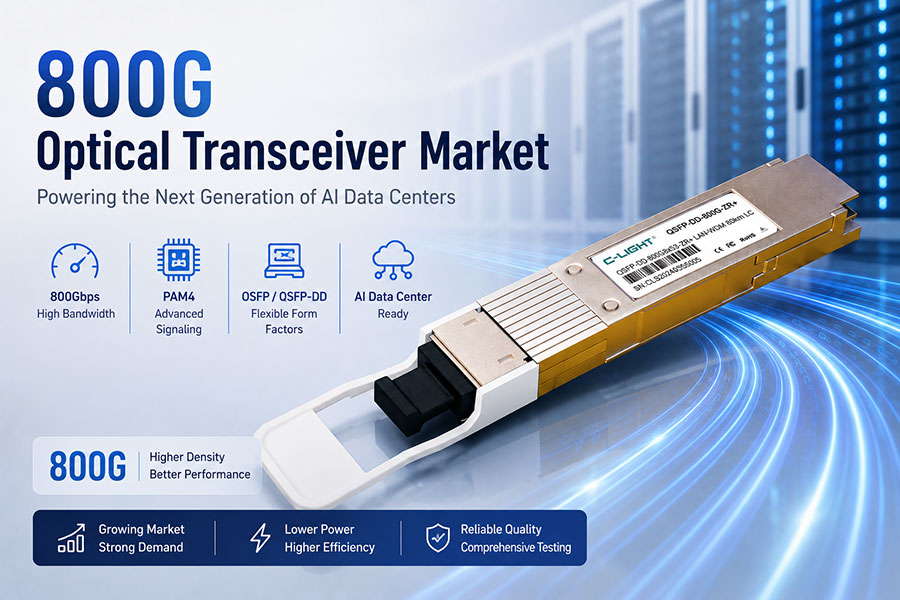
Compared with 400G, 800G optical modules provide:
Double bandwidth
Better cost per bit
Higher switch density
Lower energy consumption per Gb
800G is now widely deployed in:
AI training clusters
Cloud computing
HPC
Large language model infrastructure
Major switch ASIC vendors have already adopted 800G as the mainstream deployment speed.
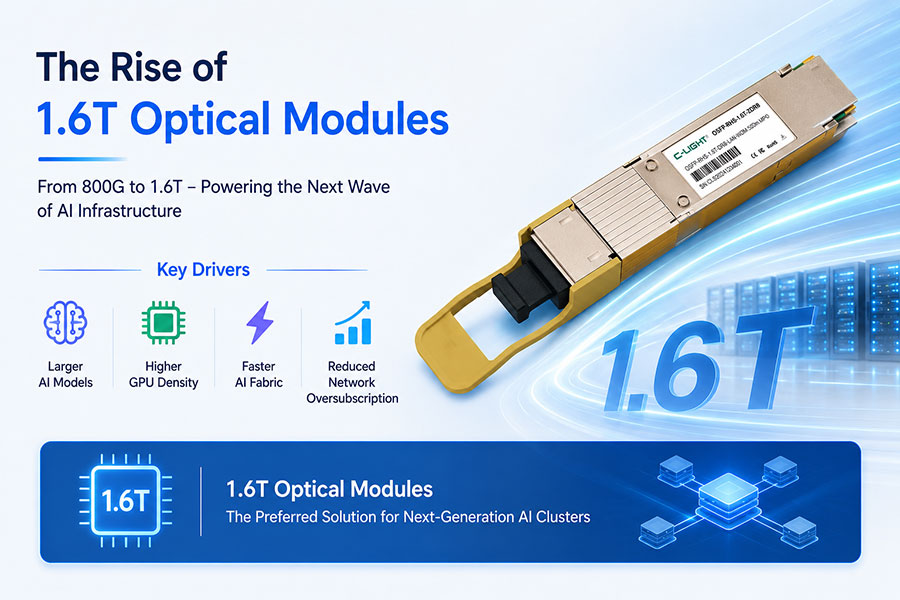
As GPU performance continues increasing, 800G will gradually transition toward 1.6T.
Key drivers include:
Larger AI models
Higher GPU density
Faster AI Fabric
Reduced network oversubscription
1.6T optical modules will become the preferred solution for next-generation AI clusters.
Several technologies are reshaping AI optical networking.
Offers:
Lower power
Higher integration
Better scalability
Lower manufacturing cost
Benefits include:
Lower latency
Reduced DSP power
Simplified architecture
Ideal for AI switching environments.
CPO integrates optics directly beside the switching ASIC.
Advantages:
Shorter electrical paths
Lower power consumption
Higher bandwidth density
CPO is expected to become increasingly important after 2027.
A successful AI data center requires proper cabling planning.
Recommended components include:
MPO/MTP trunk cables
High-density fiber panels
Breakout assemblies
Fiber management systems
High-density patch cords
Well-designed structured cabling improves scalability while simplifying future upgrades.
C-LIGHT provides a comprehensive portfolio of AI networking products, including:
400G Optical Modules
800G Optical Modules
1.6T Optical Modules
DAC Cables
AOC Cables
AEC Cables
MPO/MTP Fiber Solutions
DCI Coherent Optical Modules
These products are designed for AI training clusters, cloud data centers, hyperscale networks, and high-performance computing environments, delivering high compatibility, stable performance, and reliable operation.
AI networking is evolving toward:
800G deployment at scale
Rapid adoption of 1.6T
Silicon Photonics integration
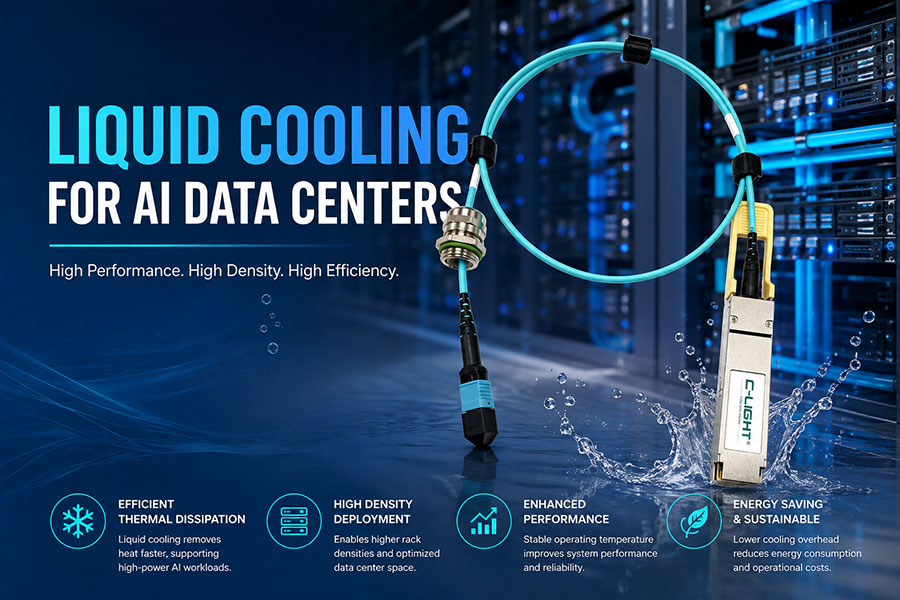
Liquid-cooled AI infrastructure
Intelligent optical fabrics
Energy-efficient networking
AI-native data center architecture
Optical interconnect technology will remain one of the most critical foundations supporting future AI computing.
Answer: AI optical interconnect refers to high-speed optical communication technologies that connect GPUs, servers, switches, and storage systems inside AI data centers.
Answer: 800G optical modules provide higher bandwidth, better switch density, lower cost per bit, and improved power efficiency for AI workloads.
Answer: DAC (Direct Attach Copper) uses passive copper for short-distance connections, AOC (Active Optical Cable) uses integrated optical transceivers for longer transmission distances, and AEC (Active Electrical Cable) uses active signal conditioning to extend high-speed copper connectivity.
Answer: 1.6T optical modules are recommended for next-generation AI clusters requiring higher bandwidth density and future-proof networking.
Answer: Silicon Photonics integrates optical components onto silicon chips, reducing power consumption while improving scalability and manufacturing efficiency.
Answer: Co-Packaged Optics (CPO) integrates optical engines directly with switch ASICs to reduce electrical losses and support ultra-high bandwidth.
Answer: C-LIGHT provides optical transceivers, DAC, AOC, AEC, MPO/MTP cabling solutions, and coherent optical modules for AI, cloud, and hyperscale data center deployments.
For any questions, please contact us by email or WhatsApp.
Email: sales@c-light.com
WhatsApp: +86 132 6656 7067