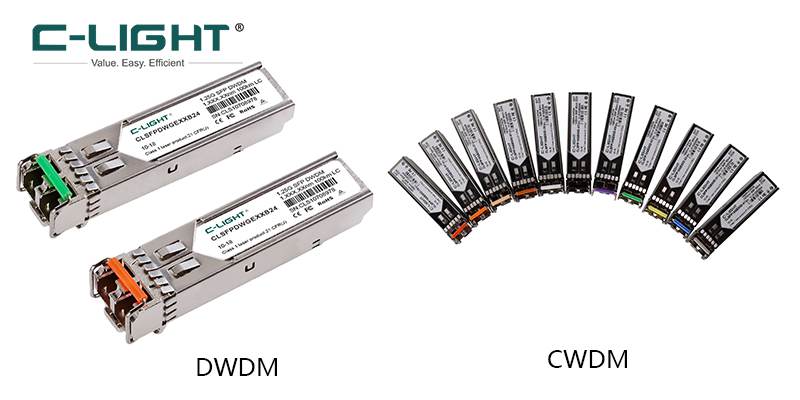
In fiber optic communication systems, as data traffic continues to surge, maximizing bandwidth on limited fiber resources has become a core challenge for network architects. Wavelength Division Multiplexing (WDM) technology effectively increases fiber bandwidth utilization by simultaneously transmitting multiple optical signals of different wavelengths over a single fiber. CWDM and DWDM are two mainstream solutions developed based on WDM technology. They differ significantly in channel spacing, transmission capacity, application scenarios, and other aspects.
| Comparison Dimension | CWDM | DWDM |
| Channel Spacing | 20nm (Wider spacing) | 0.8nm / 0.4nm (Dense spacing) |
| Max. Wavelength Channels | Up to 18 (Commonly 8, 1470~1610nm) | 40 / 80 / 96, up to 160 channels |
| Wavelength Range | 1270nm ~ 1610nm | C-Band (1525~1565nm) + L-Band (1570~1610nm) |
| Transmission Capacity | 100 Gbit/s class | Terabit/s class |
| Transmission Distance | Short-to-medium range, up to ~160km | Long-haul, scalable to hundreds/thousands of km via EDFA |
| Laser Type | Uncooled Laser (Electronic Tuning) | Cooled Laser (Thermal Tuning) |
| Power Consumption & Cost | Lower power consumption, lower equipment cost | Higher power consumption, higher equipment cost |
| Optical Amplifier Support | Not supported (Channel spacing too wide) | Supported (EDFA/Raman Amplifiers) |
CWDM channel spacing is approximately 100 times wider than DWDM. This fundamental difference determines the distinct positioning of the two technologies in terms of cost, performance, and applicable scenarios.
CWDM utilizes a wide 20nm channel spacing, allowing up to 18 wavelengths within the 1270nm to 1610nm range (though typically 8 bands from 1470~1610nm are used). In contrast, DWDM employs extremely narrow channel spacing (0.8nm or 0.4nm, corresponding to 100GHz/50GHz grid), enabling the multiplexing of 40, 80, 96, or even 160 channels within the C-band and L-band. The channel density is significantly higher than CWDM.
CWDM is typically used for applications below 10G with relatively lower capacity. Current pluggable CWDM optical modules can reach up to 100Gbps, with transmission distances generally limited to within 80km. Due to the wide channel spacing, CWDM cannot utilize traditional optical amplifiers (like EDFA), thus limiting transmission reach. DWDM supports high-speed protocols (100G/200G/400G per wavelength) and enables ultra-long-haul transmission over hundreds or thousands of kilometers using EDFA amplifiers, making it the core technology for backbone networks and Data Center Interconnect (DCI).
CWDM systems use uncooled lasers relying on electronic tuning, resulting in lower power consumption and lower equipment costs. DWDM systems utilize cooled lasers with precise thermal tuning to lock wavelengths, ensuring higher system performance, security, and longer operational life, albeit with higher power consumption.
The primary advantage of CWDM is lower cost. The core components—filters and lasers—are significantly less expensive than those in DWDM systems. This makes CWDM highly advantageous for short-distance, cost-sensitive applications. While the price gap between CWDM and DWDM components has narrowed recently with technological advancements, CWDM still maintains a high cost-performance ratio in large-scale deployments.
Key Factors for Selection:
CWDM Applicable Scenarios: 5G Fronthaul networks, campus interconnects, metro network aggregation layers, FTTH access networks, temporary link setups, and other short-distance, cost-sensitive requirements.
DWDM Applicable Scenarios: Cross-provincial backbone networks, large-scale Data Center Interconnect (DCI), long-distance fiber transmission, and high-capacity secure applications.
In simple terms: CWDM uses "wide lanes" for short distances and low cost; DWDM uses "dense lanes" for long distances and high capacity.
Shenzhen C-LIGHT Networks Communication Co., Ltd., established in 2011, is a high-tech company specializing in R&D and manufacturing of optical modules. Its product portfolio covers eight categories, including 800G, 400G, 200G, 100G, 50G, 25G, and 10G, totaling over a thousand optical module solutions. C-LIGHT offers a complete product matrix in both CWDM and DWDM fields.
C-LIGHT's self-developed 100G/40G/25G CWDM SFP28/QSFP+ optical modules support transmission distances of 10km and 40km. These products feature CDR functionality and high-temperature operation capability up to 85°C, meeting various network requirements such as 5G fronthaul, access network uplinks, and metro networks.
Main CWDM Optical Module Models:
| Form Factor | Product Model | Data Rate | Wavelength Range | Reach |
| QSFP28 | CL100GQSFPCW10-** | 100G | CWDM | 10km |
| QSFP+ | CLQSFP40GCW10-** | 40G | CWDM | 10km |
| SFP28 | CLSFP25GCW40P/E/I-XX | 25G | 1470~1610nm | 40km |
| SFP28 | CLSFP25GCW20P/E/I-XX | 25G | 1470~1610nm | 20km |
| SFP28 | CLSFP25GCWB16-XX | 25G | 1270~1370nm | 40km |
| SFP28 | CLSFP25GCWB12-XX | 25G | 1270~1370nm | 10km |
Additionally, C-LIGHT offers the 25G CWDM SFP28 10km optical module, a high-performance, industrial-temperature-range, cost-effective transmission solution designed for 25G Ethernet and Fibre Channel applications.
C-LIGHT's DWDM optical modules cover a wide range of rates, from 400G to 100G, 25G, 10G, 2.5G, and 1G, all operating within the C-BAND 100GHz/50GHz grid, enabling shared passive WDM optical networks.
Core DWDM Optical Module Products:
| Product Model | Form Factor | Data Rate | Wavelength | Reach | Key Technology |
| CL400GQDDZR+-300 | QSFP-DD | 400G/100G | C-BAND Tunable | 300km | DCO, DSP, TEC |
| CLSFP25GDW40P-XX | SFP28 | 25G | C-BAND | 40km | CDR, DSP, TEC |
| CLSFP10GDWB26-XX | SFP+ | 9.9G~11.3G | C-BAND | 120km | CDR, TEC |
Answer: The main difference between CWDM and DWDM optical systems is channel spacing, transmission capacity, and application scenarios. CWDM uses wider 20nm wavelength spacing with fewer channels, providing a cost-effective solution for short- and medium-distance networks. DWDM uses much narrower wavelength spacing, enabling more channels and higher capacity for long-distance transmission and backbone networks.
Answer: CWDM (Coarse Wavelength Division Multiplexing) is used to increase fiber capacity by transmitting multiple wavelengths over a single optical fiber. It is commonly deployed in enterprise networks, data center aggregation, metro networks, and 5G fronthaul applications where cost efficiency and simple deployment are important.
Answer: CWDM is typically designed for short- to medium-distance transmission, with common applications reaching tens of kilometers depending on the optical module and network design. DWDM supports much longer distances by using dense wavelength spacing and optical amplification technologies such as EDFA, making it suitable for metro networks, backbone networks, and long-haul optical transmission.
Answer: DWDM is preferred for high-capacity backbone networks because it supports a much higher number of wavelength channels and greater bandwidth scalability. By using narrow channel spacing and advanced optical technologies, DWDM systems can support 100G, 200G, 400G, and beyond per wavelength, making them ideal for telecom networks, DCI, cloud infrastructure, and hyperscale data centers.
Answer: The choice between CWDM and DWDM depends on bandwidth requirements, transmission distance, and future scalability. CWDM is suitable for cost-sensitive short-distance connections, while DWDM is recommended for high-capacity DCI applications requiring multiple wavelengths, higher bandwidth, and longer transmission distances.
Answer: CWDM MUX/DEMUX and DWDM MUX/DEMUX both combine multiple optical signals onto a single fiber and separate them at the receiving end. The main difference is wavelength spacing and channel capacity. CWDM uses wider spacing with fewer channels, while DWDM uses dense wavelength spacing to support significantly more channels and higher network capacity.
Answer: CWDM is more cost-effective because it uses wider wavelength spacing, which allows simpler optical components and uncooled laser technology. Compared with DWDM systems that require precise wavelength control and higher-performance components, CWDM provides lower equipment cost, lower power consumption, and easier deployment for medium-capacity optical networks.
Answer: CWDM and DWDM optical modules are based on different wavelength plans and are generally designed for different WDM systems. They cannot be directly mixed on the same MUX/DEMUX channel, but they can coexist within the same overall network architecture when separate WDM systems are properly designed and deployed.
For any questions, please contact us by email or WhatsApp.
Email: sales@c-light.com
WhatsApp: +86 132 6656 7067