
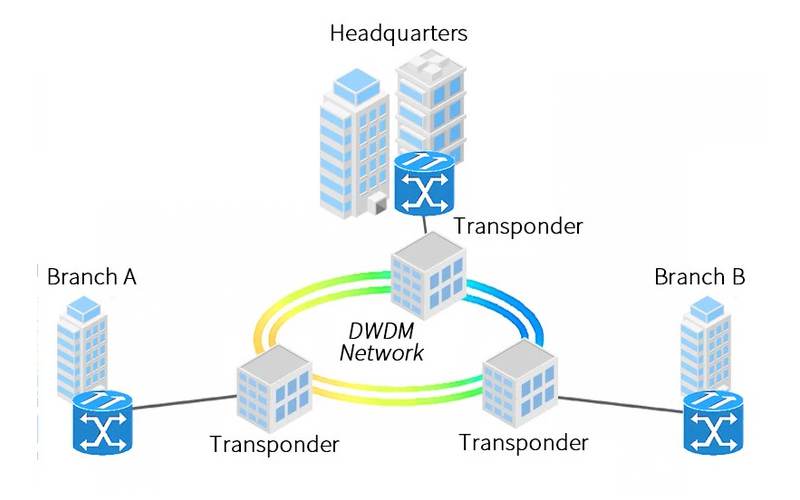
The design and deployment of a DWDM network require comprehensive consideration of multiple factors and adherence to certain principles and standards to ensure network performance, reliability, and scalability.
The following key aspects require focused attention during the DWDM network design process:
Optical Signal-to-Noise Ratio (OSNR): OSNR is a key metric for measuring the performance of a DWDM system, directly impacting transmission quality and reach. The design must ensure that the OSNR for each wavelength across the entire link meets the required specifications. This is typically achieved through precise optical power calculations and the configuration of appropriate amplifiers.
Dispersion Compensation: Chromatic dispersion in optical fiber causes pulse broadening, limiting transmission distance and data rate. DWDM systems must employ various dispersion compensation techniques to overcome this issue, such as using Dispersion Compensation Fiber (DCF), Fiber Bragg Gratings (FBG), or electronic dispersion compensation. The principle of dispersion compensation is to achieve near-zero total dispersion across the entire link, while also managing the additional loss introduced by the compensation modules.
Nonlinear Effects Management: When the injected optical power is high, nonlinear effects in the fiber—such as Self-Phase Modulation (SPM), Cross-Phase Modulation (XPM), and Four-Wave Mixing (FWM)—can become major limiting factors for system performance. Mitigating the impact of nonlinear effects requires controlling the launch power, utilizing Non-Zero Dispersion-Shifted Fiber (NZ-DSF), or employing methods like unequal channel spacing.
Network Protection and Restoration: To enhance network reliability, DWDM systems must incorporate appropriate protection mechanisms, such as optical channel protection, optical line protection, and ring protection. Based on the criticality and quality requirements of the services, suitable protection schemes should be selected to enable fast switching and service restoration in the event of a network failure.
For any questions, please contact us by email or WhatsApp.
Email: sales@c-light.com
WhatsApp: +86 132 6656 7067