
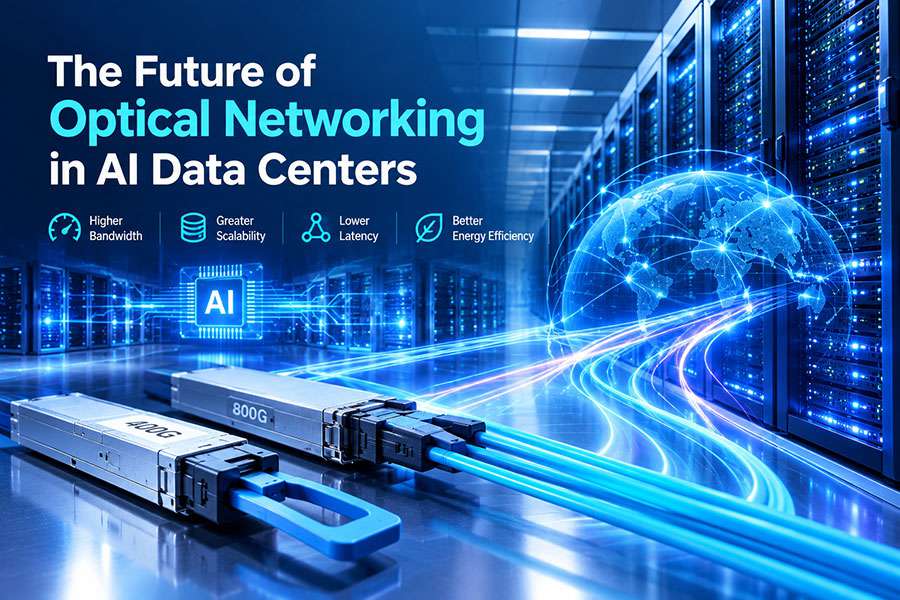
The future of optical networking in AI data centers is moving toward 800G, 1.6T, silicon photonics, LPO, CPO, and higher-density optical connectivity.
AI workloads rely on large-scale GPU clusters that continuously exchange data between accelerators, servers, switches, and storage systems. Optical networking provides the bandwidth and reach required to support these high-volume communication environments.
As AI models and GPU clusters become larger, network traffic continues to increase. Higher-speed optical interfaces are needed to prevent network bandwidth from becoming a limitation on computing performance.
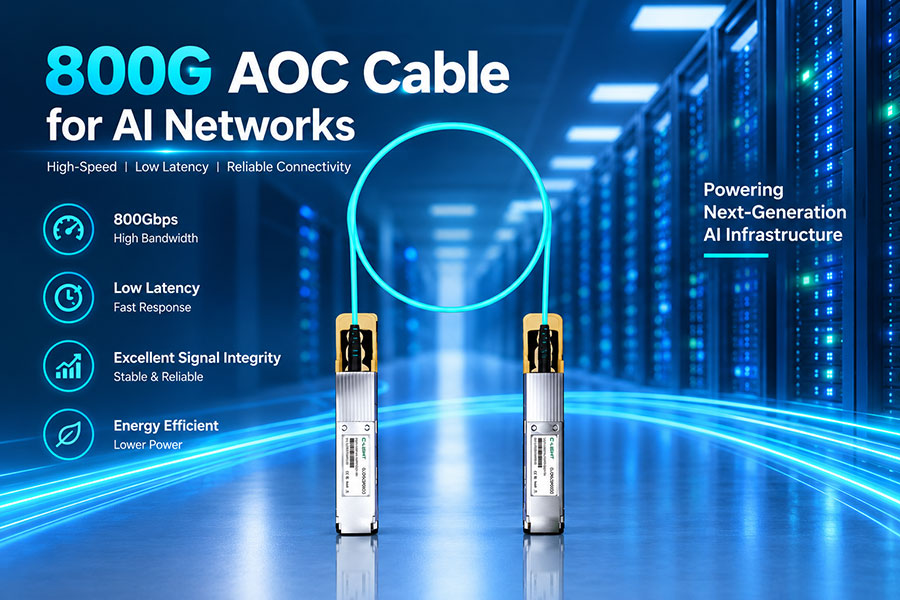
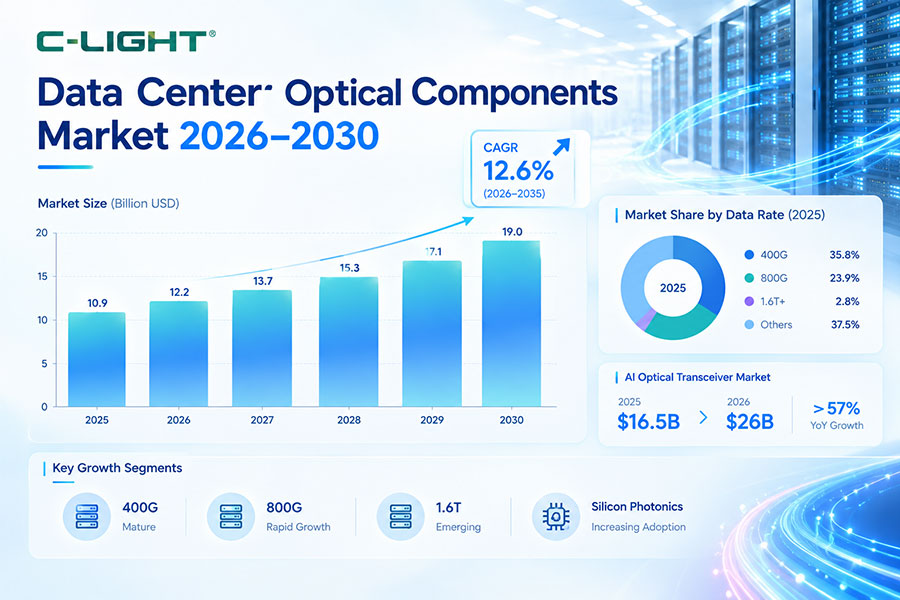
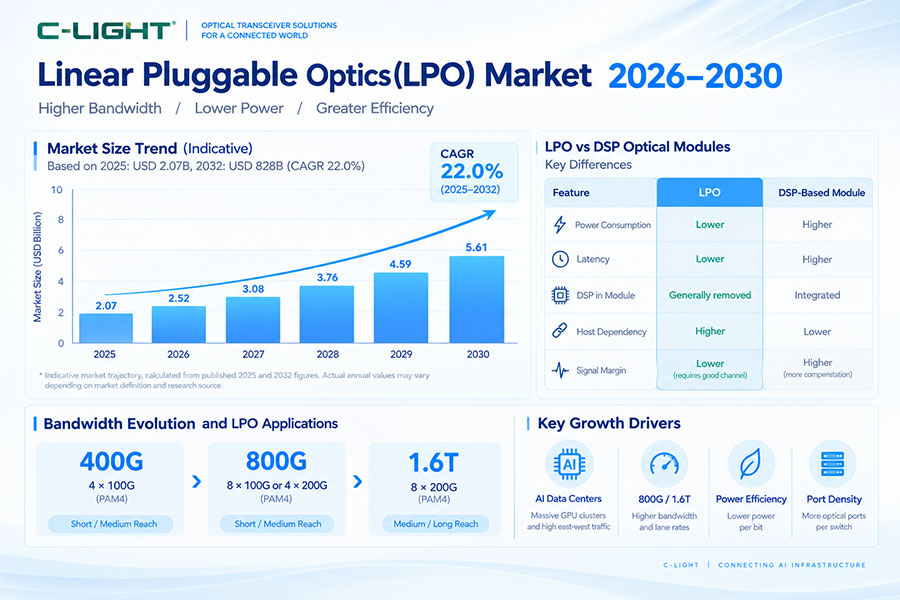
400G remains an important data center connectivity speed, while 800G is becoming increasingly important for AI networks. 1.6T is emerging as the next major step in optical port bandwidth.
800G optical transceivers support high-bandwidth connections between switches, servers, and AI accelerators. OSFP and QSFP-DD form factors are commonly considered for high-speed data center deployments.
1.6T optical transceivers increase bandwidth per port and can help reduce the number of physical ports required for high-capacity network connections. 8×200G PAM4 architectures are an important approach for 1.6T connectivity.
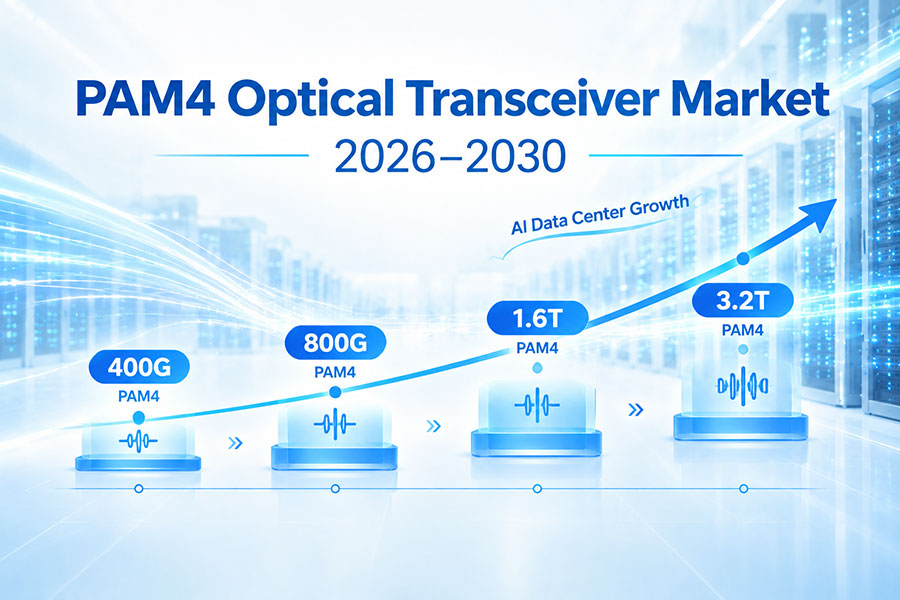
PAM4 remains a key signaling technology for high-speed optical networking. Increasing lane speeds from 50G to 100G and 200G enables 400G, 800G, and 1.6T interfaces.
Future AI data centers require greater bandwidth within limited rack and switch space. Higher-speed optical modules allow more network capacity per port while supporting high-density system designs.
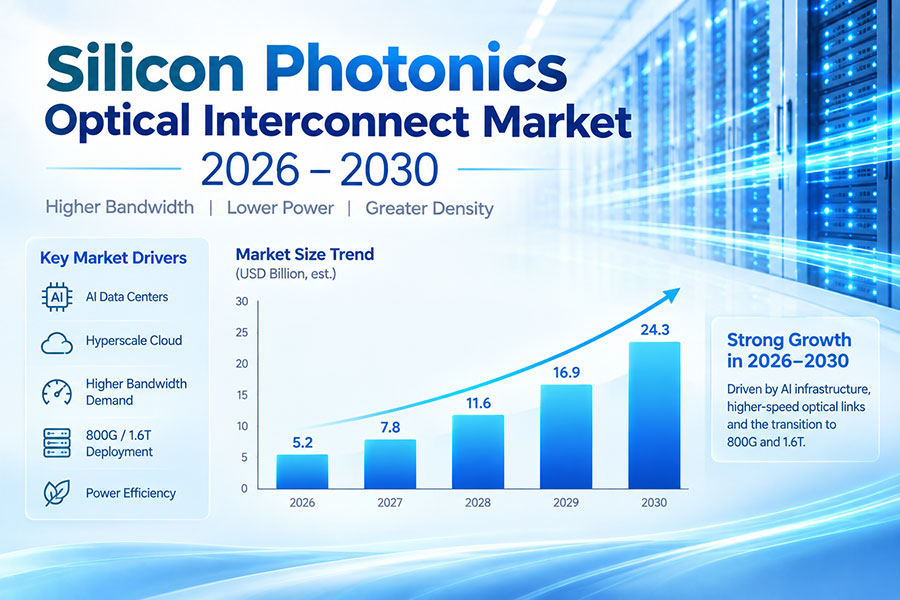
Silicon photonics integrates optical functions with silicon photonic integrated circuits. It is becoming increasingly important for high-speed optical connectivity because of its potential for integration, scalability, and manufacturing efficiency.
LPO reduces some digital signal processing between the host and optical module. By simplifying the signal path, LPO can potentially reduce power consumption and latency in suitable high-speed applications.
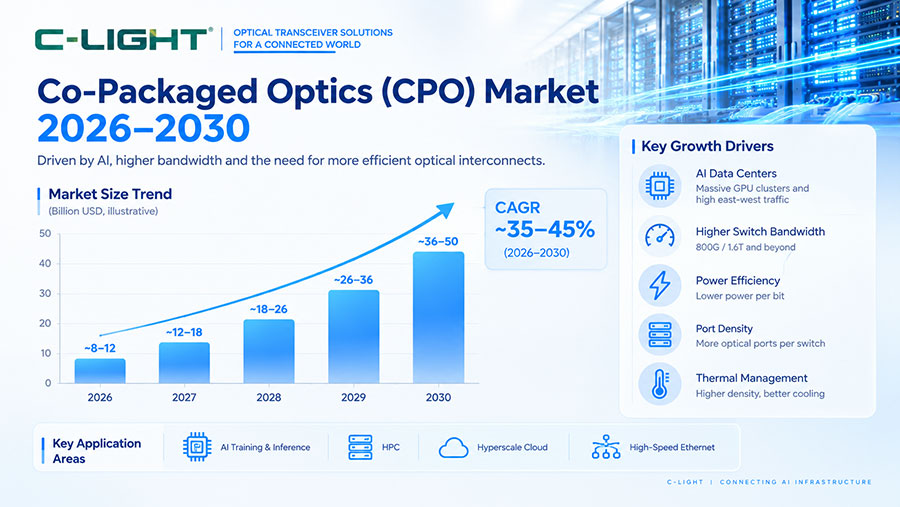
CPO places optical engines closer to switching ASICs, reducing the electrical distance between the switch chip and optical interface. It is being developed as a solution for future high-bandwidth and high-density networking.
As switch ASIC bandwidth increases, traditional front-panel pluggable optics face increasing power and electrical reach challenges. CPO provides a different architecture that integrates optical connectivity more closely with the switching system.
Large GPU clusters require fast communication between accelerators. Optical links can connect GPU systems to switches and provide high-bandwidth connectivity across racks and network layers.
High-capacity switch-to-switch links are becoming increasingly important in AI networks. 800G and future 1.6T optical interfaces can support high-volume east-west traffic between network layers.
As AI clusters expand across multiple racks, optical interconnects provide the reach and bandwidth needed for rack-to-rack communication while avoiding the limitations of long copper connections.
Different interconnect technologies will continue to serve different distances. DAC is suitable for very short copper connections, AOC provides optical connectivity for longer short-reach links, and AEC extends copper connectivity through active signal conditioning.
Network power consumption becomes a major consideration as AI data centers scale. Future optical solutions will focus on increasing bandwidth while reducing power per bit and improving overall system efficiency.
Higher bandwidth alone is not sufficient for future AI networks. Optical module design must improve power efficiency so that network capacity can grow without creating excessive thermal and energy requirements.
800G and 1.6T optical modules generate significant thermal considerations. Advanced heatsinks, improved optical engines, efficient DSP architectures, and new packaging technologies will become increasingly important.
Form factors such as QSFP112, QSFP-DD, and OSFP provide different combinations of size, thermal capacity, electrical interface, and port density. Form factor selection will remain important as optical speeds increase.
Multimode fiber remains useful for short-reach applications, while single-mode fiber supports longer transmission distances. AI data center networks can use both according to reach and deployment requirements.
Future AI infrastructure will require networks that can scale from individual racks to large multi-rack GPU clusters. Higher-speed optical interfaces provide a foundation for expanding network capacity without proportional increases in physical connectivity.
FEC will remain important as signaling speeds increase. It helps correct transmission errors and maintain reliable communication across high-speed PAM4 optical links.
Higher-speed electrical and optical interfaces require careful control of signal integrity. Equalization, DSP, connector design, PCB layout, optical components, and cable performance all influence link quality.
The optical industry is moving toward greater integration of lasers, photonic integrated circuits, drivers, receivers, and signal-processing functions. This integration can support higher density and more efficient optical systems.
After 1.6T, future networks will continue increasing lane speeds and total port bandwidth. Technologies developed for 1.6T will provide a foundation for future 3.2T and higher-speed optical connectivity.
Future AI data centers will combine high-speed optical transceivers, active cables, high-capacity switches, optical engines, and advanced network architectures to create scalable accelerator fabrics.
Hyperscale operators require large numbers of high-speed optical connections. Standardized interfaces, multi-vendor interoperability, power efficiency, and high-volume manufacturing will become increasingly important.
As optical speeds increase, compatibility between transceivers, switches, cables, and network platforms becomes increasingly important. Standards compliance and interoperability testing help reduce deployment risks.
The next generation of AI optical networking will be driven by higher bandwidth demand, lower power consumption, greater port density, improved optical integration, and the rapid growth of distributed AI computing.
Key trends include 800G deployment, 1.6T adoption, 200G-per-lane signaling, silicon photonics, LPO, CPO, advanced optical engines, improved thermal management, and higher-density network architectures.
The future of optical networking in AI data centers is centered on higher bandwidth, lower power consumption, greater integration, and improved scalability. 800G and 1.6T optical technologies will play an increasingly important role, while silicon photonics, LPO, and CPO will support the continued evolution of AI network infrastructure.
For any questions, please contact us by email or WhatsApp.
Email: sales@c-light.com
WhatsApp: +86 132 6656 7067