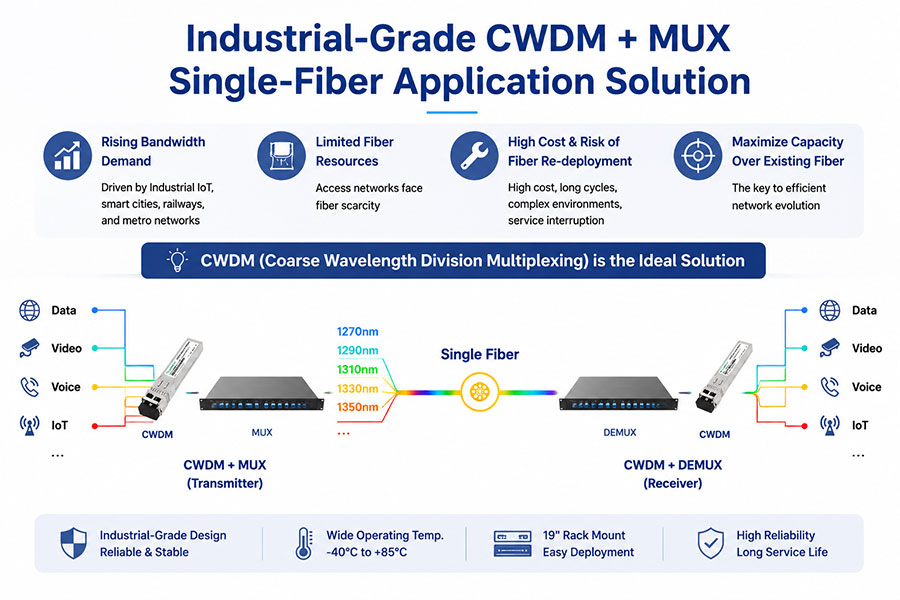
With the rapid development of industrial IoT, smart cities, railway transportation, and carrier metro networks, bandwidth demand continues to grow. However, fiber resources in access networks are often limited. Re-deploying fiber cables usually involves high construction costs, long deployment cycles, complex field environments, and service interruption risks. Therefore, maximizing network capacity over existing fiber resources has become a key concern.
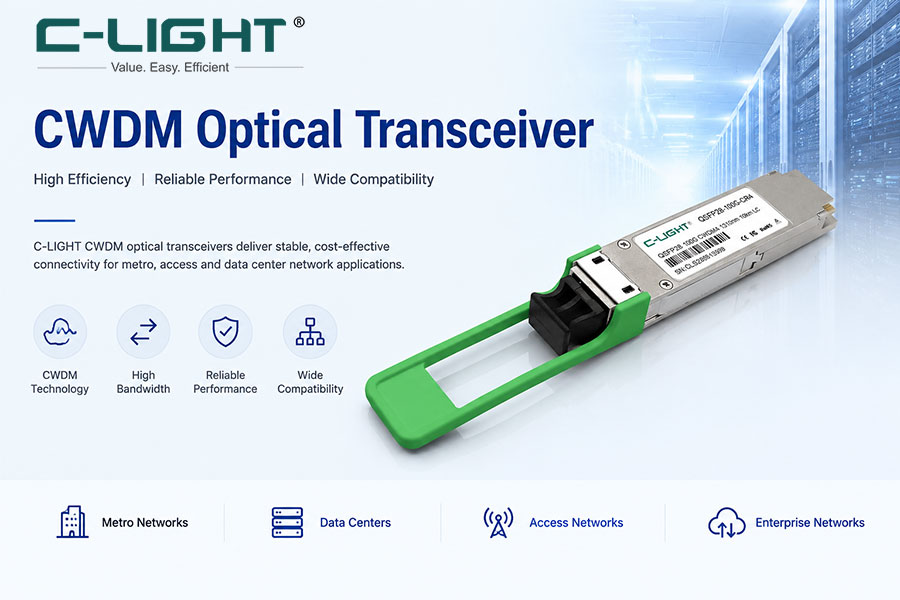
CWDM (Coarse Wavelength Division Multiplexing) is an ideal solution to address this challenge.
CWDM (Coarse Wavelength Division Multiplexing) is a technology that multiplexes multiple optical signals of different wavelengths onto a single fiber for transmission, enabling “one fiber, multiple services.”
The C-LIGHT industrial-grade CWDM MUX aggregates multiple CWDM wavelengths onto a single fiber, and the DEMUX at the remote end separates them back into individual wavelengths.
https://www.c-light.com/products/details/CWDM_MUX.html
| Parameter | Specification |
|---|---|
| Product Type | CWDM MUX/DEMUX |
| Number of Channels | 18 channels |
| Wavelength Range | 1270nm–1610nm |
| Fiber Type | SMF-28e |
| Single-Fiber Support | Yes |
| Insertion Loss | < 3.0 dB |
| Adjacent Channel Isolation | ≥ 30 dB |
| Non-Adjacent Channel Isolation | ≥ 40 dB |
| Return Loss | ≥ 50 dB |
| Directivity | ≥ 55 dB |
| Polarization Dependent Loss | ≤ 0.1 dB |
| Max Optical Power | 500 mW |
| Operating Temperature | -10°C ~ +70°C |
| Storage Temperature | -40°C ~ +85°C |
The C-LIGHT industrial 2.5G/11.3G multi-rate optical module supports multiple operating rates, and works with the DEMUX at the remote end to separate both wavelength and data.
https://www.c-light.com/products/details/CWDM_10G_2.5G_1G_100M.html
| Product Type | CWDM SFP+ Multi-Rate 11.3G/10.3G/2.5G/1.25G/100Mbps |
|---|---|
| Wavelength Range | 18 channels, 1270nm–1610nm |
| Center Wavelength | Center Channel ±6.5nm |
| Transmit Power | 2 ~ 6 dBm |
| Receiver Sensitivity | -22 dBm @ 11.3G/10.3G; -24 dBm @ 2.5G/1.25G/100Mbps |
| Spectral Width | ≤ 1 nm |
| SMSR | ≥ 35 dB |
| Extinction Ratio | ≥ 4.5 dB |
| Optical Rise/Fall Time | ≤ 2 ns |
| Eye Margin | ≥ 20% |
| Receiver Overload | ≥ -7 dBm |
| LOS De-Assert | ≥ -25 dBm |
| LOS Assert | ≤ -30 dBm |
| Operating Temperature | -40°C ~ +85°C |
Single-mode fiber link
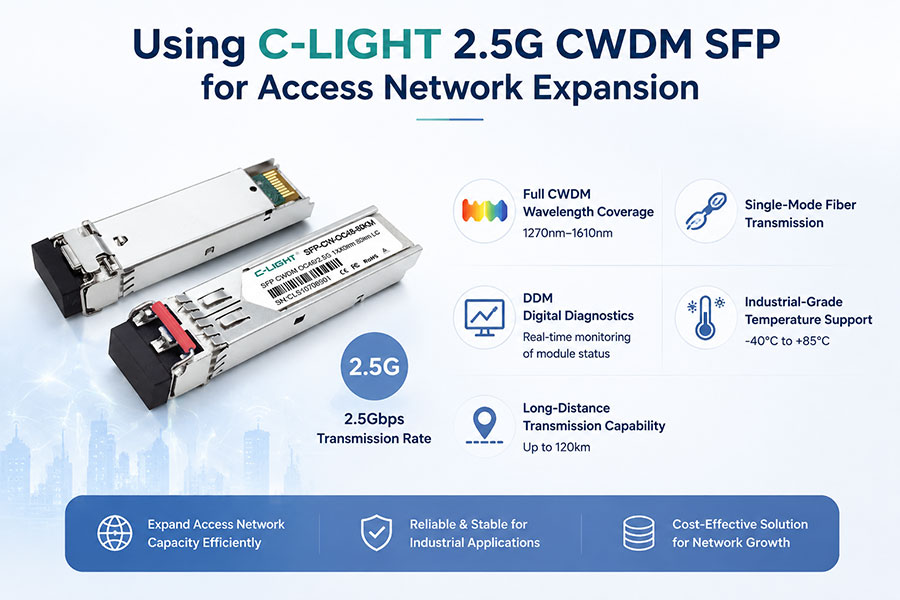
2.5Gbps transmission rate
Full CWDM wavelength coverage (1270nm–1610nm)
Single-mode fiber transmission
DDM digital diagnostics
Industrial-grade temperature support
Long-distance transmission capability
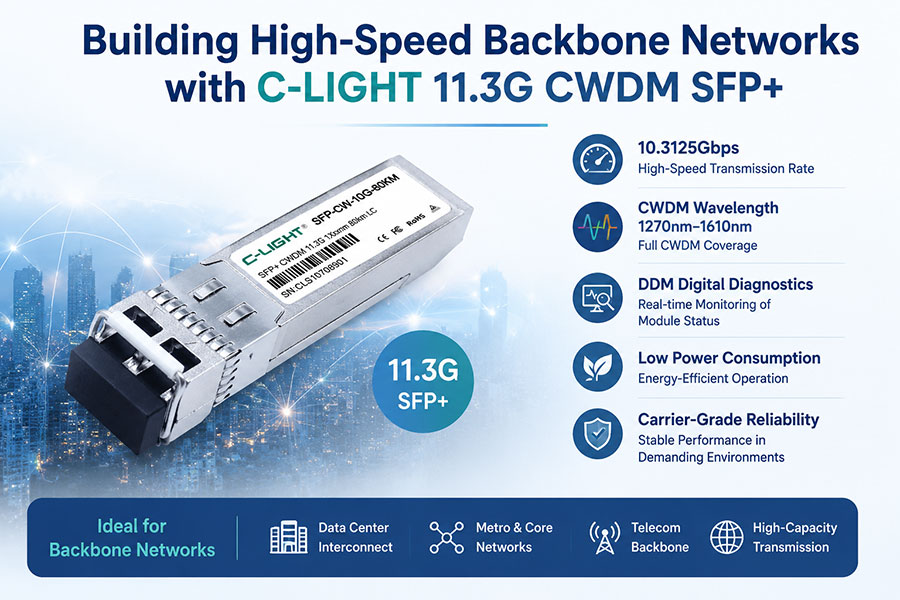
10.3125Gbps transmission rate
CWDM wavelength 1270nm–1610nm
DDM digital diagnostics
Low power consumption
Carrier-grade reliability
Maximum fiber utilization
Flexible network evolution
Cost reduction
Industrial reliability
Smart Grid
Rail Transit
Industrial Parks
Carrier Metro Networks
Industrial-grade CWDM MUX
2.5G CWDM SFP
11.3G CWDM SFP+
Full wavelength compatibility
One-stop solution
CWDM optical transceivers
CWDM MUX/DEMUX
Single-mode fiber
CWDM transceivers generate optical signals at specific wavelengths, while the MUX combines multiple wavelengths onto a single fiber. Therefore, they must be used together.
Configuration example:
If Channel 1 on the MUX at Site A is configured as 1270 nm TX / 1290 nm RX, then the switch at Site A should be equipped with a dual-fiber CWDM transceiver with a 1270 nm transmit wavelength. Connect the transceiver’s TX port to the MUX's 1270 nm port and its RX port to the MUX's 1290 nm port.
For example, if the 1270 nm channel on the MUX at Site A is used for transmission, a 1270 nm TX CWDM transceiver should be installed at that site. At Site B, where the corresponding channel is used for reception, a 1290 nm TX CWDM transceiver should be installed.
In simple terms, the TX wavelengths at the two ends of the link must be paired in an alternating manner.
1.25G CWDM SFP
2.5G CWDM SFP
11.3G CWDM SFP+
25G CWDM SFP28 (depending on the network design)
Among these, 2.5G CWDM is commonly used in access-layer networks, while 11.3G CWDM is typically deployed in aggregation and backbone networks.
For any questions, please contact us by email or WhatsApp.
Email: sales@c-light.com
WhatsApp: +86 132 6656 7067