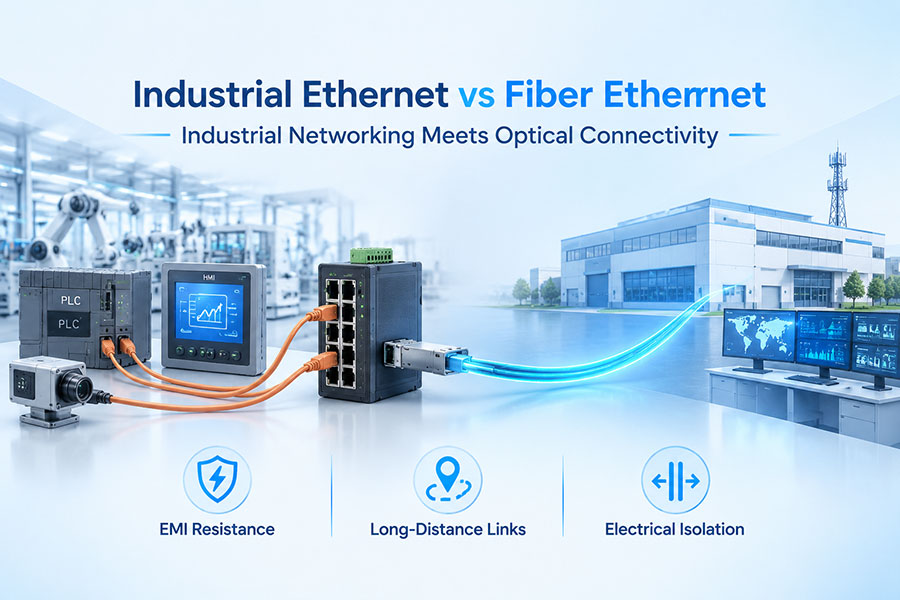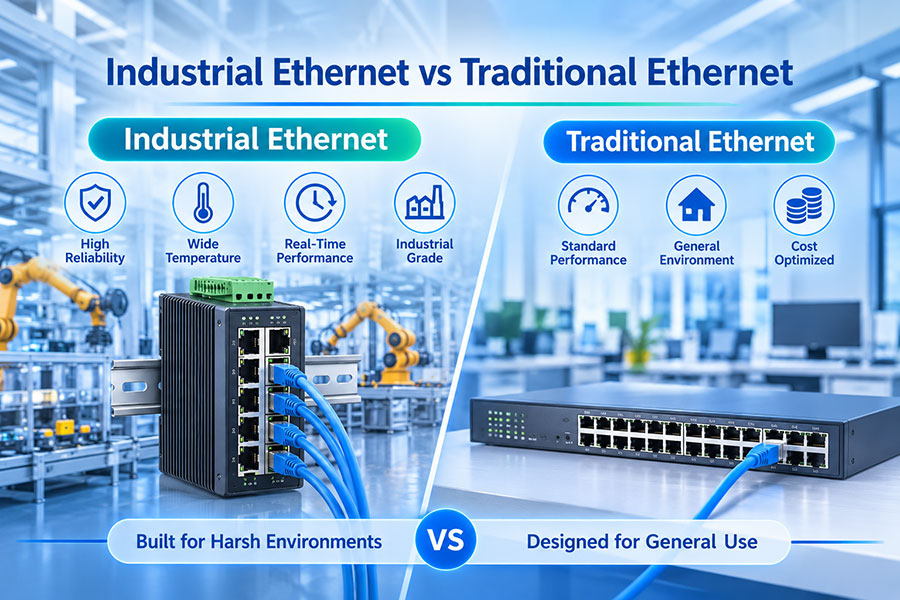
Industrial Ethernet and traditional Ethernet share the same fundamental Ethernet technology, but they are engineered for different operating conditions. Traditional Ethernet is widely deployed in offices, enterprise networks, campuses, and data centers, where connectivity, bandwidth, and general network availability are major priorities. Industrial Ethernet extends Ethernet into manufacturing, process control, transportation, energy, and other operational technology environments.
The distinction is not simply about transmission speed or cable type. Industrial Ethernet deployments place greater emphasis on predictable communication, environmental tolerance, network recovery, synchronization, equipment durability, and integration with industrial automation protocols.
1. Industrial Ethernet and Traditional Ethernet: Core Differences
Traditional Ethernet generally refers to standard Ethernet networks used for office and enterprise data communication. These networks connect computers, servers, printers, wireless access points, storage systems, and other IP-based devices through switches, routers, and structured cabling.
Industrial Ethernet applies Ethernet communication to operational systems where network behavior can directly affect machines, production processes, and physical infrastructure. It connects PLCs, industrial PCs, remote I/O modules, sensors, drives, HMIs, and supervisory control systems.
Both can use standard Ethernet frame formats and IP networking. Industrial Ethernet does not necessarily require a completely different physical layer. The industrial requirements are addressed through a combination of protocols, switches, network architecture, cabling, connectors, and equipment specifications.
2. Technical Comparison: Industrial Ethernet vs Traditional Ethernet
| Technical Factor | Traditional Ethernet | Industrial Ethernet |
|---|---|---|
| Primary application | Office networks, enterprise IT, campuses, and data centers | Factory automation, process control, energy, transportation, and infrastructure |
| Communication requirements | General data delivery, throughput, and network availability | May require bounded latency, synchronization, cyclic updates, and predictable traffic handling |
| Hardware design | Usually designed for controlled indoor environments | May require rugged enclosures, industrial connectors, extended temperature ratings, and vibration resistance |
| Network recovery | Commonly uses enterprise redundancy and spanning-tree technologies | May use industrial ring protection and rapid recovery mechanisms selected for the control application |
| Protocol ecosystem | TCP/IP, HTTP, DNS, DHCP, standard Ethernet services | PROFINET, EtherNet/IP, EtherCAT, Modbus TCP, and other industrial communication technologies |
| Time synchronization | NTP and other enterprise time services are common | PTP, IEEE 1588, and application-specific synchronization may be required |
| Environmental conditions | Typically offices, equipment rooms, and controlled data center spaces | May include dust, temperature variation, electrical noise, vibration, and outdoor exposure |
| Maintenance priorities | IT service continuity, security, capacity, and user experience | Production continuity, process availability, fault isolation, and equipment lifecycle |
These are typical design tendencies rather than absolute boundaries. Enterprise Ethernet can support high availability and precise timing, while industrial networks can use standard Ethernet switches and protocols when the application requirements permit.
3. Real-Time Communication and Deterministic Network Behavior
One of the most important distinctions in industrial networking is the need to control communication timing. In office networks, a short delay in transferring a file or loading a web page is usually acceptable. In automation systems, communication timing can affect motion control, sensor feedback, machine coordination, and process synchronization.
Industrial applications may exchange cyclic process data at fixed intervals. A PLC can send control commands to drives while receiving status information from remote I/O devices. The network must deliver this traffic within the timing limits defined by the application.
Latency and Jitter
Latency is the time required for data to travel from source to destination. Jitter describes variation in packet delay. Industrial control applications may require both values to remain within defined limits, particularly when multiple devices must coordinate their operations.
Industrial Ethernet networks can use traffic prioritization, scheduled communication, dedicated network paths, and time-aware mechanisms to manage latency and jitter. The actual performance depends on the protocol, switch implementation, traffic load, topology, and end-device behavior.
Time-Sensitive Networking
Time-Sensitive Networking (TSN) is a set of IEEE 802.1 standards that adds mechanisms for time synchronization, traffic scheduling, and improved delivery guarantees over Ethernet networks.
Relevant mechanisms include:
IEEE 802.1AS for time synchronization.
IEEE 802.1Qbv for scheduled traffic transmission.
IEEE 802.1Qbu and IEEE 802.3br for frame preemption.
IEEE 802.1Qci for per-stream filtering and policing.
TSN capabilities are not automatically present in every industrial Ethernet switch. The selected devices, software, network configuration, and end-to-end architecture must support the required functions.
4. Industrial Ethernet Protocols and Standard Network Protocols
Traditional Ethernet commonly carries IP-based services such as web access, file transfers, cloud applications, and enterprise management traffic. Industrial Ethernet uses Ethernet as a communication foundation for automation protocols that exchange control data and device information.
| Protocol or Technology | Technical Role | Typical Application |
|---|---|---|
| TCP/IP | General-purpose network communication suite | Enterprise services, industrial monitoring, and device communication |
| PROFINET | Industrial Ethernet communication technology | PLC, remote I/O, drives, and factory automation |
| EtherNet/IP | Industrial protocol using the Common Industrial Protocol over Ethernet | Control systems, industrial devices, and distributed I/O |
| EtherCAT | Real-time industrial Ethernet technology using specialized frame processing | Motion control and high-speed machine automation |
| Modbus TCP | Client-server industrial messaging over TCP/IP | Instrumentation, PLCs, and supervisory systems |
| IEEE 1588 PTP | Precision clock synchronization | Industrial automation and time-sensitive systems |
| TSN | Ethernet mechanisms for time synchronization and traffic management | Converged industrial networks and time-sensitive applications |
Protocol selection should follow the automation architecture and device ecosystem. Two devices with Ethernet ports are not necessarily application-compatible: they must also support the same industrial protocol, data model, configuration, and communication behavior.
5. Industrial Ethernet Switches and Network Resilience
Industrial Ethernet switches connect controllers, sensors, drives, HMIs, and other network devices. Compared with general-purpose enterprise switches, industrial models may provide additional features for control cabinets, distributed equipment, and challenging installation environments.
Rugged Hardware and Power Design
Industrial switches may use metal enclosures, DIN rail mounting, terminal-block power connections, extended operating-temperature ratings, and fanless cooling. Selected models also provide redundant DC power inputs to reduce the risk of network interruption caused by a single power source failure.
Network Redundancy
Production networks often need rapid recovery from a cable or switch-port failure. Depending on the application, industrial architectures may use ring topologies, redundant uplinks, or specialized protection mechanisms.
Common technologies include:
RSTP and MSTP for spanning-tree-based network redundancy.
MRP for ring redundancy in supported PROFINET environments.
ERPS, standardized in ITU-T G.8032, for Ethernet ring protection.
PRP and HSR for high-availability applications requiring redundant paths.
These mechanisms have different recovery characteristics and interoperability requirements. They should not be treated as interchangeable features. The selected switch must explicitly support the intended redundancy technology.
Network Segmentation and Security
Industrial networks increasingly require separation between operational technology (OT) and enterprise IT. VLANs, access control lists, industrial firewalls, secure remote access, and controlled routing boundaries help limit unnecessary traffic between production systems and business networks.
Network segmentation also supports fault isolation and reduces the impact of broadcast traffic or misconfigured devices. Security policies should be designed around production requirements, device compatibility, and operational maintenance procedures.
6. Copper Ethernet, Fiber Ethernet and Industrial Connectivity
Industrial Ethernet can operate over copper or optical fiber. Copper is common for short connections between controllers and nearby devices, while fiber is useful for longer links, electrical isolation, and environments with substantial electromagnetic interference.
| Connection Type | Typical Interface | Common Role |
|---|---|---|
| Copper Ethernet | RJ45 | Short connections to PLCs, HMIs, computers, and field devices |
| 100M Fiber Ethernet | 100Base-FX / 100Base-X | Legacy industrial fiber links and lower-bandwidth network segments |
| Gigabit Fiber Ethernet | 1000Base-X, SFP | Industrial switch uplinks and facility network backbones |
| 10G Fiber Ethernet | 10GBase-X, SFP+ | High-capacity aggregation and industrial backbone connections |
Optical links require compatible transceivers at both ends. Data rate, wavelength, fiber type, connector, transmission distance, and optical power budget must be matched. Industrial temperature requirements should also be checked for each active component.
Industrial Fiber Media Converter
C-LIGHT's Industrial Fiber Media Converter series provides bidirectional conversion between copper Ethernet and optical fiber. It is designed for industrial network extension where equipment requires RJ45 connectivity while the backbone uses optical links.
Model options with 1 or 2 RJ45 ports.
100Base-X SC and 1000Base-X SC optical interfaces on selected models.
SFP-based configurations supporting 1000Base-X or 100Base-FX on applicable models.
Selected SFP+ models for 10G optical connectivity.
12–48 VDC power input on listed models.
Aluminum enclosure and fanless design.
Operating temperature of -40°C to 75°C for the listed models.
Redundant power input available on selected configurations.
The series can be used to extend Ethernet connectivity between industrial equipment, remote control cabinets, and fiber backbone segments. Model-specific interface and power specifications should be confirmed before deployment.
7. Industrial PoE and Connected Field Devices
Industrial networks increasingly connect IP cameras, wireless access points, access-control equipment, and other powered Ethernet devices. Power over Ethernet (PoE) allows compatible devices to receive electrical power and data through a single copper Ethernet cable.
When these devices are located far from the central network room, a fiber uplink can extend the communication path while PoE supplies power locally at the edge. This arrangement is useful in transportation infrastructure, industrial surveillance, outdoor monitoring, and distributed facilities.
Industrial PoE Media Converter
C-LIGHT's Industrial PoE Media Converter combines fiber-to-copper Ethernet conversion with PoE power delivery. It supports industrial network layouts where remote Ethernet devices need both optical network connectivity and local power over copper.
RJ45 Ethernet and optical fiber interfaces, depending on model.
100Base-X, 1000Base-X, SFP and selected SFP+ configurations.
PoE power options vary by model.
Industrial aluminum enclosure and DIN rail installation on applicable models.
Redundant power options on selected configurations.
Operating temperature of -40°C to 75°C for listed models.
Typical applications include industrial IP cameras, intelligent transportation systems, remote monitoring equipment, and distributed PoE network nodes. The required PoE standard, power budget, optical interface, and environmental rating must be checked against the exact model.
8. Industrial Ethernet Network Architecture
Industrial Ethernet networks often combine machine-level communication, control-system aggregation, and connections to enterprise infrastructure. A layered architecture helps separate real-time control traffic from supervisory and business applications.
Machine-Level Network
PLCs, drives, sensors, actuators, and remote I/O modules connect through industrial switches or supported device-level network interfaces. Communication cycles and timing requirements are determined by the control protocol and application.
Cell or Area Network
Multiple machines or production cells connect to an aggregation switch. VLANs, traffic prioritization, and industrial redundancy mechanisms can be applied according to the control design.
Plant Backbone
Fiber Ethernet links connect production areas, control rooms, equipment buildings, and central network facilities. SFP or SFP+ optical interfaces provide a modular way to select fiber type and optical reach.
IT and OT Integration
Industrial data can be transferred to supervisory platforms, manufacturing execution systems, historians, and enterprise applications through controlled network boundaries. Routing, firewalls, and access policies help maintain separation between operational control and business information systems.
PLC / Drives / Sensors → Industrial Access Switch → Area Aggregation Switch → Fiber Ethernet Backbone → Plant Core Network → SCADA / MES / Enterprise Systems
Industrial fiber media converters can be used where existing field equipment provides copper Ethernet but the network backbone requires optical connectivity.
9. How to Select Ethernet Equipment for Industrial Applications
Industrial Ethernet equipment should be selected according to the control application, environmental conditions, network topology, and lifecycle requirements. A commercial switch or transceiver should not be assumed suitable for industrial installation simply because its Ethernet speed and connector match.
| Selection Factor | Engineering Requirements |
|---|---|
| Protocol compatibility | Confirm support for PROFINET, EtherNet/IP, EtherCAT, Modbus TCP, or the required industrial communication technology. |
| Timing performance | Check latency, jitter, synchronization, cyclic update requirements, and supported real-time features. |
| Environmental rating | Verify operating temperature, enclosure protection, vibration tolerance, and installation conditions. |
| Power requirements | Check DC input range, redundant power options, PoE power budget, and grounding arrangements. |
| Optical interface | Match data rate, wavelength, fiber type, connector, optical budget, and transceiver reach. |
| Redundancy | Confirm support for the selected ring, protection, or parallel redundancy mechanism. |
| Network security | Evaluate VLANs, access control, firewall boundaries, remote access, and device authentication requirements. |
| Lifecycle support | Consider equipment availability, maintenance procedures, spare units, firmware support, and long-term compatibility. |
10. When to Use Industrial Ethernet or Traditional Ethernet
The choice depends on the environment and the consequences of network interruption. Traditional Ethernet is suitable for general-purpose enterprise communication, while industrial Ethernet is appropriate when equipment, control timing, and operating conditions introduce additional engineering requirements.
Office computers and printers.
Enterprise servers and storage.
Campus and commercial networks.
General IP communication and internet access.
Data center connectivity.
Factory automation and production lines.
PLC and distributed I/O communication.
Motion control and machine coordination.
Energy and utility infrastructure.
Transportation and remote monitoring systems.
In many facilities, both network types coexist. Industrial Ethernet handles machine and process communication, while traditional enterprise networking supports office systems, business applications, and external connectivity. A carefully designed boundary connects the two without exposing control networks to unnecessary traffic or security risks.
11. Industrial Ethernet Connectivity from C-LIGHT
Industrial Ethernet deployment often requires a combination of rugged fiber media conversion, PoE connectivity, and compatible optical transceivers. C-LIGHT provides industrial fiber media converters and optical transceiver products for network extension and fiber backbone applications.
For industrial switch uplinks, the C-LIGHT Optical Transceiver Portfolio includes multiple data-rate and interface categories. The appropriate module should be selected according to the switch's supported optical interface, fiber infrastructure, wavelength, transmission distance, and environmental requirements.
For installations requiring conversion between RJ45 Ethernet and fiber, the Industrial Fiber Media Converter provides model options for 100M, Gigabit, and selected 10G connectivity. Where remote devices also require power over Ethernet, the Industrial PoE Media Converter offers combined fiber conversion and PoE functionality.
Industrial Ethernet and Fiber Connectivity Solutions
From industrial fiber media converters to optical transceivers and PoE connectivity, C-LIGHT supports fiber network extension for industrial and enterprise applications.
For product specifications, interface compatibility, and customized connectivity requirements, Contact C-LIGHT.