

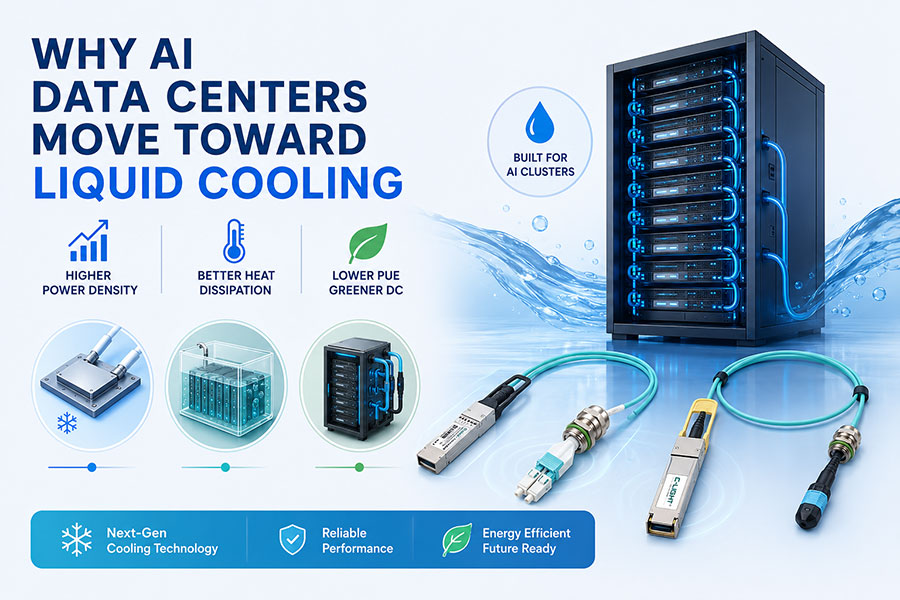
As AI foundation models continue to grow in complexity, GPU clusters have expanded from thousands to tens or even hundreds of thousands of GPUs. At the same time, rack power density has increased dramatically, making traditional air cooling insufficient for modern AI infrastructure.
To address these thermal challenges, more AI data centers are adopting advanced liquid cooling technologies, including:
Cold Plate Cooling
Immersion Cooling
Rack-Level Liquid Cooling
Liquid cooling significantly improves heat dissipation while reducing Power Usage Effectiveness (PUE), making it a key technology for next-generation green data centers.
As computing infrastructure evolves, high-speed interconnect solutions must also operate reliably in liquid-cooled environments. Consequently, Liquid Cooling DAC (Direct Attach Copper Cable) and Liquid Cooling AOC (Active Optical Cable) have become essential networking components for AI clusters and high-performance computing (HPC) systems.
A Liquid Cooling DAC (Direct Attach Copper Cable) is an optimized version of a conventional DAC cable specifically designed for liquid-cooled environments in AI data centers.
Liquid Immersion Transceiver for AI Data Centers | 400G/800G/1.6T Optical Solutions丨C-LIGHT
Compared with standard DAC cables, Liquid Cooling DACs feature enhanced mechanical durability and environmental protection, including:
Liquid-resistant material construction
High-sealing connector design
Corrosion-resistant cable jacket
High-reliability internal soldering technology
Long-term operation in high-temperature, high-humidity, and liquid cooling environments
Typical connector options include:
QSFP56
QSFP-DD
OSFP
OSFP-XD
Supported data rates include:
100G
200G
400G
800G
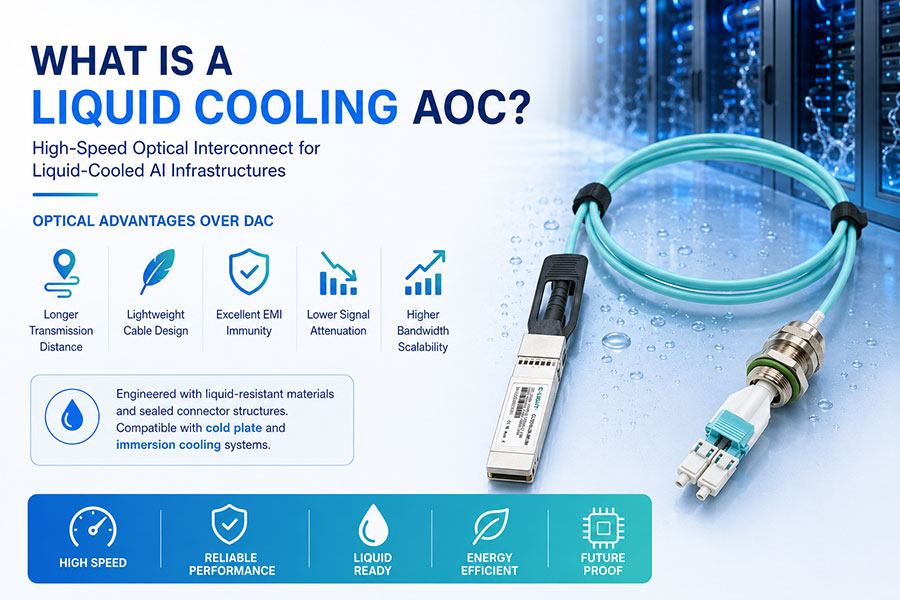
A Liquid Cooling AOC (Active Optical Cable) is a high-speed optical interconnect specifically engineered for liquid-cooled AI infrastructures.
Liquid Immersion Transceiver for AI Data Centers | 400G/800G/1.6T Optical Solutions丨C-LIGHT
Unlike DAC cables that transmit electrical signals over copper, AOCs utilize optical fiber transmission, providing several advantages:
Longer transmission distance
Lightweight cable design
Excellent electromagnetic interference (EMI) immunity
Lower signal attenuation
Higher bandwidth scalability
Liquid Cooling AOCs also incorporate liquid-resistant materials and sealed connector structures, making them compatible with both cold plate and immersion cooling systems.
| Feature | Liquid Cooling DAC | Liquid Cooling AOC |
|---|---|---|
| Transmission Medium | Copper Cable | Optical Fiber |
| Power Consumption | Very Low | Low |
| Typical Distance | 0.5–3 m (up to 5 m) | 5–100 m+ |
| Cost | Lower | Higher |
| Latency | Ultra-Low | Ultra-Low |
| EMI Immunity | Good | Excellent |
| Cable Weight | Heavier | Lighter |
| Cable Management | Standard | More Flexible |
| Liquid Cooling Compatibility | Supported | Supported |
| Typical Applications | In-Rack Connectivity | Inter-Rack Connectivity |
For short-distance connections inside GPU server racks, Liquid Cooling DAC offers several significant benefits:
Lower deployment cost
No optical-to-electrical conversion
Extremely low power consumption
Ultra-low latency for AI training workloads
Easy installation and maintenance
Ideal for Top-of-Rack (ToR) switch connectivity
Typical applications include:
GPU Server ↔ GPU Server
GPU ↔ Leaf Switch
ToR Switch ↔ AI Server
As AI clusters continue to expand, inter-rack connectivity becomes increasingly important. Liquid Cooling AOC is the preferred solution for medium- and long-distance networking.
Key advantages include:
Longer transmission distances
Lightweight fiber cables
Reduced cable management complexity
Higher bandwidth scalability
Better support for high-density cabling
Lower signal loss
Typical applications include:
Rack ↔ Rack
Spine ↔ Leaf
AI Fabric
GPU POD
HPC Networks
| Application | Recommended Solution |
|---|---|
| Server-to-Server (Same Rack) | Liquid Cooling DAC |
| ToR Switch to Server | Liquid Cooling DAC |
| Short GPU Connections | Liquid Cooling DAC |
| Inter-Rack Connectivity | Liquid Cooling AOC |
| Spine-Leaf Network | Liquid Cooling AOC |
| AI Supercomputing Centers | Liquid Cooling AOC |
| HPC Networks | Liquid Cooling AOC |
General recommendations:
For connections within 3 meters, choose Liquid Cooling DAC to achieve the best balance of performance and cost.
For distances exceeding 3–5 meters, Liquid Cooling AOC is recommended to ensure signal integrity and flexible cable management.
To meet the networking requirements of liquid-cooled AI data centers, C-LIGHT provides a comprehensive portfolio of liquid cooling interconnect products.
100G QSFP28 DAC
200G QSFP56 DAC
400G QSFP-DD DAC
800G OSFP DAC
800G QSFP-DD DAC
Passive DAC
Active Copper Cable (ACC)
100G AOC
200G AOC
400G AOC
800G AOC
OSFP AOC
QSFP-DD AOC
Custom-Length AOC
Liquid-resistant material design
High-reliability sealed connectors
Excellent corrosion resistance
Compatible with cold plate and immersion cooling systems
Low power consumption
Ultra-low latency
High bandwidth
Compatible with mainstream AI networking platforms
100% factory-tested for reliability and stability
Driven by the rapid growth of AI foundation models, GPU clusters, and liquid-cooled data centers, 800G and 1.6T networking technologies are becoming the new industry standard.
Future Liquid Cooling DAC and Liquid Cooling AOC products will continue evolving toward:
Higher transmission speeds (800G, 1.6T, and 3.2T)
Lower power consumption
Improved temperature and corrosion resistance
Lighter cable construction
Higher-density connector designs
More comprehensive liquid cooling compatibility certifications
Liquid-cooled high-speed interconnects will play a critical role in the next generation of AI data center infrastructure.
Answer: The main difference between Liquid Cooling DAC and Liquid Cooling AOC is the transmission medium and application scenario. Liquid Cooling DAC uses copper conductors and is optimized for short-distance, low-cost, ultra-low-power connections. Liquid Cooling AOC uses optical fiber with integrated optical components, providing longer transmission distance, lighter cabling, and better scalability for large AI clusters.
Answer: AI data centers are moving toward higher GPU density and greater rack power consumption, making traditional air cooling insufficient for next-generation computing infrastructure. Liquid cooling technologies such as cold plate cooling and immersion cooling require interconnect solutions that can operate reliably in high-temperature and liquid environments. Liquid Cooling DAC and AOC provide high-speed connectivity while supporting 400G, 800G, and future 1.6T AI networking architectures.
Answer: Liquid Cooling DAC provides extremely low latency, very low power consumption, and cost-effective deployment for short-distance AI cluster connections. Since it does not require optical-electrical conversion, it reduces system complexity and power consumption. It is ideal for applications such as GPU server-to-server, GPU server-to-ToR switch, and in-rack AI connectivity.
Answer: Liquid Cooling AOC provides longer transmission distance, lighter cable weight, better electromagnetic interference immunity, and improved cable management flexibility. Compared with copper-based DAC solutions, AOC is better suited for rack-to-rack, leaf-spine, AI Fabric, and HPC networking environments where scalability and airflow optimization are important.
Answer: Liquid Cooling DAC is mainly designed for short-distance connections, typically around 0.5m to 3m, with some solutions extending further depending on speed and design. Liquid Cooling AOC supports longer connections, commonly from several meters to more than 100m, making it suitable for large-scale AI clusters and data center networking.
Answer: The choice depends on network architecture and transmission distance. Liquid Cooling DAC is recommended for short-distance, cost-sensitive connections inside GPU racks. Liquid Cooling AOC is recommended for inter-rack connections, AI Fabric networks, and large-scale HPC environments requiring higher flexibility and longer reach.
Answer: Yes. Both Liquid Cooling DAC and Liquid Cooling AOC are evolving to support next-generation AI networking requirements, including 800G and future 1.6T interconnect architectures. They provide different solutions depending on distance, bandwidth density, power efficiency, and deployment requirements.
Answer: Liquid Cooling DAC is mainly used for GPU server connections, ToR switch links, and short-distance rack-level deployments. Liquid Cooling AOC is commonly used for rack-to-rack connectivity, spine-leaf networks, GPU Pods, AI clusters, and HPC systems. Together, they create a scalable interconnect architecture for liquid-cooled AI data centers.
For any questions, please contact us by email or WhatsApp.
Email: sales@c-light.com
WhatsApp: +86 132 6656 7067