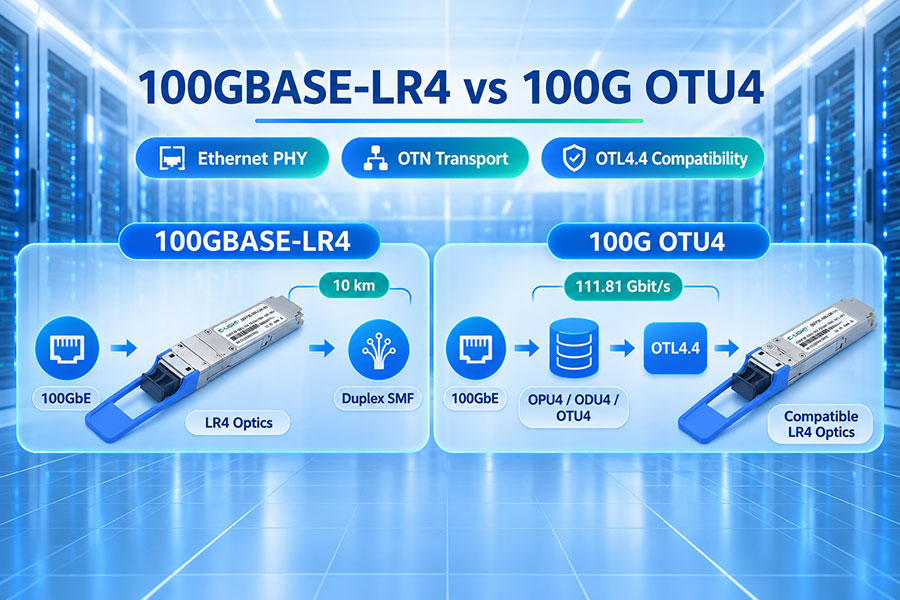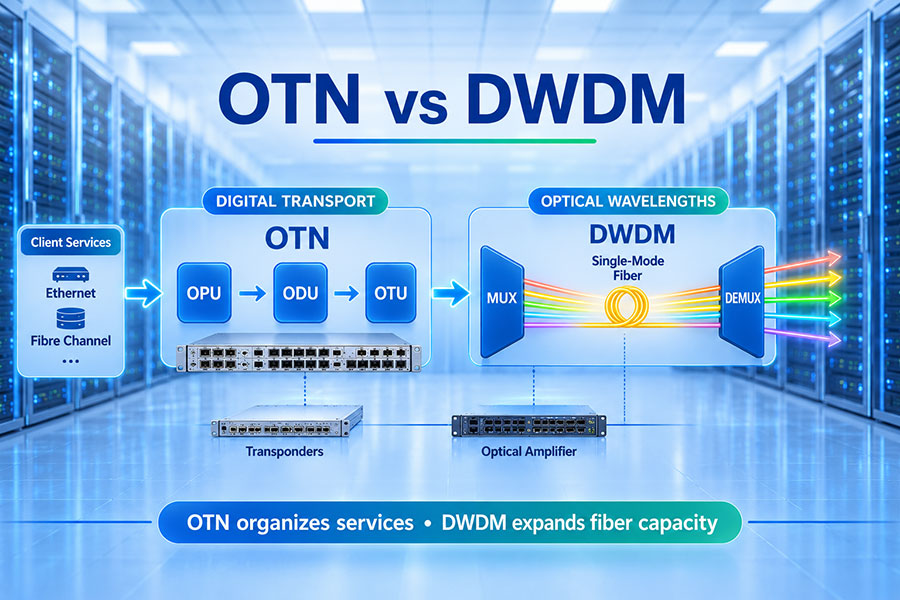
OTN (Optical Transport Network) and DWDM (Dense Wavelength Division Multiplexing) are two important technologies in high-capacity optical communication infrastructure. Although they are frequently deployed together, they perform different functions within the network.
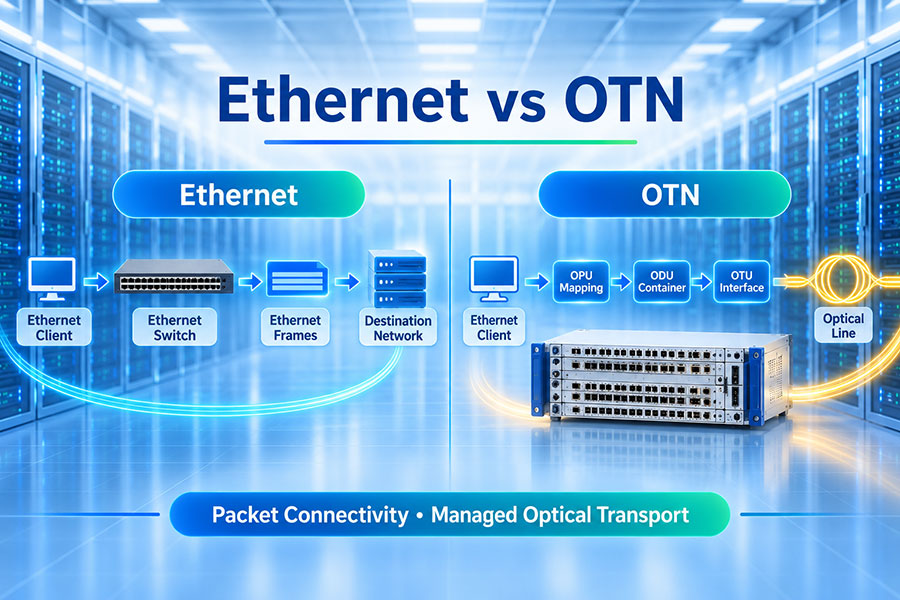
OTN provides digital transport framing, service mapping, multiplexing, performance monitoring and fault management. DWDM increases fiber transmission capacity by combining multiple optical wavelengths onto a shared fiber pair. One manages the digital transport structure; the other expands the optical transmission resources available to the network.
1. OTN and DWDM Operate at Different Network Layers
OTN and DWDM should not be treated as competing transmission technologies. They address different engineering requirements and can operate as complementary layers in the same optical network.
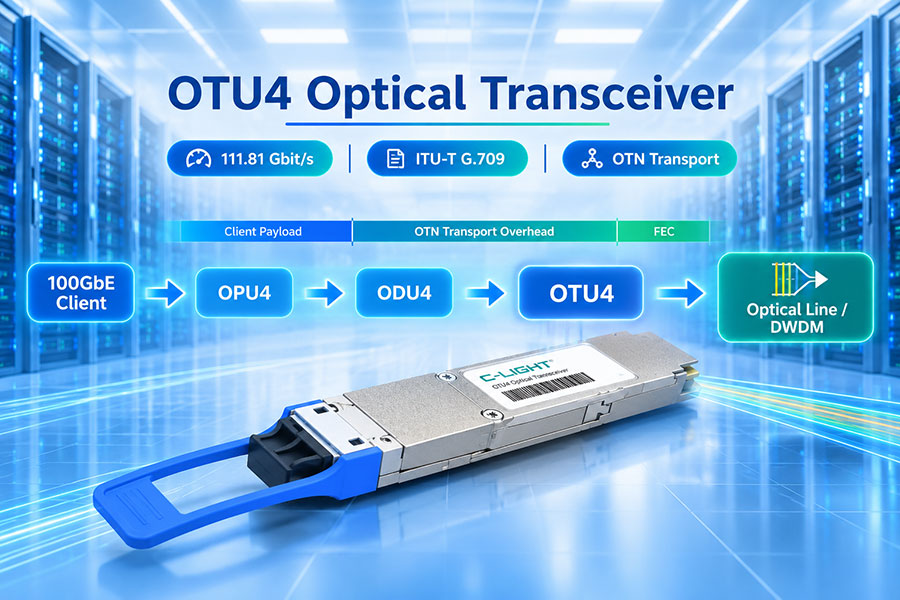
OTN is defined by ITU-T recommendations, particularly G.709. It provides a standardized digital transport hierarchy that supports client-signal mapping, ODU multiplexing, transport overhead and error monitoring. Ethernet, Fibre Channel and other supported client signals can be carried through OTN structures.
DWDM is an optical multiplexing technology that allows multiple wavelengths to travel simultaneously through one optical fiber. Each wavelength functions as an individual optical channel, enabling operators to increase the capacity of existing fiber infrastructure without installing a separate fiber pair for every service.
| Technical Aspect | OTN | DWDM |
|---|---|---|
| Full name | Optical Transport Network | Dense Wavelength Division Multiplexing |
| Primary function | Digital transport, service mapping and monitoring | Multiplexing multiple optical wavelengths onto one fiber |
| Network layer | Digital transport layer | Optical transmission layer |
| Standardization | ITU-T G.709 and related OTN recommendations | ITU-T G.694.1 frequency grid and related optical standards |
| Multiplexing method | Digital ODU multiplexing | Optical wavelength multiplexing |
| Key equipment | OTN switches, transponders and muxponders | DWDM MUX/DEMUX, optical amplifiers, ROADMs and transponders |
| Monitoring | Digital path, transport overhead and FEC statistics | Optical power, wavelength, OSNR and channel performance |
| Typical applications | Carrier transport, service aggregation and backbone networks | Metro, regional, long-haul and data center interconnects |
The distinction becomes clearer when examining a complete optical link: OTN organizes and manages the digital services, while DWDM carries multiple optical channels across the physical fiber infrastructure.
2. How OTN Processes and Transports Client Signals
OTN provides a structured way to adapt different client signals into standardized transport containers. Rather than treating every service as an independent optical wavelength, an OTN system can map multiple client signals into digital containers and aggregate them into higher-capacity transport structures.
The main components of the OTN digital hierarchy include:
OPU (Optical Payload Unit): Provides the payload structure and adaptation functions for client signals.
ODU (Optical Data Unit): Provides the digital path-layer container, including path overhead and performance monitoring.
OTU (Optical Transport Unit): Adds transport-section overhead and applicable FEC information.
OTN Digital Transport Structure
For example, a 100GbE client can be mapped into an appropriate OTN structure and transported through an OTU4 interface. The OTN equipment can monitor the transport path, report errors and provide FEC processing according to the applicable interface specification.
ODU multiplexing also allows lower-rate services to share a higher-capacity transport structure. This is useful when multiple customer connections need to be aggregated without assigning a separate optical wavelength to every client.
OTN therefore provides more than a physical optical connection. It supplies digital service organization and transport-layer visibility across the network.
3. How DWDM Increases Fiber Transmission Capacity
DWDM uses different optical wavelengths to transmit multiple independent channels over the same fiber. A DWDM multiplexer combines the wavelengths at the transmitting end, and a demultiplexer separates them at the receiving end.
Each wavelength can carry a separate signal, such as 10G, 100G, 400G or a higher-capacity coherent optical channel, depending on the transceiver and line-system design.
DWDM Optical Multiplexing Architecture
The ITU-T G.694.1 frequency grid defines standardized channel frequencies and spacing options for DWDM systems. Common fixed-grid spacing values include 100 GHz, 50 GHz, 25 GHz and 12.5 GHz, while flexible-grid arrangements support more adaptable channel allocation.
In a practical deployment, the number of usable wavelengths depends on the selected grid, optical amplifier bandwidth, transceiver specifications, channel power management and total system design. A 96-channel system, for example, is not a universal capacity figure for every DWDM platform.
DWDM is especially valuable when fiber resources are limited or when network operators need to expand transmission capacity over existing long-distance fiber routes.
4. OTN vs. DWDM: Bandwidth Allocation and Multiplexing
Both technologies support multiplexing, but they operate on different types of resources.
OTN multiplexes digital client signals into ODU containers. Multiple lower-rate ODU signals can be combined into a higher-rate OTN structure, allowing transport capacity to be allocated according to service requirements.
DWDM multiplexes optical wavelengths. Each wavelength occupies a defined position in the optical frequency grid and carries an independent optical signal across the shared fiber.
| Capacity Function | OTN | DWDM |
|---|---|---|
| Resource being multiplexed | Digital transport containers | Optical wavelengths |
| Multiplexing domain | Digital domain | Optical domain |
| Typical aggregation | Multiple ODU services into higher-rate ODU structures | Multiple wavelengths onto one fiber |
| Bandwidth allocation | ODU rates, tributary slots and ODUflex | Channel frequency, spacing and optical bandwidth |
| Capacity expansion | Higher-rate transport structures and additional ODU resources | Additional wavelengths or higher-capacity channels |
Consider a network carrying several 10G and 100G services between two metropolitan sites. OTN can aggregate and organize those services into higher-rate digital transport structures. DWDM can then carry the resulting optical channels alongside other wavelengths over the same fiber infrastructure.
This separation allows operators to manage service capacity and optical fiber capacity independently.
5. Monitoring, FEC and Network Management
OTN and DWDM provide different forms of operational visibility. Their monitoring functions are complementary because they measure different aspects of transmission performance.
OTN monitoring focuses on digital transport integrity. Its overhead structures support path supervision, tandem connection monitoring, alarm reporting and error-performance analysis. Applicable OTU interfaces also include FEC capabilities for correcting transmission errors.
DWDM monitoring focuses on the optical layer. Engineers monitor parameters such as channel power, total optical power, wavelength accuracy, optical signal-to-noise ratio and amplifier operating conditions. These measurements help identify channel degradation, excessive attenuation and optical power imbalance.
| Monitoring Parameter | OTN | DWDM |
|---|---|---|
| Path error monitoring | ODU and OTU transport monitoring | Not inherently provided as an equivalent digital path function |
| FEC statistics | Available on applicable OTN interfaces | Depends on the transponder or coherent interface implementation |
| Optical channel power | May be available through associated optical equipment | Key optical-layer measurement |
| OSNR monitoring | May be exposed by the optical line interface | Important for evaluating optical signal quality |
| Service-level fault localization | Can identify transport path and client-related defects | Primarily identifies optical channel and line-system conditions |
| Wavelength management | Not its primary function | Central to channel planning and optical line operation |
FEC should not be attributed exclusively to OTN. Coherent DWDM transceivers commonly implement their own FEC as part of the optical modem or DSP architecture. The specific coding scheme, correction capability and performance counters depend on the transceiver and line-system implementation.
For troubleshooting, engineers should correlate OTN error and alarm information with DWDM optical measurements. A rising FEC correction count, for example, may indicate declining optical signal quality even when the optical channel remains active.
6. How OTN and DWDM Work Together in One Network
In many carrier and enterprise backbone networks, OTN and DWDM are deployed as two coordinated layers. OTN prepares and manages the digital transport signals, while the DWDM system provides the optical channels used to transmit them across fiber.
Combined OTN and DWDM Architecture
A typical transmission process follows these stages:
Client signal reception: Routers, switches or storage equipment provide Ethernet, Fibre Channel or other supported client signals.
OTN adaptation: OTN equipment maps the client signals into appropriate OPU and ODU structures and adds the required transport overhead.
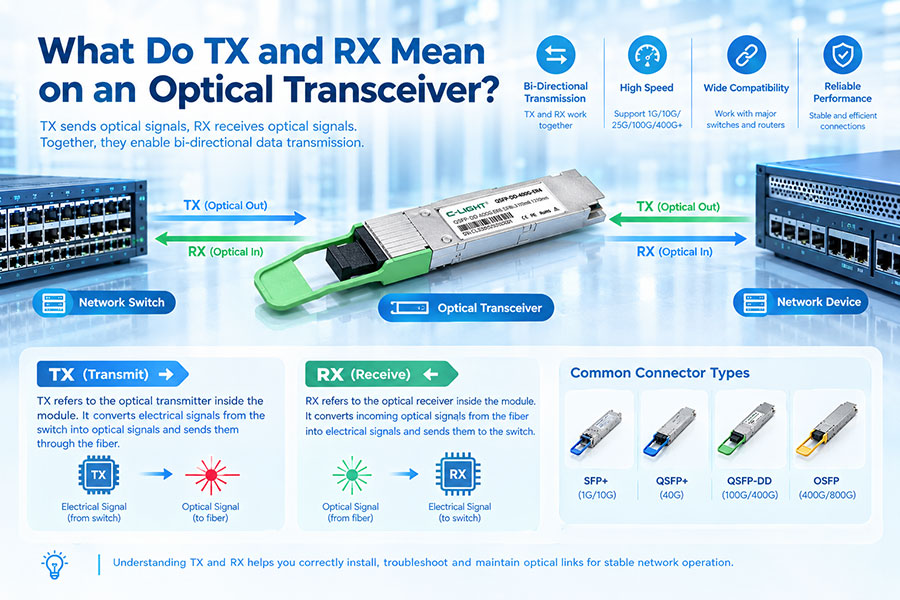
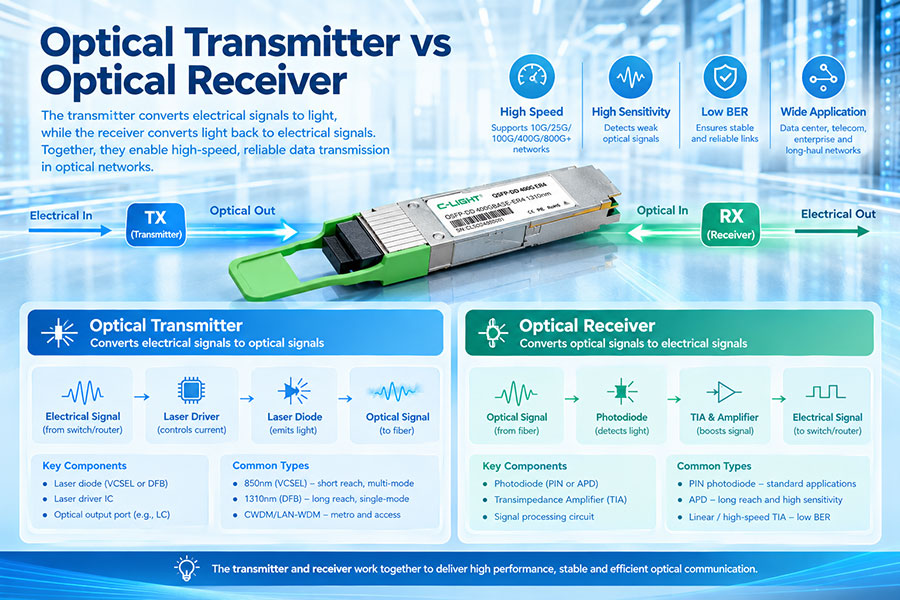
Optical signal generation: Transponders or compatible coherent interfaces generate the optical signals for the selected line architecture.
DWDM multiplexing: The MUX combines multiple optical channels onto a shared fiber.
Long-distance transmission: Optical amplifiers and other line-system components compensate for link loss and support the optical transmission budget.
Remote reception: The receiving DWDM system separates the wavelengths, and the transport equipment recovers and delivers the client services.
The exact arrangement varies by system. Some coherent pluggables can connect directly to a DWDM line system, while other deployments use separate transponders, muxponders and OTN switching equipment.
7. Can DWDM Work Without OTN?
Yes. DWDM does not require OTN to operate. A DWDM system can transmit multiple optical channels without an OTN switching layer, provided the optical interfaces and line system are compatible.
For example, two data centers can establish multiple point-to-point wavelength connections using coherent optical transceivers and DWDM MUX/DEMUX equipment. Each wavelength carries a signal between the two locations, without requiring every service to pass through an OTN switch.
This architecture can be suitable when the network has relatively straightforward point-to-point connectivity requirements or when the connected routers and optical interfaces already provide the required client and line functions.
However, without an OTN layer, operators may have less standardized visibility into individual digital transport paths and fewer ODU grooming and switching capabilities. These functions may instead be provided by other equipment or management systems.
8. Can OTN Work Without DWDM?
Yes. OTN does not inherently require DWDM. OTN signals can be transmitted over point-to-point optical links, dedicated wavelengths or other compatible optical transmission systems.
For shorter transport distances or networks with limited wavelength requirements, a dedicated optical interface may provide sufficient capacity without deploying a full DWDM line system.
OTN remains useful in these environments when service mapping, transport monitoring, ODU multiplexing and standardized fault management are required.
The decision to add DWDM depends on fiber availability, capacity growth, distance, wavelength requirements and the economics of the optical infrastructure.
OTN can operate over optical interfaces that do not use DWDM, and DWDM can carry signals without an OTN switching layer. Their combination is common in high-capacity transport networks, but neither technology is an absolute prerequisite for the other.
9. OTN vs. DWDM in Different Network Applications
The value of each technology depends on the network's service requirements and optical infrastructure. OTN is especially relevant where digital service aggregation and transport management are priorities. DWDM is valuable where multiple high-capacity channels must share limited fiber resources.
| Network Environment | OTN Application | DWDM Application |
|---|---|---|
| Metro Transport | Aggregates and monitors multiple client services | Provides multiple optical channels across metro fiber routes |
| Long-Haul Backbone | Supports managed high-capacity transport paths | Expands fiber capacity across long-distance routes |
| Data Center Interconnect | Provides structured service transport where required | Connects sites through multiple high-speed wavelengths |
| Carrier Wholesale Network | Supports service mapping, monitoring and transport isolation | Provides wavelength capacity for multiple customer services |
| Enterprise Backbone | Aggregates high-capacity services between network locations | Expands available bandwidth over existing fiber |
| Cloud Infrastructure | Supports managed transport between major network facilities | Provides high-capacity optical connectivity between data centers |
For a network with a small number of direct optical connections, DWDM may be sufficient. For a carrier network with many different service types and transport paths, OTN can provide additional digital-layer control. Large backbone networks often combine both technologies to address these requirements simultaneously.
10. Key Equipment Used in OTN and DWDM Systems
Although some equipment integrates multiple functions, OTN and DWDM systems have different primary hardware components.
Common OTN Equipment
OTN switches for ODU cross-connect and transport switching.
Transponders for adapting client signals to optical line interfaces.
Muxponders for aggregating multiple client signals into higher-rate transport interfaces.
OTN cards and line interfaces for framing, FEC and transport monitoring.
Common DWDM Equipment
DWDM MUX/DEMUX for combining and separating optical wavelengths.
EDFA amplifiers for compensating optical signal attenuation.
ROADMs for remotely configurable wavelength routing and optical add/drop functions.
Coherent optical transceivers for high-capacity wavelength transmission.
Optical monitoring and control equipment for channel power and line-system supervision.
C-LIGHT WDM OTN Subsystems and Optical Components
C-LIGHT's WDM OTN portfolio includes OTN systems, DWDM MUX/DEMUX, EDFA, SOA, OADM/FWDM and dispersion-compensation components. These products address different parts of optical transport infrastructure, from wavelength multiplexing to optical amplification and transmission management.
11. Coherent DWDM Transceivers and Their Role in High-Capacity Transport
Coherent optical transceivers are important components in modern DWDM systems. They use coherent detection and digital signal processing to transmit high-capacity signals over optical wavelengths, with performance determined by modulation format, baud rate, FEC, optical power and the characteristics of the fiber route.
Unlike conventional intensity-modulated optical interfaces, coherent systems recover information from the amplitude and phase characteristics of the optical signal. This supports higher spectral efficiency and more flexible transmission over metro, regional and long-haul networks.
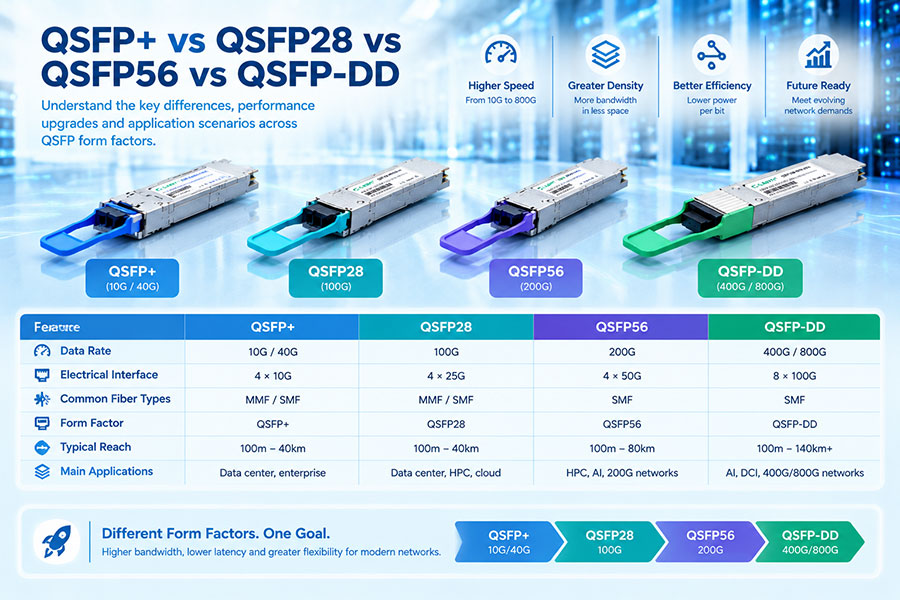
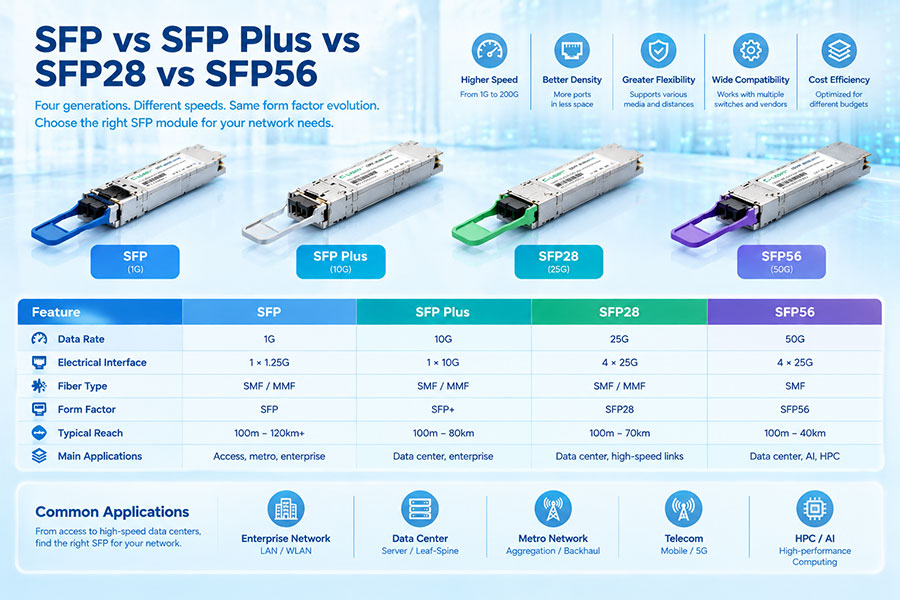
Pluggable coherent DCO modules integrate coherent optical functions into compact form factors. Depending on the product, they can be installed in routers, switches or optical transport equipment with suitable host interfaces and line-system compatibility.
| Transceiver Category | Typical Form Factors | Network Role |
|---|---|---|
| 100G Coherent DCO | QSFP28, CFP2 | 100G-class DWDM transport |
| 200G Coherent DCO | CFP2 and other supported platforms | Metro and regional optical transmission |
| 400G Coherent DCO | QSFP-DD, OSFP and CFP2 variants | High-capacity DCI and carrier transport |
| 800G Coherent DCO | Supported high-density pluggable platforms | Next-generation high-capacity optical links |
C-LIGHT 100G–800G DWDM DCO Coherent Transceivers
C-LIGHT's DWDM DCO portfolio includes 100G, 200G, 400G and 800G product categories, with QSFP28, CFP2, QSFP-DD and OSFP form factors. The portfolio supports tunable C-band DWDM applications for carrier networks, cloud infrastructure and data center interconnects.
Product selection should account for the required line rate, coherent standard, host interface, optical reach, FEC mode and compatibility with the DWDM line system.
12. How to Choose Between OTN, DWDM or a Combined Architecture
The correct network design depends on whether the main requirement is digital transport management, optical capacity expansion or both.
| Network Requirement | Recommended Architecture | Primary Reason |
|---|---|---|
| Direct point-to-point optical connection | Optical transceivers or coherent links | Simple connectivity without an additional OTN switching layer |
| Multiple wavelengths over limited fiber resources | DWDM | Increases fiber capacity through wavelength multiplexing |
| Digital service aggregation and transport monitoring | OTN | Provides ODU mapping, multiplexing and path monitoring |
| Large carrier backbone with multiple services | OTN + DWDM | Combines digital transport management with high-capacity optical transmission |
| High-capacity DCI with coherent optics | DWDM with coherent transceivers; OTN where required | Provides high-speed wavelength connectivity with optional structured transport |
| Multi-site metro network expansion | OTN + DWDM, depending on service requirements | Supports service aggregation and scalable wavelength capacity |
Before selecting equipment, engineers should evaluate fiber availability, required capacity, service granularity, optical reach, wavelength planning, OSNR, protection requirements and network management architecture.
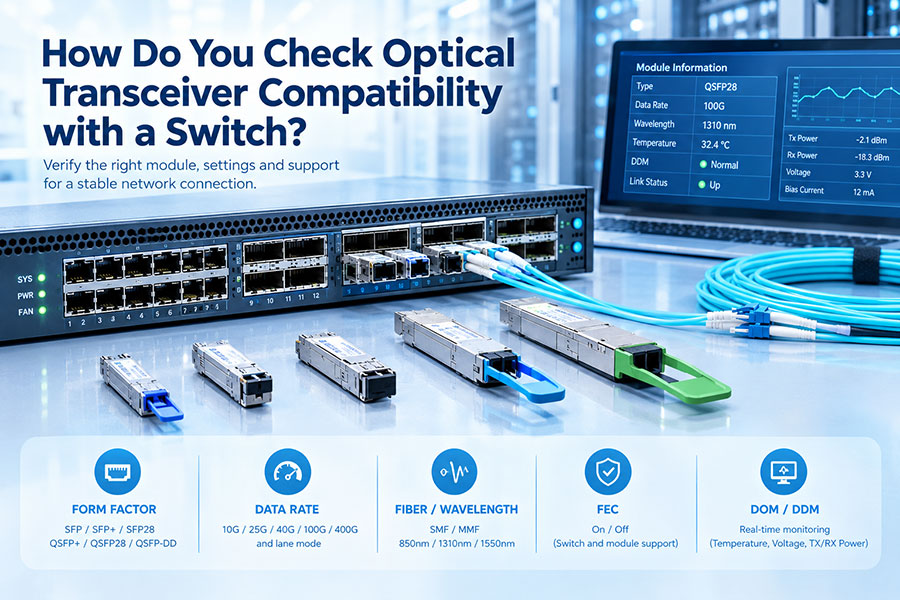
It is also important to determine whether the proposed transceiver is a client-side interface, an OTN line interface or a coherent DWDM line interface. Similar data-rate labels do not guarantee protocol or host compatibility.
13. Conclusion: OTN Manages Digital Transport, DWDM Expands Optical Capacity
OTN and DWDM address different requirements in optical transport networks. OTN provides structured digital transport through client mapping, ODU multiplexing, framing, FEC and performance monitoring. DWDM increases the capacity of optical fiber by transmitting multiple wavelengths through a shared fiber infrastructure.
Neither technology replaces the other. OTN can operate without DWDM, and DWDM can carry optical signals without an OTN switching layer. When deployed together, they provide a scalable architecture for metro networks, carrier backbones, long-haul transmission and data center interconnects.
As network demand grows from 100G to 400G, 800G and beyond, coherent transceivers, high-density wavelength systems and flexible OTN transport architectures will remain important components of high-capacity optical infrastructure.
Planning an OTN or DWDM optical transport network?
C-LIGHT provides DWDM coherent transceivers, optical multiplexing components, OTN equipment and optical line solutions for carrier transport, metro networks and data center interconnect applications.
Contact C-LIGHT for product specifications, optical interface compatibility and network configuration requirements.