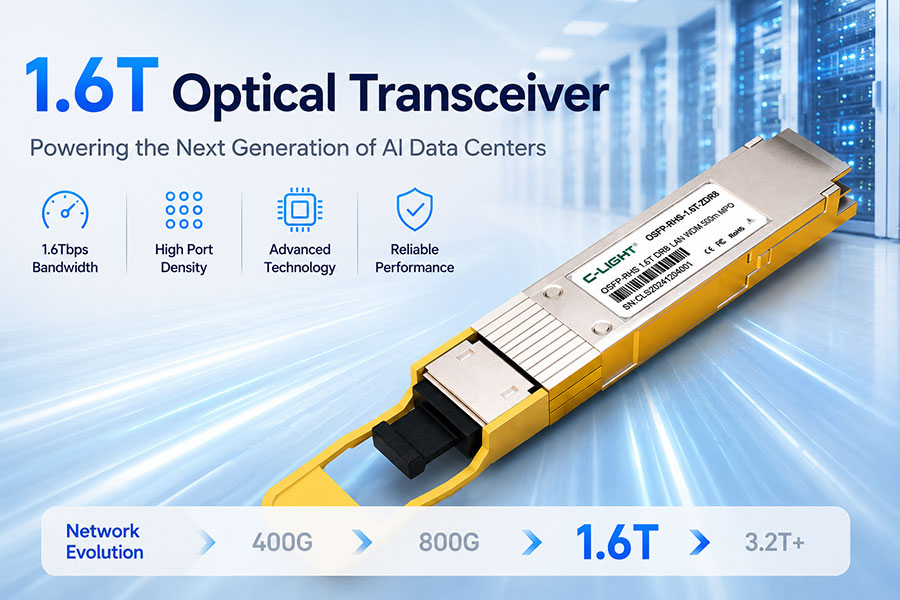
PAM4 technology has become one of the most important signal modulation technologies in modern high-speed optical communication systems. With the rapid growth of AI data centers, cloud computing, and high-performance networking, traditional NRZ signaling is facing bandwidth limitations. PAM4 provides a more efficient way to increase data transmission rates while maintaining existing infrastructure.
Today, PAM4 is widely used in 400G, 800G, and next-generation 1.6T optical communication solutions, enabling higher bandwidth, improved transmission efficiency, and scalable network upgrades for data centers and optical interconnect applications.
PAM4 stands for Pulse Amplitude Modulation 4-Level. It is an advanced modulation technology that uses four different signal amplitude levels to transmit digital information.
Unlike traditional NRZ (Non-Return-to-Zero) signaling, which uses two voltage levels to represent one bit, PAM4 uses four amplitude levels. Each PAM4 symbol can represent two bits of information, effectively doubling the data transmitted per symbol.
NRZ: 2 signal levels, 1 bit per symbol
PAM4: 4 signal levels, 2 bits per symbol
By increasing the amount of data carried by each symbol, PAM4 helps optical networks achieve higher speeds without requiring a proportional increase in signal frequency.
For many years, NRZ modulation was widely used in optical communication systems, including 10G, 25G, 40G, and 100G optical networks.
However, as network speeds continue increasing, NRZ faces several challenges:
Higher electrical bandwidth requirements
Increased signal loss at high frequencies
Greater power consumption
Difficult signal integrity management
As data centers move toward 400G, 800G, and beyond, PAM4 has become a key technology for overcoming these limitations.
AI workloads require massive communication bandwidth between GPUs, switches, and storage systems. Modern AI clusters generate extremely high east-west traffic, requiring faster and more efficient optical networks.
PAM4 technology enables:
Higher data rates over existing channels
Improved bandwidth efficiency
Support for 400G and 800G optical modules
Scalable solutions for future AI networks
PAM4 uses four amplitude levels to represent two-bit combinations:
Level 0: 00
Level 1: 01
Level 2: 10
Level 3: 11
Each symbol carries twice the information of an NRZ symbol, improving transmission efficiency.
One of the biggest advantages of PAM4 is reducing the required baud rate for higher-speed transmission.
For example:
100G NRZ requires approximately 100G electrical signaling
100G PAM4 requires lower symbol rate because each symbol carries more information
400G and 800G systems use PAM4 to achieve higher capacity efficiently
PAM4 is widely used in 400G optical modules, including:
400G QSFP-DD
400G OSFP
400G QSFP112
These modules typically use 50G or 100G PAM4 electrical lanes to achieve high-speed optical transmission.
800G optical modules rely heavily on PAM4 technology to support next-generation AI and cloud data center networks.
Common applications include:
800G OSFP optical modules
800G QSFP-DD optical modules
AI cluster networking
High-performance computing networks
As optical networks evolve toward 1.6T and beyond, PAM4 continues playing an important role in increasing transmission capacity while maintaining manageable power consumption and system complexity.
PAM4 doubles the amount of information transmitted per symbol compared with NRZ, enabling higher-speed communication without significantly increasing signal frequency.
PAM4 allows data centers to upgrade network speeds while using similar optical and electrical architectures, helping reduce infrastructure upgrade costs.
By reducing required signal bandwidth, PAM4 can help improve power efficiency in high-speed optical systems.
Because PAM4 uses four signal levels, the voltage difference between each level is smaller than NRZ. This makes PAM4 more sensitive to:
Noise
Jitter
Signal distortion
Crosstalk
PAM4-based systems require more advanced testing methods, including:
Eye diagram analysis
BER testing
Jitter measurement
TDECQ testing
Signal integrity verification
Optical modules using PAM4 require advanced components such as:
High-performance DSP
Advanced drivers
High-speed receivers
Optimized optical engines
| Technology | Signal Levels | Bits per Symbol | Main Applications |
|---|---|---|---|
| NRZ | 2 Levels | 1 Bit | 10G, 25G, 100G Networks |
| PAM4 | 4 Levels | 2 Bits | 400G, 800G, 1.6T Networks |
C-LIGHT provides advanced optical connectivity solutions designed for high-speed data center and AI networking applications.
The product portfolio includes:
400G PAM4 Optical Transceivers
800G PAM4 Optical Modules
1.6T Optical Connectivity Solutions
High-speed DAC, AOC, and AEC solutions
By adopting advanced PAM4 technology, C-LIGHT solutions support the growing bandwidth requirements of AI clusters, cloud data centers, and next-generation optical networks.
PAM4 technology has become a fundamental technology for modern high-speed optical communication. As networks continue evolving from 400G to 800G and 1.6T, PAM4 provides an efficient pathway to achieve higher bandwidth, better scalability, and improved network performance.
Driven by AI data centers, cloud computing, and high-performance networking, PAM4 will continue playing a critical role in the future development of optical communication infrastructure.
Answer: PAM4 is a four-level pulse amplitude modulation technology that uses four signal levels to transmit two bits of data per symbol, improving transmission efficiency compared with NRZ.
Answer: PAM4 enables higher data rates by increasing information per symbol, making it suitable for high-speed optical communication systems.
Answer: NRZ uses two signal levels and transmits one bit per symbol, while PAM4 uses four signal levels and transmits two bits per symbol.
Answer: PAM4 provides higher bandwidth efficiency, improved scalability, and supports high-speed networking requirements.
Answer: PAM4 is more sensitive to noise, jitter, and signal distortion, requiring advanced testing and signal processing technologies.
Answer: PAM4 is widely used in 400G, 800G, and next-generation optical transceivers, including QSFP-DD and OSFP modules.
Answer: PAM4 will continue supporting future high-speed optical networks, including 1.6T solutions, together with advanced optical engines and signal processing technologies.
Answer: C-LIGHT integrates PAM4 technology into high-speed optical connectivity solutions to support AI data centers, cloud networks, and next-generation optical communication systems.
For any questions, please contact us by email or WhatsApp.
Email: sales@c-light.com
WhatsApp: +86 132 6656 7067