
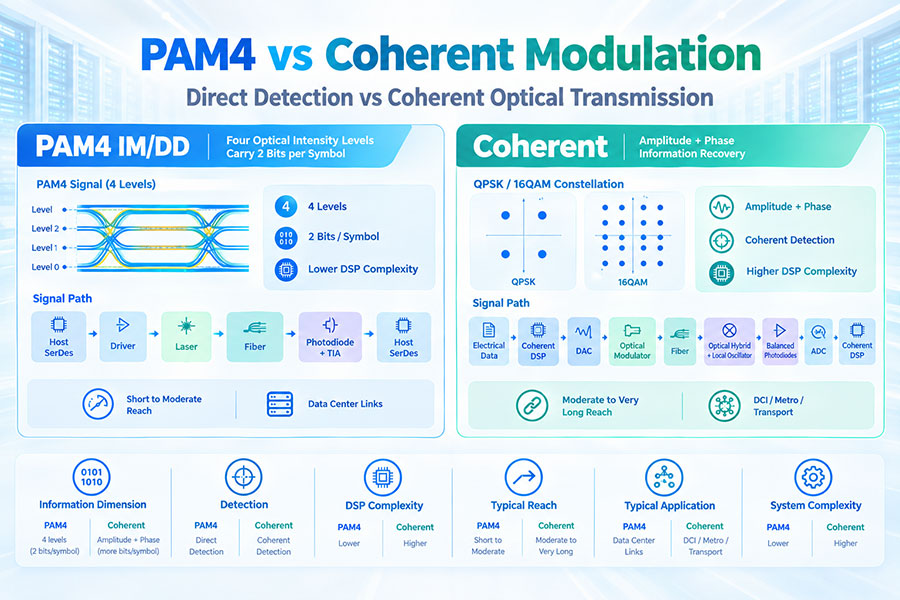
PAM4 and coherent optical transmission are two important technologies used to increase optical communication bandwidth. PAM4 is a four-level pulse amplitude modulation format that is widely used in high-speed data center optical links, while coherent transmission uses both the amplitude and phase of the optical carrier and normally relies on coherent detection and digital signal processing.
These technologies are sometimes described as direct competitors, but they solve different transmission challenges. PAM4 is particularly effective for short and medium-reach high-speed data center connections because it can provide higher bits per symbol without requiring the full complexity of a coherent receiver. Coherent technology is designed to extract much more information from the optical carrier and is therefore better suited to longer-distance transmission, higher spectral efficiency, and optical networks with significant impairments.
The difference becomes increasingly important as optical interfaces move from 400G and 800G toward 1.6T and beyond. Understanding PAM4 and coherent transmission requires looking not only at the modulation format but also at the transmitter, receiver, DSP, optical link budget, fiber distance, power consumption, and network architecture.
PAM4 stands for four-level Pulse Amplitude Modulation. Instead of using only two amplitude levels like NRZ, PAM4 uses four distinct amplitude levels.
Because four levels can represent four possible symbols, each PAM4 symbol carries two bits of information:
00 → Level 1
01 → Level 2
10 → Level 3
11 → Level 4
The two-bit-per-symbol characteristic allows PAM4 to double the number of transmitted bits per symbol compared with binary NRZ at the same baud rate.
Coherent optical transmission uses information encoded in the optical carrier's amplitude and phase and recovers the signal using a coherent receiver.
A coherent receiver typically combines the incoming optical signal with a local oscillator and uses balanced photodetection and digital signal processing to recover the transmitted information.
Coherent systems can use modulation formats such as QPSK and higher-order QAM formats including 16QAM, depending on the required data rate, reach, spectral efficiency, and implementation.
This distinction is important.
PAM4 describes a signal modulation format.
Coherent describes a transmission and receiver architecture in which the optical field's phase and amplitude information are recovered.
In modern data communication discussions, PAM4 usually refers to an IM/DD optical link, while coherent communication normally refers to a system using coherent detection and a coherent DSP.
Therefore, a technically accurate comparison is often:
PAM4 IM/DD vs Coherent Optical Transmission
| Parameter | PAM4 IM/DD | Coherent Transmission |
|---|---|---|
| Primary information dimension | Optical intensity | Amplitude and phase |
| Typical detection | Direct detection | Coherent detection |
| Typical modulation | PAM4 | QPSK, 16QAM and other coherent formats |
| Receiver architecture | Photodiode + TIA | Coherent receiver + ADC/DSP |
| DSP complexity | Lower | Much higher |
| Typical application | Data center and short-reach links | DCI, metro, regional and long-haul links |
| Optical reach | Short to moderate | Moderate to very long |
| System complexity | Lower | Higher |
PAM4 uses four amplitude levels to represent two bits per symbol.
For example, a sequence of four symbols can represent:
00 → 01 → 11 → 10
Each transition corresponds to a different optical amplitude.
The advantage is higher bit throughput at a given baud rate. The disadvantage is that the distance between adjacent amplitude levels becomes smaller, reducing vertical eye opening and making the system more sensitive to noise and distortion.
NRZ normally uses two signal levels and carries one bit per symbol.
PAM4 uses four levels and carries two bits per symbol.
| Characteristic | NRZ | PAM4 |
|---|---|---|
| Signal levels | 2 | 4 |
| Bits per symbol | 1 | 2 |
| Eye openings | 1 | 3 |
| Vertical margin | Higher | Lower |
| Bandwidth efficiency | Lower | Higher |
| Noise sensitivity | Lower | Higher |
Coherent optical systems can use multiple dimensions of the optical field instead of relying only on signal intensity.
For example, QPSK uses the phase of the carrier to represent multiple symbols. 16QAM combines amplitude and phase to create a larger constellation with more bits per symbol.
Dual-polarization coherent systems can use two orthogonal polarization states, effectively increasing the amount of information transmitted through one optical carrier.
DP-16QAM means Dual-Polarization 16-state Quadrature Amplitude Modulation.
It combines 16QAM with two polarization states.
This significantly increases spectral efficiency compared with simple intensity modulation, making it suitable for high-capacity transmission over longer distances.
OIF's 400ZR specification uses single-carrier coherent DP-16QAM as part of its 400Gb/s optical interface architecture. :contentReference[oaicite:0]{index=0}
A typical PAM4 transmitter converts the electrical PAM4 signal into an optical waveform.
A simplified signal path is:
Host SerDes → Driver → Laser → Fiber
Depending on the optical module, the transmitter can use technologies such as VCSEL, DML, EML, or silicon photonics.
High-speed PAM4 optical transmitters require sufficient bandwidth, linearity, extinction characteristics, and signal integrity to preserve the four-level waveform.
A coherent transmitter generally contains a narrow-linewidth laser, optical modulator, polarization handling, and associated high-speed electronics.
A simplified path is:
Electrical Data → Coherent DSP → DAC → Optical Modulator → Optical Carrier → Fiber
The exact architecture varies by coherent implementation.
Compared with a typical PAM4 IM/DD transmitter, a coherent transmitter contains significantly more optical and electronic processing.
A PAM4 receiver typically uses a photodiode and TIA to convert optical power into an electrical signal.
A simplified path is:
Fiber → Photodiode → TIA → Electrical Processing → Host SerDes
Because the receiver directly detects optical intensity, it does not recover the optical phase of the carrier.
A coherent receiver is considerably more complex.
A simplified path is:
Fiber → Optical Hybrid → Local Oscillator → Balanced Photodiodes → ADC → Coherent DSP
The receiver compares the incoming optical field with a locally generated optical reference. This allows the system to recover both amplitude and phase information.
The coherent receiver must recover information that is not available through simple direct detection.
It may need to compensate for:
Chromatic dispersion
Polarization effects
Polarization-mode dispersion
Phase noise
Frequency offset
Fiber nonlinearities
Optical impairments
These functions usually require powerful digital signal processing.
PAM4 systems can use DSP or CDR functions depending on the module architecture, but their signal-processing requirements are generally much lower than those of coherent systems.
A conventional PAM4 data center optical module may use a DSP or retimer for electrical and optical signal conditioning, while LPO architectures can remove the conventional module DSP and rely more heavily on host SerDes.
This provides a range of PAM4 architectures rather than one fixed implementation.
Coherent optical systems depend heavily on DSP.
The coherent DSP can perform functions such as:
Equalization
Polarization demultiplexing
Frequency recovery
Carrier recovery
Chromatic dispersion compensation
Phase estimation
FEC processing
The exact processing chain depends on the coherent standard and implementation.
Data center links frequently prioritize high bandwidth, low power, low latency, compact form factors, and cost efficiency over extremely long optical reach.
PAM4 provides a relatively simple way to increase the bits transmitted per symbol while keeping the optical architecture significantly simpler than coherent transmission.
This makes PAM4 well suited to high-volume short-reach Ethernet optical modules.
800G optical modules commonly use multiple PAM4 lanes to reach an aggregate 800Gb/s data rate.
For example, 100G-class electrical and optical lanes can be combined across multiple channels. Coherent introduced 100G PAM4 VCSEL and photodiode arrays specifically for 800G short-reach transceivers and active optical cables, illustrating the role of PAM4 in high-density data center connectivity. :contentReference[oaicite:1]{index=1}
As optical bandwidth moves toward 1.6T, PAM4 remains important because higher electrical lane rates can be combined across multiple channels.
Typical architectures may use 200G-class PAM4 lanes.
This approach increases aggregate capacity while maintaining the general pluggable data center optical architecture.
PAM4 continues to evolve toward higher baud rates and higher lane speeds.
At OFC 2026, Coherent demonstrated 400G-per-lane PAM4 optical links for emerging 3.2T pluggable architectures using both differential EML and silicon photonics implementations. :contentReference[oaicite:2]{index=2}
This illustrates that PAM4 is not limited to the current 800G generation.
Coherent technology has traditionally been associated with long-haul optical transport, but its use has expanded into data center interconnect and high-capacity metro applications.
400ZR is a prominent example of coherent technology moving into data center networking.
OIF describes 400ZR as a 400Gb/s interoperable coherent interface based on DP-16QAM and designed for data center interconnect applications above 80 km. Cisco documents support 400ZR point-to-point transmission up to 120 km for compatible configurations. :contentReference[oaicite:3]{index=3}
PAM4 is commonly used for short and medium-reach optical links.
Typical data center applications include:
Server-to-switch
Switch-to-switch
Leaf-to-spine
AI accelerator interconnects
Data center short-reach connectivity
Depending on the optical design, PAM4 modules can support distances ranging from meters to several kilometers and, in some implementations, longer reaches.
Coherent technology is designed for substantially longer transmission distances.
By using phase and amplitude information together with powerful DSP and FEC, coherent systems can compensate for a wide range of fiber impairments.
This is why coherent technology is widely used in metro, regional, data center interconnect, and long-haul networks.
| Application | PAM4 IM/DD | Coherent |
|---|---|---|
| Server connectivity | Common | Rare |
| Top-of-rack | Common | Not typical |
| Leaf-spine | Common | Possible in specialized architectures |
| Intra-data-center | Common | Possible depending on distance |
| Data center interconnect | Possible for shorter distances | Major application |
| Metro | Limited | Common |
| Regional | Limited | Common |
| Long-haul | Generally unsuitable | Core application |
Optical power budget is one of the reasons PAM4 and coherent systems are suited to different applications.
A PAM4 IM/DD link typically relies on transmitter optical power, receiver sensitivity, fiber attenuation, connector losses, and other optical penalties to establish its reach.
Coherent systems use advanced detection and DSP in addition to optical power to overcome transmission impairments.
In an IM/DD PAM4 system, receiver performance depends strongly on optical power, photodetector characteristics, TIA noise, bandwidth, and signal quality.
Coherent receivers benefit from mixing with a local oscillator and extracting information from the optical field, providing sensitivity and impairment tolerance suitable for long-distance transmission.
Chromatic dispersion causes different optical frequency components to travel at different velocities through the fiber.
At high data rates and longer fiber lengths, the resulting waveform distortion can become significant.
Short-reach PAM4 systems are generally designed so that dispersion remains manageable within the intended transmission distance.
Coherent systems can use DSP-based digital dispersion compensation, making them much better suited to long fiber spans.
Optical polarization can change as light travels through fiber.
In long-distance coherent systems, polarization changes can be tracked and compensated using digital signal processing.
Typical PAM4 IM/DD data center receivers do not recover the full optical polarization state, which keeps the receiver architecture simpler.
At long distances and high optical powers, fiber nonlinearities can become important.
Coherent DSP-based transmission can use advanced algorithms and modulation strategies to manage nonlinear and other transmission impairments.
PAM4 IM/DD links are generally designed for shorter distances where these effects are less dominant.
PAM4 optical modules generally require fewer high-complexity processing functions than coherent modules.
A typical PAM4 module may contain:
Laser
Laser driver
Photodiode
TIA
Optional DSP or retimer
Compared with a coherent system, this can result in lower module power, especially for short-reach applications.
Coherent modules typically contain more optical and electronic components.
These can include coherent DSP, ADCs, DACs, optical hybrids, local oscillators, modulators, and additional control circuitry.
This produces a substantially more complex power profile.
However, coherent technology provides capabilities that a simple PAM4 IM/DD system cannot achieve over long distances.
| Power Factor | PAM4 IM/DD | Coherent |
|---|---|---|
| Optical transmitter complexity | Lower | Higher |
| Receiver complexity | Lower | Much higher |
| DSP workload | Lower | High |
| ADC/DAC requirements | Lower or architecture-dependent | Important |
| Typical module power | Lower | Higher |
| Reach capability | Shorter | Much longer |
PAM4 IM/DD links generally have fewer processing stages than coherent systems.
A direct-detection receiver can convert the optical signal into the electrical domain without reconstructing the full optical field.
Coherent systems require additional DSP stages for synchronization, polarization recovery, equalization, carrier recovery, dispersion compensation, and FEC.
Therefore, coherent systems generally have greater processing latency.
Low latency is important in AI clusters, high-performance computing, and distributed accelerator systems.
PAM4 can provide very high bandwidth without introducing the full processing chain of a coherent receiver.
This makes PAM4 particularly attractive for short links where fiber impairments do not require the additional capabilities of coherent technology.
The additional latency of coherent DSP is a deliberate engineering trade-off.
The system gains much greater reach, spectral efficiency, dispersion compensation, polarization processing, and transmission flexibility.
For long-haul and metro links, these capabilities generally matter more than minimizing every nanosecond of module processing latency.
PAM4 optical modules can use both multimode and single-mode fiber depending on the target reach and optical architecture.
VCSEL-based PAM4 is widely associated with short-reach multimode applications.
Single-mode PAM4 architectures can support longer distances using technologies such as EML, DML, and silicon photonics.
Coherent optical communication is primarily associated with single-mode fiber because long-distance transmission requires controlled spatial propagation and high optical coherence.
Coherent systems are optimized around wavelength channels, optical amplification, dispersion management, polarization processing, and DWDM architectures.
A PAM4 module can use a single optical wavelength or multiple wavelengths depending on its design.
For example, parallel single-mode modules can use multiple optical lanes, while WDM architectures can combine multiple wavelengths over duplex fiber.
Coherent transmission typically uses a narrow-linewidth carrier and advanced modulation to transmit very high amounts of data over one wavelength channel.
Coherent transmission generally provides much higher spectral efficiency than PAM4 IM/DD.
A coherent system can manipulate both amplitude and phase and can use polarization multiplexing and higher-order modulation.
This allows substantially more information to be transmitted through a given optical spectrum.
PAM4 provides improved spectral efficiency over NRZ, but its overall spectral efficiency is generally lower than advanced coherent formats.
Spectral efficiency becomes critical when fiber capacity is limited.
In a long-haul or metro network, a single fiber may carry many wavelength channels through DWDM.
Increasing the information carried by each wavelength allows more total capacity to be transmitted without proportionally increasing the number of fiber pairs.
This is a major reason coherent technology dominates long-distance optical transport.
Forward Error Correction is widely used in high-speed Ethernet systems, including PAM4-based interfaces.
FEC can correct a certain amount of transmission errors and improve the effective link performance.
However, the FEC used in an Ethernet PAM4 system should not be confused with the much more extensive DSP processing used in coherent transmission.
FEC is fundamental to modern coherent communication systems.
Coherent systems typically use powerful FEC together with modulation, equalization, carrier recovery, dispersion compensation, and other DSP functions.
The combination allows coherent systems to operate over long distances with much stronger impairment tolerance than simple IM/DD links.
PAM4 has become a key technology for high-speed AI and cloud data center connectivity.
As switch and accelerator interfaces move to 800G, 1.6T, and higher aggregate bandwidths, PAM4 allows multiple high-speed lanes to be combined into extremely high-capacity optical modules.
The low-latency and relatively simple architecture is particularly relevant to short-reach interconnects inside AI clusters.
Coherent optics are increasingly important when data centers need to be connected over metropolitan or regional distances.
400ZR is an important example of coherent technology moving directly into pluggable router and switch interfaces.
Coherent 400ZR modules can provide long-distance transmission without requiring a separate traditional transport chassis in suitable IP-over-DWDM architectures. :contentReference[oaicite:4]{index=4}
| Parameter | 400G PAM4 | 400G Coherent |
|---|---|---|
| Typical architecture | IM/DD | Coherent detection |
| Typical application | Data center | DCI / metro / regional |
| Typical DSP complexity | Lower | High |
| Optical field information | Intensity | Amplitude + phase |
| Polarization recovery | Not normally used | Used |
| Chromatic dispersion compensation | Limited / controlled by reach | Digital compensation available |
| Power | Lower | Higher |
| Reach | Short to moderate | Long |
At 800G, both technologies can appear in the optical ecosystem, but they target different applications.
800G PAM4 is strongly associated with high-density data center connectivity. 800G coherent modules target applications such as higher-capacity data center interconnect and transport networking.
Coherent's 800G ZR/ZR+ technology has been developed for metro, regional, and data center interconnect applications, with commercial implementations supporting hundreds of kilometers depending on operating mode and link conditions. :contentReference[oaicite:5]{index=5}
| Architecture Item | 800G PAM4 | 800G Coherent |
|---|---|---|
| Primary target | Short-reach data center | DCI / metro / transport |
| Typical modulation | PAM4 | Coherent modulation |
| Detection | Direct | Coherent |
| DSP complexity | Lower | Very high |
| Optical wavelength strategy | Single wavelength, parallel lanes or WDM | High-capacity wavelength channel |
| Optical reach | Shorter | Longer |
| Module power | Lower | Higher |
As optical interfaces continue beyond 800G, PAM4 remains attractive for short-reach links because it can scale by increasing the lane rate and the number of lanes.
Coherent technology is also evolving toward higher capacities. OIF has been working on future coherent interfaces such as 1600ZR, while higher-speed electrical and optical interfaces continue to be investigated. :contentReference[oaicite:6]{index=6}
The two technologies can therefore continue to evolve in parallel rather than one necessarily replacing the other.
PAM4 modules can use relatively compact optical components.
Depending on the target application, the module may contain:
VCSEL
DML
EML
Silicon photonics PIC
Photodiode
TIA
Laser driver
The exact component selection is determined by reach, wavelength, optical budget, temperature, cost, and power requirements.
Coherent modules use a more complex optical engine.
A typical implementation can include:
Narrow-linewidth laser
IQ optical modulator
Optical hybrid
Balanced photodiodes
Local oscillator
High-speed ADC/DAC
Coherent DSP
These components enable much more sophisticated signal processing.
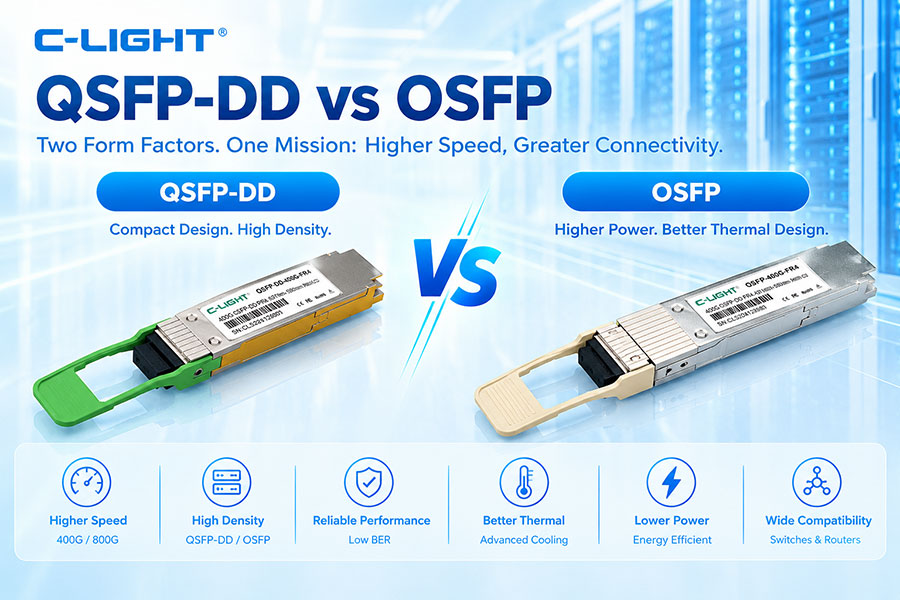
PAM4 technology is commonly implemented in compact pluggable form factors such as QSFP-DD and OSFP.
The architecture is highly compatible with front-panel data center switches and high-speed network interface devices.
800G and 1.6T PAM4 products are being developed in these pluggable ecosystems as bandwidth increases. Coherent products can also use pluggable form factors, but their internal architecture is substantially more complex.
Coherent technology is not limited to large transport chassis.
Modern digital coherent optics can be implemented in compact pluggable modules.
400ZR and 800ZR/ZR+ are examples of coherent technology being integrated into QSFP-DD and other compact form factors for direct connection to routers and switches. :contentReference[oaicite:7]{index=7}
PAM4 is closely associated with Linear Pluggable Optics because LPO architectures typically process high-speed PAM4 electrical signals using linear drivers and TIAs rather than a conventional high-speed DSP inside the module.
This relationship is particularly relevant to 800G and 1.6T data center optical links.
However, PAM4 and LPO are also different concepts:
PAM4 = modulation format
LPO = optical module architecture
A PAM4 module does not automatically mean it is LPO.
Coherent modules normally depend heavily on DSP because coherent detection requires extensive digital processing.
The DSP reconstructs the transmitted optical signal from the electrical samples generated by the receiver and compensates for many transmission impairments.
This makes coherent optics fundamentally different from a simple direct-detection PAM4 receiver.
| Test Item | PAM4 IM/DD | Coherent |
|---|---|---|
| Eye diagram | Important | Not the only primary measurement |
| OMA | Important | Different measurement framework |
| TDECQ | Important for PAM4 Ethernet interfaces | Not the primary coherent metric |
| EVM | Less central | Important |
| Constellation | Not typical | Central |
| Phase noise | Limited relevance | Critical |
| Polarization analysis | Not normally required | Important |
| Chromatic dispersion | Reach dependent | Major parameter |
A PAM4 eye diagram contains three eye openings corresponding to the four signal levels.
The eye openings must remain sufficiently large to ensure reliable symbol detection.
Noise, distortion, jitter, linearity problems, and bandwidth limitations can reduce the eye openings and increase the error rate.
Coherent systems are commonly analyzed using constellation diagrams.
Each point in the constellation represents a possible combination of amplitude and phase.
For a 16QAM system, sixteen ideal constellation points exist before transmission impairments and receiver effects are considered.
Actual received points spread around their ideal positions because of noise, phase errors, nonlinearities, dispersion, and other impairments.
Both PAM4 and coherent systems must achieve a sufficiently low error rate for reliable communication.
However, the mechanisms used to achieve the required BER are different.
PAM4 relies heavily on signal quality, receiver performance, link budget, equalization, and applicable Ethernet FEC.
Coherent systems combine powerful DSP, modulation, optical design, and FEC to recover data after substantial transmission impairment.
The advantage of coherent transmission is not simply higher optical power.
Its major advantage is the ability to recover a much richer optical signal and digitally compensate for impairments accumulated over the fiber link.
This makes coherent communication suitable for distances at which direct-detection PAM4 would become increasingly difficult or inefficient.
For a short optical link, using a highly sophisticated coherent receiver may provide more processing capability than the application actually requires.
PAM4 can deliver very high aggregate bandwidth using a simpler optical transmitter and receiver.
This can reduce power consumption, component count, latency, thermal load, and module cost.
| System Factor | PAM4 IM/DD | Coherent |
|---|---|---|
| Optical components | Relatively simple | Complex |
| Receiver architecture | Direct detection | Coherent detection |
| DSP | Low to moderate depending on implementation | High |
| Thermal design | Lower complexity | More demanding |
| Module power | Generally lower | Generally higher |
| Optical reach | Shorter | Longer |
| Spectral efficiency | Moderate | High |
PAM4 optical modules generally use fewer high-complexity optical and digital components than coherent modules.
This can make them more suitable for the extremely high unit volumes found in data centers.
Coherent modules have higher component and processing complexity, but they provide much greater transmission capability over long distances.
Therefore, cost should be evaluated together with the required transmission distance and network architecture rather than as a technology-independent parameter.
High-speed data center systems contain large numbers of optical ports.
PAM4's relatively low module power can help limit the thermal load of dense front-panel optical connectivity.
Coherent modules generally require more powerful digital and analog electronics, increasing thermal-management requirements.
For DCI and transport networks, the additional power may be justified by the distance and capacity requirements.
PAM4 can be deployed using parallel single-mode fiber, multimode fiber, or WDM-based duplex fiber depending on the module design.
Coherent networking generally uses single-mode fiber and is closely associated with DWDM and transport-grade optical infrastructure.
The fiber architecture therefore reflects the different network environments in which the two technologies are normally deployed.
One approach to increasing data rate is to use multiple optical lanes in parallel.
For example, an 800G optical module can combine eight 100G-class lanes or other lane configurations depending on the implementation.
This approach allows PAM4 to achieve very high aggregate bandwidth without requiring extremely high-order modulation on a single wavelength.
Coherent technology can transmit very large amounts of data through a single optical carrier by using high-order modulation and polarization multiplexing.
This dramatically increases capacity per wavelength and reduces the number of independent optical channels required for long-distance systems.
This characteristic is especially valuable when fiber spectrum is limited.
Switch-to-switch connections inside data centers are a major PAM4 application.
The distances are usually short enough to allow the system to use direct detection while maintaining the required error performance.
Common form factors include QSFP-DD and OSFP, depending on the switch platform and data rate.
When the optical path extends beyond the normal intra-data-center environment, coherent optics become increasingly useful.
400ZR and 800ZR-class coherent modules allow high-capacity optical interfaces to be connected directly to routers and switches in suitable network architectures.
This enables IP-over-DWDM designs in which coherent optical transmission is integrated closer to the network interface.
| Network Layer | PAM4 | Coherent |
|---|---|---|
| Server / NIC | Very common | Uncommon |
| AI accelerator interconnect | Highly relevant | Specialized |
| Top-of-rack | Common | Uncommon |
| Leaf-spine | Common | Possible depending on architecture |
| Data center interconnect | Shorter links | Major application |
| Metro network | Limited | Major application |
| Long-haul transport | Not typical | Core application |
Yes.
A modern optical network can use PAM4 for server and switch connections while using coherent optics for inter-data-center and transport connections.
This layered approach allows each technology to operate where its architecture is most appropriate.
PAM4 cannot generally replace coherent transmission across all applications.
Coherent technology provides functions that are difficult to reproduce with simple PAM4 IM/DD over long distances, including high spectral efficiency, polarization multiplexing, advanced dispersion compensation, and powerful digital impairment processing.
PAM4 instead remains highly relevant where transmission distance is limited and lower power and lower complexity are important.
Coherent technology can support some applications that use PAM4, but using coherent optics for every short data center link would introduce substantially more optical and electronic complexity.
For a short connection where PAM4 already provides sufficient performance, the additional capabilities of coherent technology may not be necessary.
AI data centers contain several different classes of optical connectivity.
Short GPU-to-switch, switch-to-switch, and scale-up or scale-out links prioritize bandwidth density, low power, low latency, and compact form factors.
These requirements align strongly with PAM4-based optical architectures.
Longer links between data center sites or metro locations have different requirements and can benefit from coherent transmission.
AI scale-up fabrics require extremely high bandwidth between compute devices.
PAM4 is well suited to this environment because the architecture can scale through multiple electrical and optical lanes while maintaining relatively compact transceiver implementations.
800G, 1.6T, and emerging higher-capacity PAM4 interfaces are therefore closely linked to AI infrastructure development.
Coherent technology is also relevant to AI infrastructure when large clusters must be connected across data centers.
In these cases, the transmission distance can extend far beyond the range of typical client-side PAM4 links.
Coherent optics provide the processing capability needed to maintain high capacity across those longer fiber paths.
Silicon photonics can be used to implement PAM4 optical engines.
A silicon photonics PIC can integrate modulators, waveguides, multiplexing structures, and other photonic functions into a compact platform.
This can be combined with high-speed PAM4 electrical interfaces to support 400G, 800G, 1.6T, and higher-capacity data center architectures.
Silicon photonics can also be combined with coherent technology.
A coherent silicon photonics platform may integrate optical modulators and other photonic components while external or integrated electronics perform the required coherent processing.
Therefore, silicon photonics is not an alternative to coherent technology. It is a photonic integration platform that can support different transmission architectures.
EML is frequently used in higher-performance single-mode PAM4 modules because it can provide the required modulation bandwidth and optical performance for longer-reach data center links.
Modern high-speed EML technologies are being developed for 100G-per-lane and 200G-per-lane PAM4 applications.
Coherent's published roadmap also includes 200G PAM4 DFB-MZ technology for 800G and 1.6T applications. :contentReference[oaicite:8]{index=8}
Phase is a critical difference between direct-detection PAM4 and coherent communication.
PAM4 receivers determine the transmitted symbol primarily from optical intensity.
Coherent receivers preserve and process information related to the optical field, including phase.
This additional information dimension enables modulation formats with much higher information density.
A coherent receiver needs a reference optical signal to compare with the incoming signal.
The local oscillator provides this reference.
By mixing the received signal with the local oscillator, the receiver can convert optical field information into electrical signals that can be sampled and processed digitally.
PAM4 only requires information about the optical intensity levels.
A photodiode can directly convert optical power into an electrical current, after which the receiver determines which of the four amplitude levels was transmitted.
This allows a much simpler receiver architecture than a coherent receiver.
| Component | PAM4 IM/DD | Coherent |
|---|---|---|
| Laser | Yes | Yes |
| Modulator | May use directly modulated or externally modulated source | High-speed coherent modulator |
| Photodiode | Yes | Balanced detector structure |
| TIA | Yes | High-speed receiver electronics |
| Optical hybrid | No | Yes |
| Local oscillator | No | Yes |
| ADC/DAC | Architecture-dependent | Core components |
| Coherent DSP | No | Yes |
PAM4 increases modulation complexity from two levels to four levels while remaining relatively simple from a receiver perspective.
Coherent systems can use multiple modulation dimensions simultaneously, making the signal constellation much richer.
This additional complexity creates higher data capacity per wavelength but also increases requirements for optical components, electronics, DSP, and system control.
Link margin represents the available performance reserve after considering transmission losses and penalties.
PAM4 links depend strongly on maintaining adequate optical power and electrical signal quality.
Coherent systems use both optical power and digital processing capability to maintain link performance over long transmission paths.
Both PAM4 and coherent optical modules must maintain performance across their specified operating temperature range.
PAM4 data center modules commonly prioritize compact thermal designs because large numbers of modules can operate simultaneously in a switch.
Coherent modules may require more sophisticated thermal management because of their higher processing and optical complexity.
High-density data center switches can contain a large number of 400G, 800G, or future higher-speed optical interfaces.
When multiplied across many ports, power per module becomes a major system consideration.
PAM4's relatively simple architecture is therefore highly valuable for high-density front-panel deployments.
For transport networks, the objective is not simply minimizing power per module.
Fiber capacity, spectral efficiency, reach, wavelength utilization, amplifier spacing, and network architecture can be more important.
Coherent technology addresses these requirements by maximizing the amount of information carried over each optical carrier.
| Application | PAM4 | Coherent |
|---|---|---|
| 100G short-reach | Common | Possible but generally unnecessary |
| 400G data center | Common | Used for longer-reach applications |
| 800G data center | Major application | Used for longer-reach networking |
| 1.6T AI data center | Major development area | Future / specialized applications |
| DCI | Shorter links | Major application |
| Metro | Limited | Major application |
| Long-haul | Not typical | Core technology |
The choice should begin with the transmission distance.
For short data center links, PAM4 is often considered because it provides high bandwidth with relatively low complexity.
For longer links where dispersion, polarization effects, spectral efficiency, and fiber capacity become major concerns, coherent technology becomes increasingly relevant.
The decision should also consider power, latency, port density, optical budget, fiber infrastructure, and network architecture.
PAM4 is generally well suited when the system requires:
High data rate
Short or controlled optical reach
Low module power
Low latency
High port density
Compact pluggable form factors
High-volume deployment
Coherent transmission becomes more appropriate when the system requires:
Long optical reach
High spectral efficiency
DWDM transmission
Strong chromatic dispersion compensation
Polarization processing
Advanced FEC
High-capacity DCI or transport networking
The fundamental trade-off can be summarized as:
PAM4 prioritizes simplicity, power efficiency, density, and short-reach bandwidth.
Coherent prioritizes transmission distance, spectral efficiency, and impairment tolerance.
Neither technology is inherently designed to replace the other across every optical networking application.
PAM4 development is moving toward higher baud rates and higher bits per lane.
As electrical interfaces move toward 200G-per-lane and beyond, optical components such as EMLs, VCSEL arrays, TIAs, laser drivers, and silicon photonics modulators must provide increasingly high bandwidth and linearity.
The development of 400G-per-lane PAM4 demonstrations for 3.2T-class pluggable architectures shows that PAM4 is continuing to scale into higher-capacity data center systems. :contentReference[oaicite:9]{index=9}
Coherent technology is also moving toward higher baud rates, higher data rates, reduced power consumption, and smaller pluggable form factors.
Research and standardization activities are extending coherent architectures toward 800G and 1.6T-class applications while maintaining the goal of achieving useful reach and interoperability.
OIF's work on 1600ZR is an example of the industry's effort to develop a power-optimized interoperable 1.6Tb/s coherent interface for data center interconnect scenarios. :contentReference[oaicite:10]{index=10}
The future optical ecosystem is not necessarily a competition between one modulation technology and another.
Both technologies are evolving rapidly.
PAM4 is extending toward higher lane rates for AI and data center systems, while coherent optics are moving into increasingly compact and power-efficient pluggable modules.
This creates a broader optical ecosystem in which different technologies can serve different network distances and architectures.
| Parameter | PAM4 IM/DD | Coherent |
|---|---|---|
| Technology type | Four-level amplitude modulation | Coherent optical transmission architecture |
| Information dimension | Intensity | Amplitude and phase |
| Typical modulation | PAM4 | QPSK / 16QAM / higher-order formats |
| Detection | Direct detection | Coherent detection |
| Receiver complexity | Lower | High |
| DSP requirement | Low to moderate depending on implementation | High |
| Power consumption | Generally lower | Generally higher |
| Latency | Lower | Higher due to processing |
| Spectral efficiency | Moderate | High |
| Optical reach | Short to moderate | Long |
| Fiber dispersion tolerance | More limited | Much higher |
| Polarization processing | Not normally required | Yes |
| Typical environment | Data centers and AI clusters | DCI, metro and transport |
| Port density | Very high | High but with greater complexity |
| Form factors | QSFP-DD, OSFP and others | QSFP-DD, OSFP and other coherent pluggables |
PAM4 and coherent optical transmission represent two fundamentally different approaches to high-speed optical networking.
PAM4 is a four-level amplitude modulation format that is typically used with direct detection in high-speed data center optics. Its relatively simple transmitter and receiver architecture enables high bandwidth with lower power, lower latency, compact form factors, and high port density.
Coherent optical transmission uses the amplitude and phase of the optical carrier and generally relies on coherent detection, high-speed ADC/DAC technology, powerful DSP, and FEC. This additional complexity enables much higher spectral efficiency, better dispersion tolerance, polarization processing, and substantially longer transmission distances.
For 400G, 800G, 1.6T, and future higher-speed networks, PAM4 is strongly associated with short-reach AI and data center connectivity, while coherent technology remains essential for DCI, metro, regional, and long-distance optical networking.
The key point is that PAM4 and coherent are not simply two competing modulation formats. PAM4 primarily describes how amplitude levels encode data, while coherent describes a broader optical transmission and detection architecture. Their differences in receiver architecture, DSP requirements, spectral efficiency, reach, power, and system complexity determine where each technology is most suitable.
For any questions, please contact us by email or WhatsApp.
Email: sales@c-light.com
WhatsApp: +86 132 6656 7067