
OLT and ONU are two fundamental devices in a Passive Optical Network (PON). The OLT is normally located on the service-provider side, while the ONU is deployed closer to the end user. Together, they establish the optical access connection between the provider network and customer equipment.
Although both devices belong to the same PON system, they perform very different functions. The OLT controls and manages the PON, while the ONU terminates the optical connection on the customer side and provides interfaces for user services.
OLT stands for Optical Line Terminal. It is the central device of a PON access network and is normally installed in a central office, data center, access aggregation location, or other provider-side facility.
The OLT connects the PON access network to the upstream Ethernet or IP network and communicates with multiple ONUs through the passive optical distribution network.
ONU stands for Optical Network Unit. It is a customer-side PON device that converts optical signals into electrical or service interfaces.
An ONU can provide Ethernet, voice, Wi-Fi, or other interfaces depending on its design. Different ONU products can be used for residential, enterprise, industrial, and other access applications.
| Feature | OLT | ONU |
|---|---|---|
| Full name | Optical Line Terminal | Optical Network Unit |
| Location | Provider side | Customer or access side |
| Main role | Controls and terminates the PON from the network side | Terminates the PON from the user side |
| Connected to | Core, aggregation or service network | User equipment or customer network |
| Number of connections | Communicates with multiple ONUs | Normally connects to one PON OLT |
| Bandwidth management | Controls shared PON bandwidth | Requests and uses allocated bandwidth |
| Typical form | Chassis, shelf, fixed-access device | Standalone unit, gateway, SFP ONU and other compact forms |
A simplified PON network can be represented as:
Core Network → OLT → Optical Fiber → Passive Splitter → Optical Fiber → ONU → Customer Network
The optical splitter is passive and does not actively route packets between users. The OLT manages communication with multiple ONUs over the shared optical access network.
The OLT is responsible for coordinating the access network. It communicates downstream toward ONUs and upstream toward the provider's aggregation network.
It also handles functions such as ONU registration, bandwidth allocation, traffic control, optical monitoring, service provisioning, and network management, depending on the PON technology and equipment implementation.
The ONU performs the opposite role. It receives optical traffic from the OLT, processes the PON protocol, and delivers customer services through electrical or wireless interfaces.
In the upstream direction, the ONU collects traffic from connected devices, converts it to optical transmission, and sends it toward the OLT during its assigned transmission opportunities.
In the downstream direction, the OLT sends optical signals through the shared fiber toward the passive splitter.
The splitter distributes the signal to multiple ONUs. Each ONU processes the traffic intended for it while ignoring traffic belonging to other logical connections.
The upstream direction is more complex because several ONUs share the same optical fiber toward the OLT.
The OLT therefore coordinates when each ONU can transmit. This prevents simultaneous transmissions from interfering with one another.
Dynamic Bandwidth Allocation (DBA) is an important function of many PON systems.
The OLT can allocate upstream transmission opportunities to ONUs according to traffic requirements, service policies, queue conditions, and configured bandwidth profiles.
This allows multiple subscribers or devices to share the same PON efficiently.
The ONU does not independently transmit whenever it wants. Its upstream transmission is coordinated by the OLT.
The ONU reports relevant traffic or bandwidth requirements, and the OLT determines when and how much data the ONU can transmit based on the applicable PON scheduling mechanisms.
Both devices have optical interfaces, but they serve different sides of the same PON connection.
The OLT optical port connects toward the optical distribution network and serves multiple subscribers. The ONU optical port connects toward the splitter and ultimately the OLT.
The optical parameters of the two sides must be compatible, including wavelength, transmit power, receiver sensitivity, optical budget, and transmission technology.
A PON OLT normally contains multiple PON ports, either as fixed interfaces or through pluggable modules depending on the equipment architecture.
Each PON port can serve multiple ONUs through passive optical splitting. The total number of subscribers supported depends on the OLT design, split ratio, optical budget, bandwidth requirements, and service configuration.
ONU interfaces vary considerably by application.
| ONU Type | Typical Interfaces |
|---|---|
| Basic ONU | Ethernet |
| Residential ONU/ONT | Ethernet, Wi-Fi, voice and other service interfaces |
| Enterprise ONU | Ethernet, SFP and business service interfaces |
| Industrial ONU | Ethernet and industrial network interfaces |
| SFP ONU | Pluggable optical PON interface |
In addition to PON ports, OLT equipment normally provides uplink interfaces toward the aggregation or core network.
Depending on the platform, uplinks can use high-speed Ethernet interfaces such as 10G, 25G, 40G, 100G, or higher-speed connections.
The exact interface configuration depends on the OLT generation, subscriber capacity, and network architecture.
A GPON OLT is designed to communicate with GPON ONUs according to the GPON specifications.
Common GPON systems use approximately 2.488 Gb/s downstream and 1.244 Gb/s upstream line rates at the PON interface. The OLT manages multiple subscribers sharing that capacity through the PON architecture.
A GPON ONU is designed to operate with a GPON OLT.
It receives GPON downstream traffic, provides subscriber-side services, and sends upstream traffic according to the OLT's transmission scheduling. GPON ONUs are widely used in FTTH and other fiber access deployments.
An EPON OLT provides the provider-side interface for an EPON network.
Traditional EPON uses an Ethernet-oriented PON architecture and approximately 1.25 Gb/s line rates in both downstream and upstream directions.
An EPON ONU connects to an EPON OLT through the passive optical distribution network.
Because EPON is based on an Ethernet-oriented architecture, EPON ONUs are commonly used in access environments where Ethernet service delivery is a major consideration.
GPON and EPON OLTs are not simply different brands of the same device. They use different PON technologies and protocol architectures.
| Item | GPON OLT | EPON OLT |
|---|---|---|
| Technology | GPON | EPON |
| Standard family | ITU-T G.984 series | IEEE Ethernet PON |
| Typical downstream | 2.488 Gb/s | 1.25 Gb/s |
| Typical upstream | 1.244 Gb/s | 1.25 Gb/s |
| Management architecture | GPON-specific management and transport mechanisms | Ethernet PON control and management mechanisms |
| ONU compatibility | GPON ONU | EPON ONU |
The OLT and ONU must share a compatible PON technology.
A GPON OLT normally communicates with a GPON ONU, while an EPON OLT communicates with an EPON ONU. A similar SFP package or optical connector does not make two devices protocol-compatible.
A conventional ONU is normally provisioned to operate with a specific PON network and OLT configuration.
Some devices support multiple PON technologies or more flexible provisioning, but this depends on the product design. Multi-OLT operation should not be assumed simply because the optical connector is compatible.
Before an ONU can provide normal service, the OLT generally needs to recognize and authorize it according to the network's provisioning rules.
Parameters can include serial number, registration identity, password or authentication information, service profiles, VLAN configuration, and other operator-defined settings.
The OLT can centrally manage a large number of ONUs.
Depending on the PON technology and equipment vendor, management functions can include configuration, service provisioning, alarms, optical diagnostics, bandwidth profiles, VLAN settings, firmware operations, and performance monitoring.
The OLT and ONU operate across a defined optical power budget.
The total optical loss includes fiber attenuation, splitter loss, connector loss, splice loss, and engineering margin. The transmit power and receiver sensitivity on both ends determine whether the optical signal can be received reliably.
The passive splitter determines how one PON port can be distributed among multiple optical branches.
For example, a 1:32 splitter creates 32 downstream branches, while a 1:64 splitter creates 64 branches. However, the actual supported split ratio depends on the optical budget, OLT and ONU specifications, network distance, and service requirements.
The number of physical PON ports is only one part of OLT capacity.
Total subscriber capacity also depends on the supported split ratio, switching capacity, uplink bandwidth, processing resources, service profiles, and traffic model.
A subscriber connected to a PON does not normally receive the entire line rate of the PON port.
The capacity is shared among multiple ONUs. The OLT uses scheduling and traffic-management mechanisms to distribute available bandwidth among connected users.
An OLT is generally a provider-side aggregation device serving many users, so its power consumption is associated with multiple PON ports, switching capacity, uplinks, control functions, and cooling requirements.
An ONU is a customer-side device designed for one subscriber or local access point, so its power requirements are generally much smaller.
OLT equipment can be available in different forms, including chassis-based systems, rack-mounted fixed systems, compact access devices, and designs using pluggable PON interfaces.
The form factor depends on subscriber density, uplink requirements, redundancy, management architecture, and deployment environment.
ONU products are available in many different physical formats.
Common examples include desktop ONUs, wall-mounted optical terminals, industrial ONUs, rack-mounted devices, gateway-type ONTs, and SFP-form-factor ONU modules.
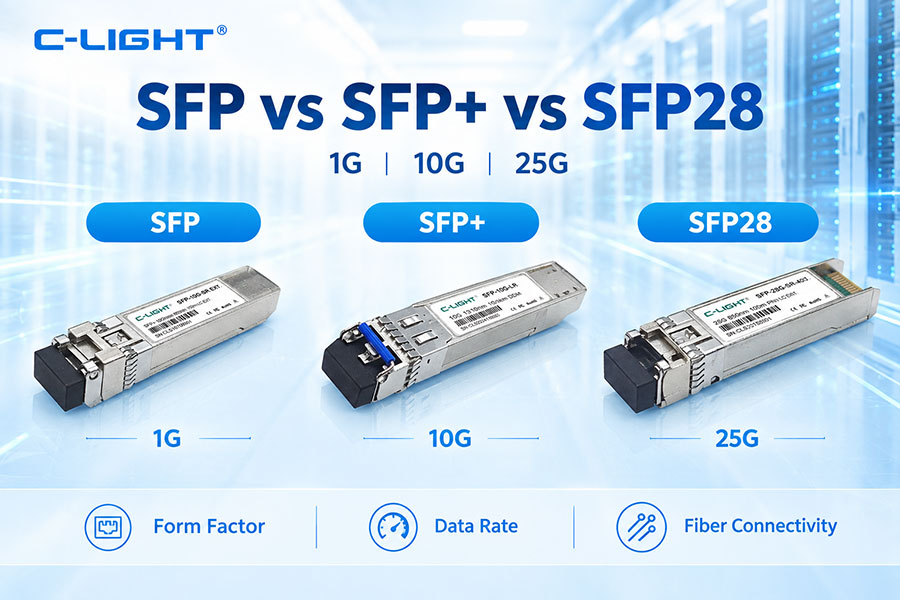
An SFP ONU integrates PON functionality into a compact pluggable module. This allows the PON interface to be installed directly into compatible network equipment.
A traditional standalone ONU is a complete device with its own power supply and customer-facing interfaces. The SFP approach can be useful when routing or switching functions are already provided by the host equipment.
In an FTTH network, the OLT is located on the provider side while the ONU or ONT is installed at the subscriber location.
The OLT provides centralized access control and connects the PON to the provider network. The ONU or ONT converts the fiber connection into services used by the home or business.
In an FTTB deployment, the OLT remains in the provider access network while the ONU can be installed inside a building or communication room.
The final connection from the ONU to individual users can then use Ethernet, copper, or another access technology depending on the design.
Enterprise PON deployments can use the OLT as a centralized access platform and ONUs as customer-side or building-side devices.
Enterprise services may require VLAN isolation, dedicated bandwidth profiles, higher upstream capacity, multiple Ethernet interfaces, or integration with existing switching and routing equipment.
For a network operator, OLT selection involves more than optical transmission. Port density, subscriber capacity, uplinks, redundancy, management, security, service provisioning, and compatibility with existing ONUs are all important.
ONU selection focuses more strongly on subscriber interfaces, optical budget, authentication, management, service functions, and compatibility with the deployed OLT platform.
Compatibility must be checked at several levels.
| Compatibility Item | What to Check |
|---|---|
| PON protocol | GPON, EPON, XG-PON, XGS-PON or another technology |
| Wavelength | Upstream and downstream optical wavelengths |
| Optical budget | Transmit power, receiver sensitivity and total link loss |
| Authentication | Serial number, password, registration and provisioning requirements |
| Management | Required management and configuration mechanisms |
| Service profile | VLAN, QoS and subscriber service configuration |
| Physical interface | Connector, fiber type and optical module format |
A common mistake is choosing an ONU only because its optical connector or module package physically fits the equipment.
Another mistake is comparing only nominal downstream speed while ignoring upstream capacity, optical budget, split ratio, authentication, management, and actual subscriber traffic requirements.
When a PON connection fails, troubleshooting should identify whether the problem is on the OLT side, optical distribution network, or ONU side.
Important checks include optical receive power, fiber continuity, connector cleanliness, splitter loss, ONU registration status, alarms, serial number configuration, VLAN provisioning, and PON protocol compatibility.
Modern access networks can evolve from GPON and EPON toward higher-speed technologies such as XG-PON, XGS-PON, and 10G-EPON.
During migration, the OLT, ONU, optical wavelengths, splitters, and management platform must be considered together. Some access architectures also support coexistence of multiple PON generations over the same outside-plant fiber through wavelength planning.
When selecting an OLT, evaluate the number of PON ports, supported PON technology, subscriber capacity, optical budget, supported split ratio, uplink capacity, management functions, redundancy, interoperability, and future upgrade requirements.
The OLT should also match the operator's existing network management and provisioning systems.
When selecting an ONU, first verify compatibility with the target OLT and PON standard.
Then check optical parameters, Ethernet interfaces, Wi-Fi or voice functions if required, operating temperature, authentication method, management features, and physical form factor.
The simplest way to understand the relationship is that the OLT manages the shared optical access network, while the ONU terminates that network at the customer or access edge.
The OLT is a multi-subscriber provider-side device. The ONU is normally a single-subscriber or local access-side device.
| Category | OLT | ONU |
|---|---|---|
| Network position | Provider side | Customer/access side |
| Primary role | Controls and aggregates PON traffic | Terminates PON and delivers user services |
| Connection model | One PON port serves multiple ONUs | Normally associated with one PON connection |
| Upstream control | Schedules shared upstream transmission | Transmits according to assigned opportunities |
| Interfaces | PON ports and network uplinks | PON optical port and user-facing interfaces |
| Management | Centralized PON and subscriber management | Local service functions and OLT-controlled management |
| Typical form | Chassis or rack-mounted access equipment | Standalone, gateway, SFP and compact devices |
OLT and ONU are complementary components rather than competing devices. The OLT sits on the provider side and centrally manages multiple optical network connections, while the ONU sits at the customer or access edge and converts the PON connection into usable network services.
The two devices must be matched according to the PON technology, optical budget, wavelength, authentication, management system, and service requirements. Understanding the different roles of the OLT and ONU is essential when designing FTTH, FTTB, enterprise PON, and other fiber access networks.
For any questions, please contact us by email or WhatsApp.
Email: sales@c-light.com
WhatsApp: +86 132 6656 7067