
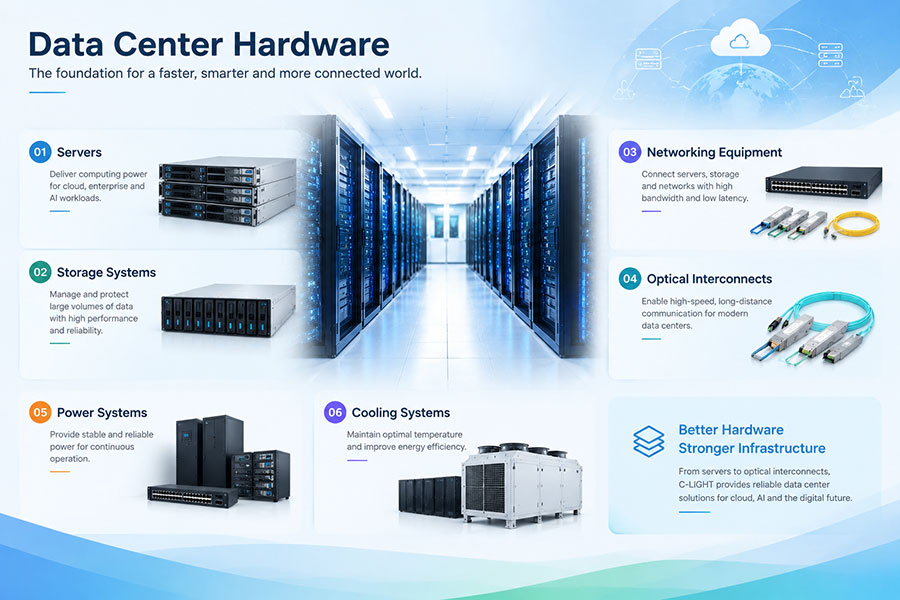
Data center hardware refers to the physical equipment used to build, operate, and maintain a data center environment. It includes computing servers, storage systems, networking devices, optical interconnect products, power systems, cooling equipment, and management platforms. Together, these hardware components provide the foundation for cloud computing, artificial intelligence workloads, enterprise applications, and global digital services.
As data traffic continues to grow, modern data centers are evolving from traditional server rooms into highly optimized infrastructure platforms. High-performance computing, AI training clusters, hyperscale cloud services, and edge computing all require advanced hardware solutions with higher bandwidth, lower latency, and improved energy efficiency.
A modern data center consists of multiple hardware layers. Each layer plays a specific role in processing, storing, transmitting, and protecting data.
Servers are the core computing hardware in a data center. They provide processing power for applications, databases, virtualization environments, and artificial intelligence workloads.
Traditional servers usually contain CPUs, memory modules, storage interfaces, and network adapters. However, AI and high-performance computing environments increasingly use servers equipped with GPUs, AI accelerators, and high-speed interconnect technologies.
Common server applications include:
Cloud computing platforms
Enterprise applications
Database processing
AI model training and inference
High-performance scientific computing
Storage hardware is responsible for saving and managing large volumes of data. Modern data centers use different storage architectures depending on performance, capacity, and reliability requirements.
Hard Disk Drives (HDDs): Used for large-capacity and cost-effective storage.
Solid State Drives (SSDs): Provide faster access speeds and lower latency.
NVMe Storage: Designed for high-performance applications requiring extremely fast data processing.
Storage Arrays: Combine multiple drives to improve reliability and scalability.
Networking hardware connects servers, storage systems, and external networks. It is one of the most important parts of modern data center infrastructure because increasing data volumes require faster and more efficient communication.
Typical network hardware includes:
Ethernet switches
Routers
Network interface cards (NICs)
Load balancers
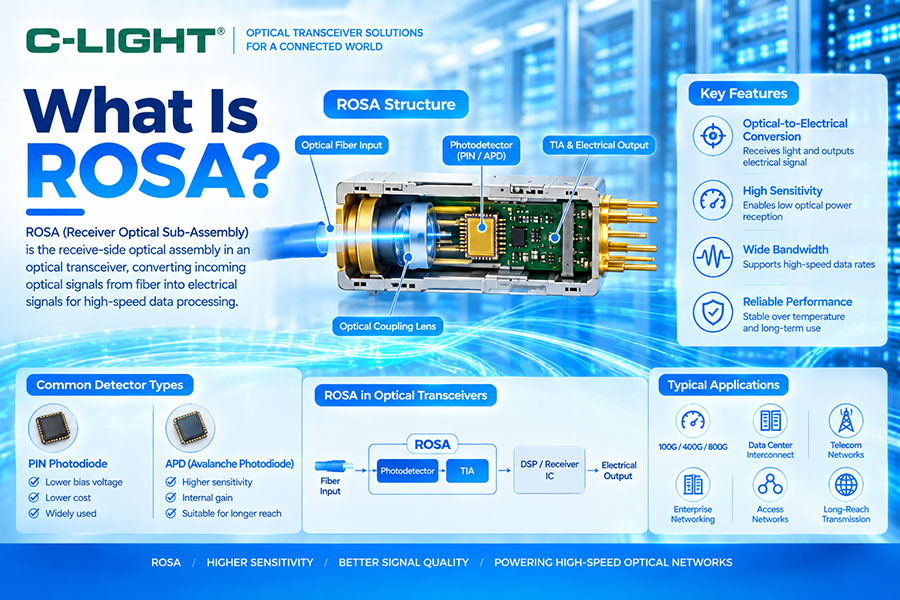
Optical transceivers
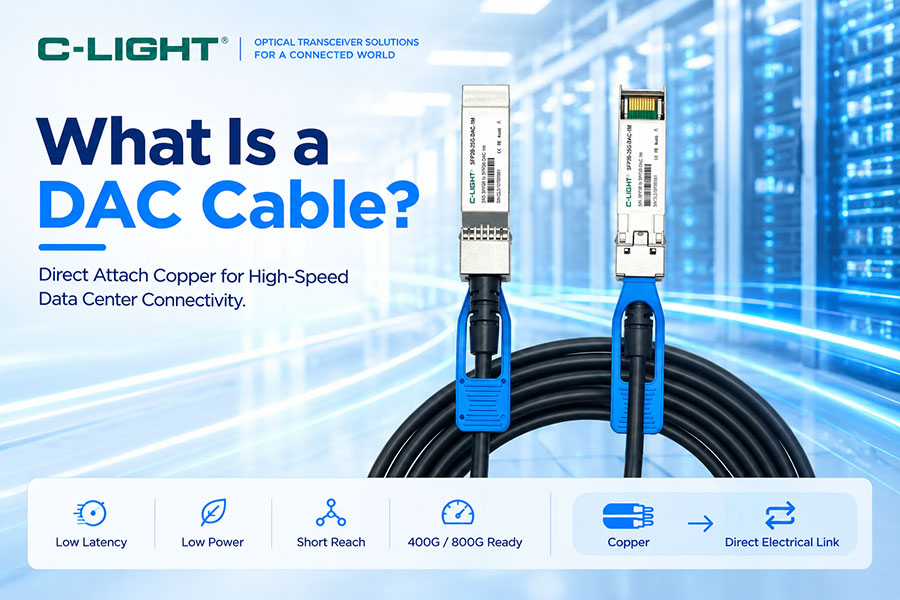
Direct Attach Copper (DAC) cables
Active Optical Cables (AOC)
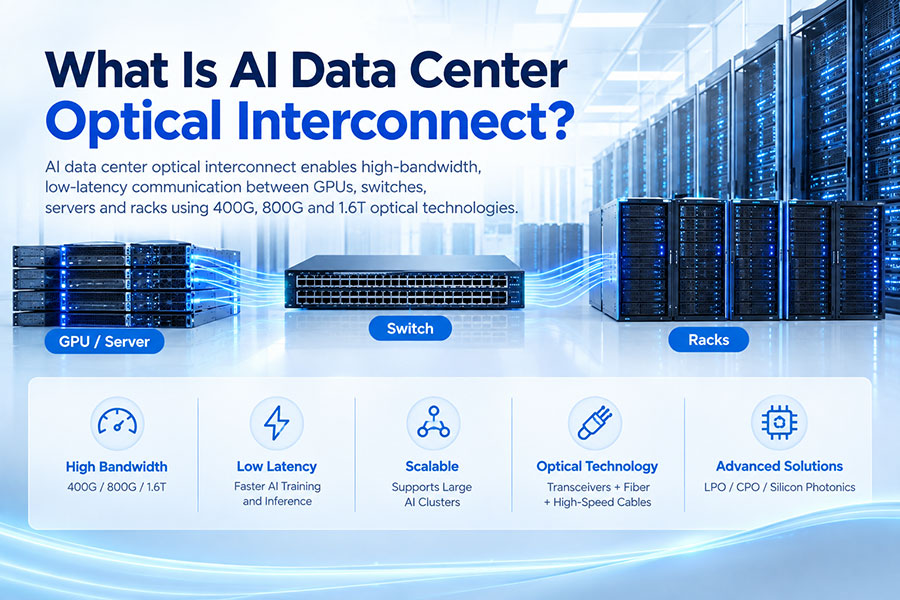
For AI data centers, network bandwidth has become a critical factor. Technologies such as 400G, 800G, and future 1.6T optical interconnect solutions are being adopted to support large-scale GPU clusters and distributed computing systems.
Optical interconnect hardware enables high-speed communication between servers, switches, and storage systems. As data center traffic continues to increase, optical technologies have become essential for achieving higher bandwidth and longer transmission distances.
Optical transceivers convert electrical signals into optical signals and transmit data through fiber optic cables. They are widely used in data center switches, servers, and network equipment.
Common data center optical transceiver types include:
100G QSFP28 optical modules
200G QSFP56 optical modules
400G QSFP-DD and OSFP optical modules
800G OSFP and QSFP-DD optical modules
1.6T optical modules for next-generation AI networks
DAC and AOC cables are widely used for short-distance connections inside data centers.
DAC cables provide a cost-effective solution for rack-level connections, while AOC cables offer longer reach and better flexibility through optical transmission.
| Technology | Main Application | Advantages |
|---|---|---|
| DAC Cable | Short-distance rack connections | Low cost, low power consumption |
| AOC Cable | Medium-distance data center links | Lightweight, flexible, EMI resistant |
| Optical Transceiver | Switch-to-switch and long-distance links | High bandwidth and long transmission distance |
Power delivery and thermal management are essential parts of data center hardware. As servers become more powerful, especially AI servers equipped with GPUs, energy consumption and heat generation have increased significantly.
Power-related hardware includes:
Uninterruptible Power Supplies (UPS)
Power Distribution Units (PDUs)
Backup generators
Power monitoring systems
These systems ensure stable electricity supply and protect critical computing equipment from unexpected power failures.
Cooling hardware maintains safe operating temperatures and improves equipment reliability.
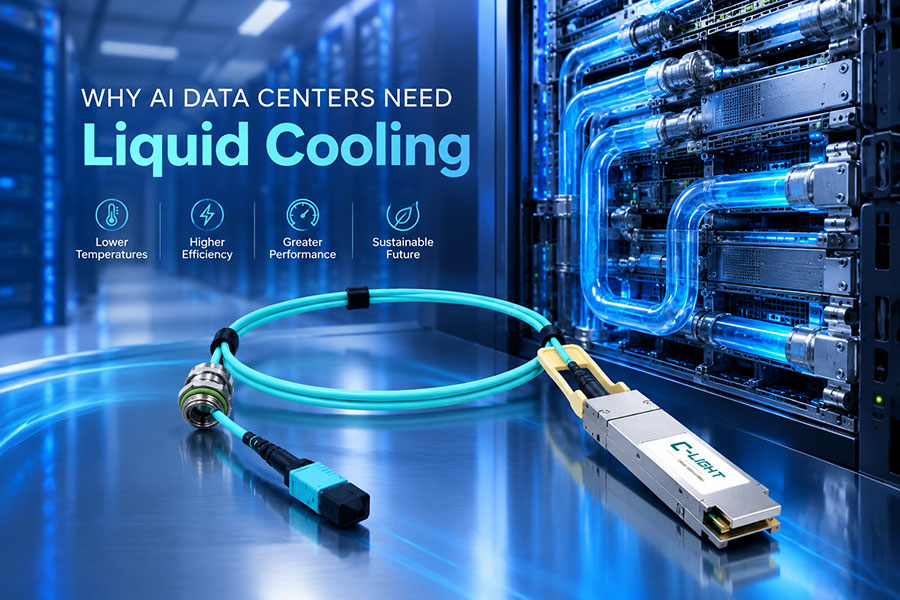
Traditional air cooling is still common, but high-density AI data centers increasingly adopt liquid cooling technologies because GPU servers generate significantly more heat than traditional computing systems.
Common cooling solutions include:
Air cooling systems
Cold plate liquid cooling
Immersion cooling
Advanced thermal management systems
Artificial intelligence is changing the design requirements of modern data centers. AI workloads require massive computing power, extremely high bandwidth, and low-latency communication between thousands of processors.
Modern AI data center hardware typically includes:
GPU servers
High-performance networking switches
400G/800G optical interconnects
High-speed storage systems
Advanced cooling infrastructure
Large AI clusters rely on efficient optical networking to connect GPUs, switches, and storage systems. Higher-speed optical modules and advanced interconnect architectures help reduce communication bottlenecks and improve overall cluster performance.
The future of data center hardware will focus on higher performance, lower power consumption, and greater scalability. Several technology trends are shaping the next generation of infrastructure.
With AI workloads growing rapidly, data centers are moving from 400G and 800G networking toward 1.6T optical solutions. Higher bandwidth optical modules will support larger AI clusters and future cloud computing requirements.
Artificial intelligence and automation technologies are being integrated into infrastructure management systems. Intelligent monitoring can optimize power usage, cooling efficiency, network performance, and equipment reliability.
Future data centers will continue improving energy efficiency through advanced processors, optimized networking hardware, renewable energy integration, and innovative cooling technologies.
Data center hardware is the foundation of modern digital infrastructure. From servers and storage systems to networking equipment, optical interconnects, power systems, and cooling solutions, every component works together to deliver reliable and high-performance computing services.
As cloud computing, artificial intelligence, and large-scale data processing continue expanding, next-generation data center hardware will require higher bandwidth, lower latency, improved efficiency, and advanced optical networking technologies.
Data center hardware refers to the physical equipment used in data centers, including servers, storage devices, networking equipment, optical interconnect products, power systems, and cooling infrastructure.
The main types include servers, storage systems, network switches, optical transceivers, cables, power equipment, and cooling systems.
Networking hardware enables communication between servers, storage systems, and external networks. High-speed networking improves data transfer efficiency and application performance.
Common optical products include optical transceivers, DAC cables, AOC cables, fiber optic cables, and high-speed 400G/800G optical solutions.
AI workloads require massive computing power, high bandwidth, and low latency communication, which require advanced servers, networking systems, and optical interconnect technologies.
AI data center hardware usually provides higher computing density, faster networking speeds, stronger cooling capability, and advanced accelerator support compared with traditional infrastructure.
Optical transceivers provide high-speed data transmission between network devices, supporting long-distance and high-bandwidth connections inside modern data centers.
Future trends include higher-speed optical networking, AI-driven management, improved energy efficiency, and advanced cooling technologies.
For any questions, please contact us by email or WhatsApp.
Email: sales@c-light.com
WhatsApp: +86 132 6656 7067