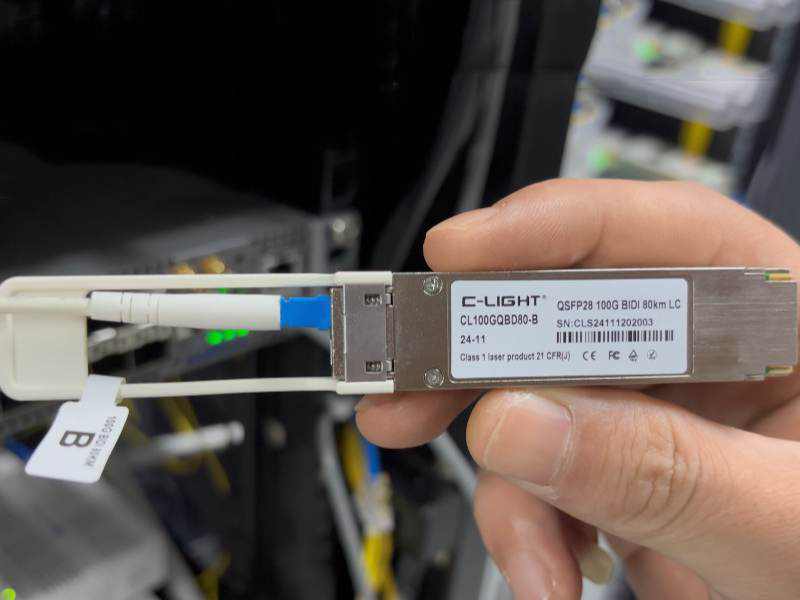
An XGS-PON OLT Stick is a compact pluggable module that integrates Optical Line Terminal (OLT) functions into an SFP+ form factor. It combines XGS-PON optical transmission and reception with PON protocol processing, scheduling, and control functions, allowing a compatible Ethernet switching or routing platform to provide optical access services without a conventional standalone OLT chassis.
Based on the ITU-T G.9807.1 XGS-PON standard, the technology supports nominal line rates of approximately 9.953 Gbps in both downstream and upstream directions. An OLT Stick uses this shared-fiber access technology to connect multiple Optical Network Units (ONUs) or Optical Network Terminals (ONTs) through a passive optical splitter.
Its main value is architectural: selected OLT functionality can be deployed at a switch, router, or edge networking location in a much smaller physical footprint. Actual deployment still depends on the module's electrical interface, host compatibility, management capabilities, and supported PON configuration.
1. How an XGS-PON OLT Stick Works
A conventional Ethernet optical transceiver mainly converts signals between the host's electrical interface and the optical fiber. An OLT Stick performs additional access-network functions. It handles PON transmission and reception, communicates with connected ONUs, and coordinates the upstream traffic that shares the PON channel.
In the downstream direction, Ethernet traffic enters through the host interface. The module processes the traffic according to its supported PON architecture and transmits the XGS-PON signal over the feeder fiber. A passive splitter distributes the signal to the connected ONUs or ONTs.
In the upstream direction, ONUs transmit in coordinated time slots assigned by the OLT. The OLT Stick receives these transmissions, processes the PON traffic, and forwards the resulting data toward the host interface. This scheduling is essential because multiple ONUs share the same upstream optical channel.
The host's Ethernet switching or routing functions remain important. The module does not automatically replace an entire network switch, router, service-management platform, or all the functions of a large carrier-grade OLT system.
2. Internal Architecture and Functional Integration
The integration of PON-specific functions distinguishes an OLT Stick from a standard SFP+ Ethernet transceiver. Depending on the design, its internal architecture may include the following elements.
| Functional Block | Role in the Module | Engineering Consideration |
|---|---|---|
| XGS-PON OLT MAC and protocol processing | Handles PON framing, ONU communication, upstream scheduling, and related protocol operations. | Must support the intended XGS-PON standard, ONU population, and required management features. |
| Optical transmitter | Transmits downstream data from the OLT toward the optical distribution network. | Optical wavelength, launch power, transmission quality, and the specified optical class must match the link design. |
| Optical receiver | Receives upstream bursts transmitted by connected ONUs. | Receiver sensitivity, overload limits, burst-mode performance, and optical budget affect link reliability. |
| Host electrical interface | Transfers data between the integrated OLT functions and the host platform. | The host and module must support compatible electrical signaling, port speed, and interface configuration. |
| Management and monitoring logic | May provide module diagnostics, alarm reporting, configuration, firmware functions, or ONU status information. | Control access and supported management methods vary by product and must be verified. |
| Power and thermal design | Supplies and manages power for the module's optical and processing components. | Host power availability, temperature limits, airflow, and port density affect operating stability. |
These functions are integrated in a compact enclosure, but the level of software and management integration differs by implementation. Some modules provide configurable PON parameters and detailed diagnostics; others are designed for a narrower deployment model. The relevant data sheet and management documentation determine what is actually available.
3. XGS-PON OLT Stick Technical Specifications
Because OLT Stick products are not all identical, the following table describes the XGS-PON technology and common product characteristics rather than a universal specification for every module.
| Parameter | Typical Specification or Requirement |
|---|---|
| PON technology | XGS-PON |
| Standard | ITU-T G.9807.1 |
| Nominal downstream line rate | 9.95328 Gbps |
| Nominal upstream line rate | 9.95328 Gbps |
| Module form factor | SFP+ for compatible implementations |
| Optical medium | Single-mode fiber |
| Common basic wavelength set | Downstream: 1575–1580 nm; upstream: 1260–1280 nm |
| Optical connector | Often SC/UPC or SC/APC; confirm the exact module specification |
| Typical advertised reach | Up to 20 km for many products, subject to optical budget and implementation |
| Supported ONUs | Depends on the OLT Stick model, software, optical budget, and PON configuration |
| Power consumption | Model-dependent; verify the maximum power requirement with the host platform |
The nominal line rate is the capacity of the PON interface, not a guaranteed 10 Gbps of usable traffic for each subscriber. Downstream capacity is shared across the ONUs connected to the same PON port. Upstream capacity is also shared and allocated through the PON scheduling mechanism.
The wavelength ranges above describe the basic XGS-PON wavelength set. XGS-PON also defines an optional wavelength set intended for specific coexistence scenarios. The correct choice depends on the existing optical distribution network and the equipment deployed at both ends.
4. XGS-PON OLT Stick vs. Traditional OLT
Both architectures can provide OLT-side PON functionality, but they target different equipment configurations and deployment scales.
| Feature | XGS-PON OLT Stick | Traditional OLT |
|---|---|---|
| Physical form | Compact pluggable module, typically SFP+ | Dedicated appliance, chassis, or integrated access platform |
| Host dependency | Requires a compatible switch, router, or other supported host platform | Typically provides its own system platform and management environment |
| PON port density | Usually deployed as a single integrated PON port per module | Can support multiple PON ports and higher aggregate capacity |
| Deployment footprint | Small and suitable for distributed or space-constrained installations | Requires space for dedicated equipment or a chassis |
| Management | Depends on module software and host integration | Often includes platform-level provisioning, alarms, and multi-port management |
| Typical fit | Small access networks, campus environments, enterprise edge, and selected remote sites | Large access networks, multi-port deployments, and centralized operator infrastructure |
An OLT Stick can reduce the need for a separate OLT chassis and dedicated equipment space. However, the total deployment cost also includes the host switch or router, module management, supporting software, installation, and ongoing maintenance.
For a network with many PON ports, high subscriber density, centralized provisioning, or advanced redundancy requirements, a traditional OLT may provide a more suitable system architecture. The choice should be based on port count, service scale, operational requirements, and total cost of ownership rather than module size alone.
5. OLT Stick vs. ONU Stick: The Functional Difference
OLT Stick and ONU Stick products have similar pluggable packaging, but serve opposite ends of the PON access link. Confusing the two can result in selecting a module that cannot perform the required network role.
| Parameter | OLT Stick | ONU Stick |
|---|---|---|
| Network role | OLT-side termination and control of the PON access link | Subscriber-side termination of the PON access link |
| Connection toward | Host switch or router on one side; passive optical network and ONUs on the other | PON network on one side; host device on the other |
| PON scheduling role | Coordinates upstream grants and manages ONU communication | Follows OLT scheduling and transmits in assigned upstream opportunities |
| Typical deployment | Provides compact OLT functionality at an access or aggregation point | Integrates subscriber-side optical access into compatible customer equipment |
| Compatibility requirement | Must interoperate with the intended ONU population and host platform | Must register with a compatible OLT and match the host and subscriber provisioning requirements |
An OLT Stick is not a direct replacement for an ONU Stick, and two modules of the same physical size are not necessarily interchangeable. The PON operating role, protocol implementation, host interface, and optical specifications must match the intended deployment.
6. Host Compatibility and System Integration
Although an OLT Stick uses an SFP+ package, a compatible cage alone does not guarantee that it will operate correctly. The host must support the module's electrical interface and data rate, while the module must be designed to work with the host's switching or routing architecture.
Before deployment, verify the following requirements:
Electrical interface: Confirm whether the module uses XFI or another supported interface and whether the host port supports the specified signaling mode.
Port and firmware support: Check the host vendor's module restrictions, port speed configuration, firmware requirements, and operating system or network software requirements.
Data path integration: Establish how Ethernet traffic is mapped between the host interface and the PON service, including any required VLAN handling, bridging, or routing configuration.
Module power and temperature: Verify available port power, module power consumption, ambient conditions, and airflow at the intended installation location.
Management access: Confirm how to configure the module and monitor its alarms, ONU registration, optical levels, and operating status.
A module may be mechanically compatible with an SFP+ slot while still failing to establish a usable data path. Compatibility testing should therefore include module recognition, electrical link establishment, PON synchronization, ONU registration, and end-to-end Ethernet traffic.
7. ONU Provisioning, Management and Traffic Control
Deploying the OLT Stick is only one part of bringing a PON network into service. The connected ONUs must be recognized and provisioned according to the module's supported management procedures and the service configuration.
A typical commissioning process includes:
ONU discovery and registration: The OLT identifies compatible ONUs and completes the required activation and ranging procedures.
Service provisioning: The operator or administrator assigns supported service profiles, VLAN mappings, traffic parameters, and quality-of-service settings.
Upstream scheduling: Bandwidth allocation is configured or managed according to available service controls and traffic demand.
Optical supervision: Receive power, alarms, link status, and other available diagnostics are checked to identify loss of signal or marginal optical performance.
Data-plane verification: Ethernet connectivity, VLAN behavior, expected throughput, and service separation are tested between the host and endpoint networks.
Not every OLT Stick supports the same provisioning features or exposes them through the same interface. Some implementations offer an integrated management interface, while others rely on supported host software, a vendor tool, or predefined operating settings. Confirm that the available controls are sufficient for the intended network operations.
8. Optical Budget, Split Ratio and Reach
Optical performance is a critical design consideration because an OLT Stick must communicate with multiple ONUs through a passive distribution network. The signal reaching each ONU is affected by feeder and distribution fiber attenuation, splitter loss, connector loss, splice loss, and any additional optical components in the path.
The XGS-PON standard defines optical interface classes and power-budget requirements. The basic wavelength-set deployment is associated with a nominal optical distribution network loss budget around 29 dB, while the optional wavelength set has a nominal budget around 28 dB. Other specified budget classes are available in the standard, but a particular OLT Stick may support only a subset of them.
| Design Parameter | Impact on the Network |
|---|---|
| Splitter ratio | Higher ratios increase the number of possible endpoints but raise optical splitting loss. |
| Fiber distance | Longer routes generally add attenuation and may reduce available link margin. |
| Connector and splice losses | Each optical connection and splice contributes to the total loss budget. |
| Optical interface class | Determines the applicable transmitter and receiver performance requirements and loss budget. |
| Coexistence components | Wavelength multiplexers and filters add loss and must be included in the optical calculation. |
| ONU population | Must remain within the module's supported registration capacity and overall network design limits. |
Some OLT Stick products advertise reaches of up to 20 km and support for specific ONU counts. These are product-level capabilities, not guarantees for every installation. The allowable split ratio, number of endpoints, route length, and available margin must be checked against the actual module specifications and the complete optical link budget.
Commissioning should check both receiver sensitivity and overload limits. Excessive loss may produce errors or loss of registration, while an optical signal above the receiver's allowed input range can also compromise operation.
9. Deployment Scenarios and Selection Criteria
The compact architecture is most useful when an installation needs PON access but does not require the port density or centralized control features of a larger OLT platform.
Enterprise and campus networks: An OLT Stick can add point-to-multipoint fiber access at a compatible edge switch, with passive splitters distributing connectivity to offices, buildings, or other endpoints.
FTTO and compact FTTx deployments: Fiber-to-the-Office and selected smaller access deployments can benefit from the reduced space and separate-equipment requirements of an integrated module.
Remote and edge sites: Locations with limited rack space may use a compatible switch or router as the host platform, subject to environmental, power, and management requirements.
Private optical access networks: Industrial parks, campuses, and commercial sites can consider this design when the required number of PON ports and subscriber services fit the module's capabilities.
When evaluating a product, compare its standard compliance, supported host interfaces, optical class, split ratio, ONU capacity, management model, temperature range, power consumption, and interoperability evidence. For larger networks, also assess redundancy, centralized provisioning, monitoring integration, and long-term support.
10. Conclusion
An XGS-PON OLT Stick integrates OLT-side optical transmission, PON protocol processing, and control functions into a compact SFP+ module. It can enable a compatible switch or router to provide shared-fiber access at enterprise, campus, and distributed edge locations, reducing the need for a separate OLT chassis in suitable deployments.
Its practical value depends on more than the 10G-class line rate or pluggable form factor. Host electrical compatibility, ONU provisioning, optical power budget, splitter configuration, management functions, and interoperability must all be validated. For compact access deployments, an OLT Stick can offer a flexible alternative; for large multi-port networks, a traditional OLT may remain the better fit.
11. Q&A
Q1: What is the main function of an XGS-PON OLT Stick?
Answer: It integrates OLT-side PON processing and optical functions into a pluggable module, enabling a compatible host platform to connect multiple XGS-PON ONUs through a passive optical distribution network.
Q2: Is an XGS-PON OLT Stick a standard 10G Ethernet transceiver?
Answer: No. Although it may use an SFP+ package, it includes PON-specific protocol functions that a conventional Ethernet optical transceiver does not provide. Host-interface and software compatibility must be verified.
Q3: How many ONUs can one OLT Stick support?
Answer: The supported ONU count depends on the module's hardware, software, optical budget, and product specification. A stated registration capacity should not be treated as a guarantee that every ONU can operate at full line rate simultaneously.
Q4: Can an XGS-PON OLT Stick work in any SFP+ port?
Answer: No. The port must support the module's electrical interface, signaling rate, power requirements, and operating configuration. Mechanical compatibility alone does not ensure a working Ethernet-to-PON data path.
Q5: What is the difference between an OLT Stick and an ONU Stick?
Answer: An OLT Stick performs the provider-side PON termination and coordinates connected ONUs. An ONU Stick performs subscriber-side PON termination and must register with a compatible OLT.
Q6: Does an OLT Stick always support a 20 km link?
Answer: No. A 20 km reach is common in product specifications, but actual reach depends on the module's optical class, fiber losses, splitter ratio, connectors, coexistence components, and the ONUs used at the endpoints.
Q7: When should a traditional OLT be selected instead?
Answer: A traditional OLT may be preferable when a network requires many PON ports, high subscriber density, centralized provisioning, advanced redundancy, or broader carrier-grade operational functions.