1.Introduction
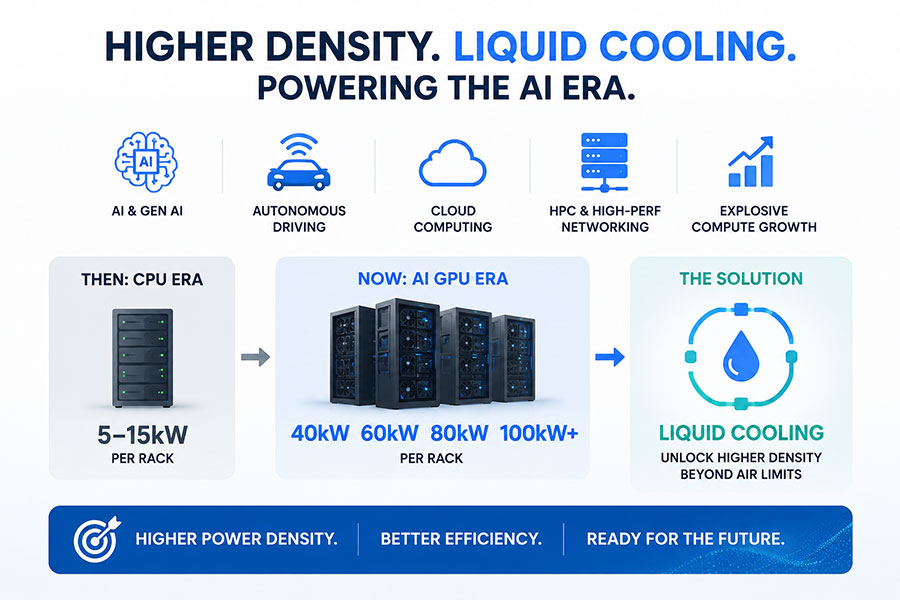
The rapid rise of large AI models, generative AI, autonomous driving, cloud computing, and high-performance computing (HPC) is pushing global data centers into an era of unprecedented computing density.
AI training clusters, GPU supercomputing platforms, cloud AI infrastructure, high-performance networking, and large-scale inference systems now demand far greater power density than traditional enterprise workloads.
In the CPU server era, a typical rack consumed approximately 5kW to 15kW. Today, AI GPU clusters frequently exceed 40kW, 60kW, 80kW, and even 100kW+ per rack. Under these conditions, traditional air-cooling approaches are approaching their physical limits, making liquid cooling one of the most important technology upgrades for next-generation AI data centers.
2.Why Must AI Data Centers Adopt Liquid Cooling?
GPU Power Consumption Continues to Increase
Modern AI infrastructure relies heavily on GPUs, AI accelerators, TPUs, and high-performance switching ASICs.
The power consumption of next-generation AI GPUs has evolved from:
to 1000W+ TDP designs.
As thousands of GPUs are densely deployed within AI clusters, heat generation increases dramatically.
Traditional air cooling faces several limitations:
Because liquids conduct heat significantly more efficiently than air, liquid cooling has become the preferred solution for high-density AI computing environments.
3.Main Types of Liquid Cooling Technologies
3.1Cold Plate Liquid Cooling
Cold plate cooling is currently the most widely adopted liquid cooling architecture in AI data centers.
The technology uses cold plates attached directly to GPUs, CPUs, and ASICs. Coolant circulates through the system and removes heat at the source.
Advantages
Typical Applications
3.2 Immersion Cooling
Immersion cooling submerges entire servers in dielectric cooling fluids.
Advantages
Challenges
More complex operations and maintenance
Higher initial investment
Stricter compatibility requirements
Typical Applications
Large-scale AI supercomputing centers
Ultra-high-power GPU clusters
Future exascale computing systems
3.3 Spray Cooling
Spray cooling dissipates heat by spraying coolant directly onto chips.
Advantages
Although promising, spray cooling is currently being explored primarily in specialized high-performance applications.
4.Key Changes in the Liquid Cooling Era
4.1 From Server Cooling to System-Level Thermal Management
Traditional data centers focused on:
Air conditioning
Airflow management
Room temperature control
Liquid-cooled facilities increasingly emphasize:
Thermal circulation architecture
Coolant Distribution Units (CDUs)
Liquid piping systems
Heat recovery systems
Chip-level cooling efficiency
As a result, data centers are evolving from pure IT infrastructure into comprehensive thermal management systems.
4.2 Network Interconnects Become Even More Critical
AI data centers require not only computing power but also:
This demand is accelerating the deployment of:
400G networking
800G networking
1.6T networking
Within liquid-cooled environments, high-speed interconnect products face new requirements:
5.High-Speed Optical Interconnects Become Core Infrastructure
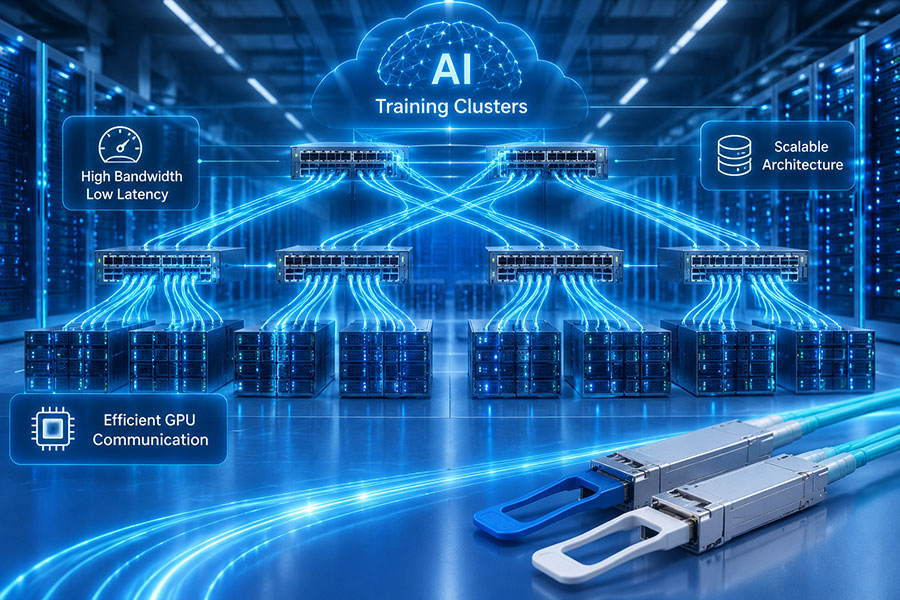
In modern AI clusters, network bandwidth is becoming nearly as important as computing performance itself.
This is particularly true in:
GPU Scale-Out Networks
Spine-Leaf Architectures
AI Fabrics
RDMA and RoCE Networks
High-speed interconnect technology directly impacts AI cluster efficiency.
6.Optical Transceivers
Applications include:
400G Ethernet
800G Ethernet
InfiniBand
AI backbone networks
Benefits
Active Optical Cables (AOC)
Applications include:
Benefits
Lightweight design
Excellent EMI immunity
Flexible deployment
DAC and AEC
Applications include:
Benefits
Lower cost
Lower power consumption
High reliability
7.C-LIGHT's High-Speed Interconnect Portfolio for Liquid-Cooled AI Data Centers
As a provider of high-speed optical communication solutions, C-LIGHT continues to expand its AI-focused interconnect portfolio.
Product Portfolio
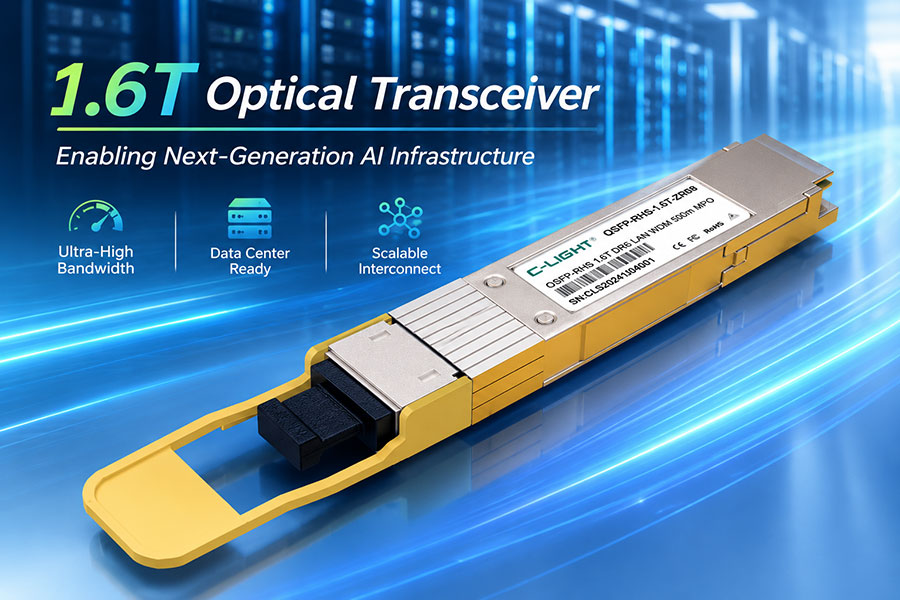
1.6T OSFP DAC AEC
800G OSFP DAC AEC
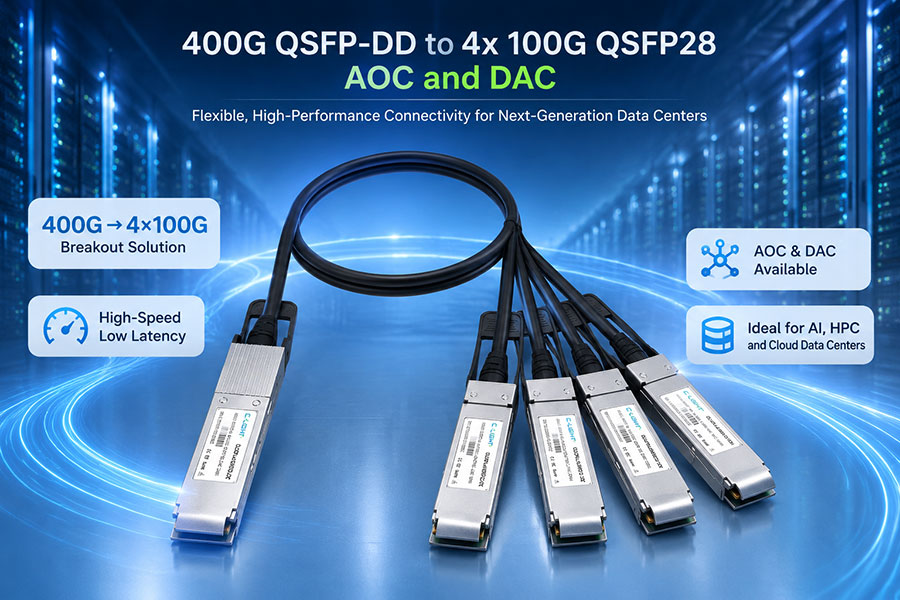
400G QSFP-DD DAC AEC
400G OSFP DAC AEC
400G QSFP112 DAC AEC
400G QSFP-DD ER4
400G QSFP-DD DCO High Power
100G Liquid Immersion Transceiver
25G Liquid Immersion Transceiver
Target Applications
Reliability Validation
To ensure long-term stability in liquid-cooled environments, products undergo:
8.Future Trends in Liquid-Cooled Data Centers
8.1 Increasing Liquid Cooling Adoption
Liquid cooling will continue to gain market share and gradually become the dominant cooling architecture for large-scale AI computing facilities.
8.2 Rapid Growth of 800G and 1.6T Networking
As GPU cluster sizes continue to expand, network bottlenecks will become increasingly critical.
Future AI data centers will accelerate adoption of:
8.3 Sustainability Becomes a Core Objective
Liquid cooling not only improves thermal efficiency but also helps reduce:
PUE
Energy consumption
Carbon emissions
This makes it a key technology for building greener and more sustainable AI infrastructure.
9.Conclusion
The era of large AI models is reshaping global data center architecture.
As GPU power consumption continues to rise, traditional air-cooling systems can no longer efficiently support future ultra-high-density computing environments. Liquid cooling is rapidly becoming a foundational technology for next-generation AI data centers.
At the same time, 400G, 800G, and 1.6T high-speed optical interconnects are emerging as critical infrastructure components within liquid-cooled AI clusters.
In the years ahead, Liquid Cooling + High-Speed Interconnects + AI Computing Power will form the foundation of the next generation of intelligent data centers.
10.Frequently Asked Questions (FAQ)
Q1. Why are AI data centers adopting liquid cooling?
Answer: AI workloads require large-scale GPU deployments with rack power often exceeding 40kW–100kW+. Liquid cooling provides significantly higher heat-transfer efficiency than air cooling, enabling better thermal management, lower energy consumption, and improved system reliability.
Q2. What is the difference between cold plate cooling and immersion cooling?
Answer: Cold plate cooling removes heat through liquid-cooled plates attached to CPUs, GPUs, and ASICs, while immersion cooling submerges entire servers in dielectric fluid. Cold plate solutions are easier to deploy, whereas immersion cooling offers higher cooling efficiency for ultra-high-density computing environments.
Q3. Why are 800G and 1.6T interconnects important for AI data centers?
Answer: Large AI clusters require massive east-west traffic between GPUs, storage systems, and switches. 800G and 1.6T networking provide the bandwidth and low latency necessary to eliminate communication bottlenecks and maximize AI training efficiency.
Q4. What optical interconnect products are commonly used in liquid-cooled AI data centers?
Answer: Common solutions include optical transceivers, AOCs, DACs, and AECs. These products support high-bandwidth, low-latency connectivity across GPU clusters, cloud infrastructures, HPC networks, and AI fabrics.
Q5. How does liquid cooling support green data center initiatives?
Answer: Liquid cooling improves cooling efficiency, lowers PUE, reduces overall power consumption, and helps decrease carbon emissions, making it a key technology for sustainable and energy-efficient AI infrastructure.