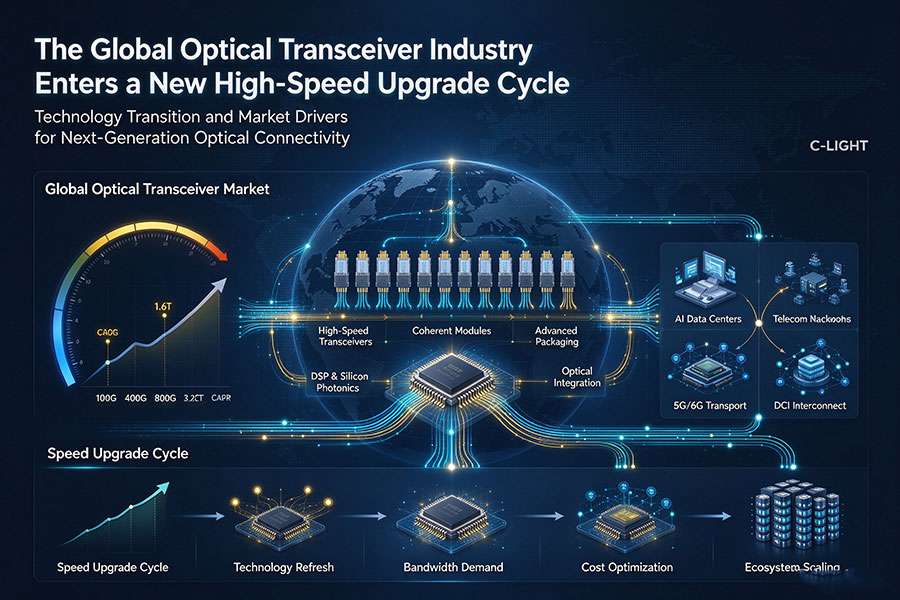
The optical interconnect market is entering a new upgrade cycle as AI computing, hyperscale cloud infrastructure and high-performance networking push data center bandwidth requirements beyond the capabilities of earlier generations. The transition from 400G to 800G is already reshaping network procurement, while 1.6T optical interfaces are moving into product qualification and early commercial deployment. This shift involves more than increasing transmission speed: it is changing optical component design, electrical interfaces, packaging methods, power budgets and the way data center networks are built.
1. Market Drivers Behind the Optical Interconnect Upgrade
Demand for optical interconnects is closely connected to the expansion of distributed computing. AI training and inference systems rely on large numbers of accelerators, high-performance switches and storage resources communicating across dense network fabrics. As cluster sizes increase, the volume of east-west traffic between servers and accelerator systems rises substantially.
Electrical connections remain practical for many short-reach applications, particularly inside servers and within tightly integrated systems. However, longer electrical channels become increasingly difficult to manage as data rates and port densities increase. Signal attenuation, equalization requirements, electromagnetic interference and power consumption all influence the achievable reach and system design.
Optical connectivity addresses these constraints by transmitting data through fiber over distances that are difficult to support economically with conventional copper links. It also supports high port density and electromagnetic immunity, making it important for connections between network switches, racks and data center facilities.
Several factors are contributing to the current market transition:
AI infrastructure investment: Large accelerator clusters require high-capacity connections between servers and network switches.
Switch bandwidth growth: Higher-capacity switching platforms require faster optical interfaces to avoid network bottlenecks.
Increasing port density: Data center operators need more bandwidth within limited rack space and equipment footprints.
Power efficiency requirements: Optical module power becomes a significant consideration as the number of high-speed ports increases.
Cloud and DCI expansion: Distributed infrastructure creates demand for both short-reach data center optics and longer-reach optical transport.
2. The Market Position of 400G Optical Interconnects
400G optical connectivity represents an important generation in the transition from 100G and 200G data center networks toward higher-capacity switching architectures. It has become an established option across hyperscale data centers, cloud infrastructure and enterprise environments that require substantial bandwidth without moving immediately to 800G.
400G products are available in multiple form factors and optical configurations. QSFP-DD and OSFP are common module platforms, while the optical interface can be designed for multimode or single-mode fiber, depending on reach and network requirements.
| 400G Interface | Typical Application | Transmission Medium | Design Consideration |
|---|---|---|---|
| 400G SR8 | Short-reach data center links | Multimode fiber | Parallel optical lanes and MPO connectivity |
| 400G DR4 | Rack-to-rack and data center connections | Single-mode fiber | Four parallel optical channels |
| 400G FR4 | Medium-reach data center links | Single-mode fiber | Wavelength multiplexing over duplex fiber |
| 400G LR4 | Longer-reach campus and data center links | Single-mode fiber | WDM transmission and optical link budget |
The continued presence of 400G is commercially significant. Not every data center upgrades all network layers simultaneously. Existing switch generations, installed fiber infrastructure, equipment replacement cycles and application requirements can keep 400G in service even as newer platforms adopt 800G.
For equipment suppliers, 400G therefore remains relevant to production continuity, replacement demand and multi-generation network deployments. Its role is increasingly determined by the economics and lifecycle of the installed network rather than by peak interface speed alone.
3. 800G Becomes a Major Growth Generation
800G optical interconnects are gaining importance as AI data centers move toward higher-capacity switch fabrics. Compared with 400G, an 800G interface can provide twice the nominal port bandwidth, helping operators increase network capacity without simply doubling the number of physical ports.
Common 800G implementations use eight high-speed electrical lanes, often based on approximately 100G-class signaling per lane. The optical implementation depends on the application and can use parallel optics or wavelength-division multiplexing.
| 800G Optical Type | Fiber Type | Typical Link Configuration | Application Focus |
|---|---|---|---|
| 800G SR8 | Multimode | Parallel optical transmission | Short-reach data center connectivity |
| 800G DR8 | Single-mode | Eight parallel optical lanes | High-density data center fabrics |
| 800G 2DR4 | Single-mode | Two groups of four optical lanes | Short-reach single-mode links |
| 800G 2FR4 | Single-mode | Wavelength-multiplexed transmission | Duplex-fiber data center links |
The move to 800G also increases the importance of host electrical performance, thermal management and module power. A transceiver must operate within the electrical interface, firmware, optical budget and thermal limits of the host platform. A matching data rate or form factor alone does not guarantee interoperability.
As a result, qualification increasingly involves complete system testing, including switch compatibility, signal integrity, error performance, temperature behavior and link stability under operating conditions.
4. The Transition Toward 1.6T Optical Interfaces
1.6T represents the next major bandwidth step for high-density data center networking. It is particularly relevant to emerging switch platforms and AI fabrics where the number of high-speed connections continues to increase.
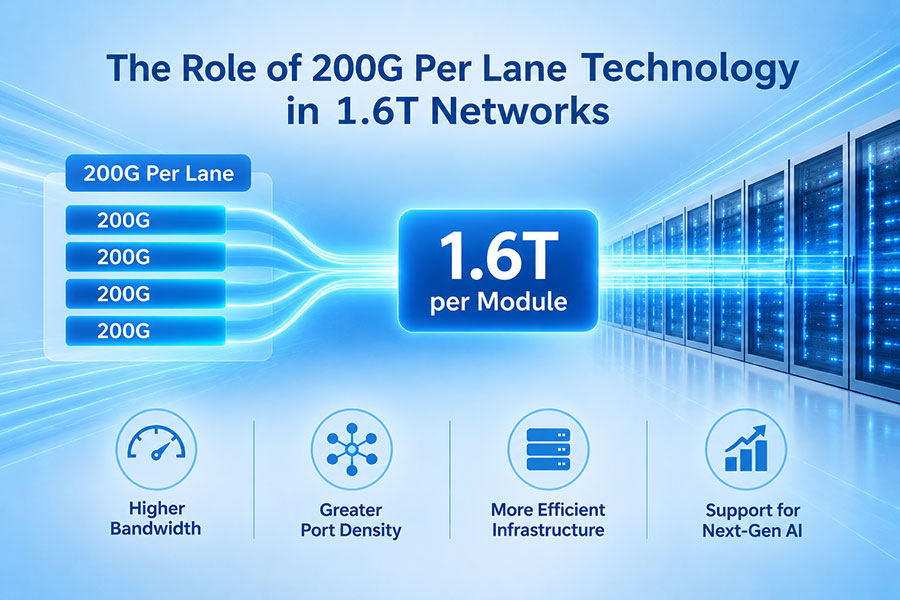
Many 1.6T designs are based on eight electrical lanes operating at approximately 200G-class signaling per lane. This places greater demands on SerDes technology, DSP performance, optical modulation, packaging and high-speed electrical design. Exact lane configurations and optical implementations depend on the module standard and product architecture.
Several engineering challenges influence the transition:
Higher electrical signaling rates: Host interfaces and module electronics must maintain signal integrity at faster lane speeds.
Optical component performance: Lasers, modulators, photodetectors and optical coupling components must support the required bandwidth and link budget.
DSP development: Signal processing must manage distortion and channel impairments while meeting power and thermal limits.
Thermal constraints: Higher module bandwidth can increase heat density, requiring careful system-level cooling design.
Manufacturing yield: Advanced photonic integration and packaging require consistent assembly, alignment and test processes.
Commercial adoption will depend on more than the availability of a 1.6T module. Compatible switches, host electrical interfaces, optical components, firmware and network design must mature together. Consequently, early product qualification and initial deployments do not mean that every 800G network will immediately migrate to 1.6T.
5. 400G, 800G and 1.6T: How the Generations Differ
The three generations represent different stages in data center capacity planning. Their coexistence is likely to continue as operators upgrade network segments according to equipment lifecycle, application demand and deployment economics.
| Category | 400G | 800G | 1.6T |
|---|---|---|---|
| Market position | Established deployment | Rapidly expanding generation | Early commercial deployment and qualification |
| Typical electrical lane architecture | Often 8 × 50G-class or 4 × 100G-class, depending on design | Commonly 8 × 100G-class | Commonly 8 × 200G-class |
| Module platforms | QSFP-DD, OSFP | QSFP-DD, OSFP | OSFP and emerging platform-specific designs |
| Key engineering focus | Cost, reach and installed-base compatibility | Port density, power and signal integrity | 200G-class lanes, thermal design and photonic integration |
| Deployment considerations | Existing network upgrades and capacity expansion | AI cluster and high-capacity switching fabrics | Next-generation switching and high-density AI infrastructure |
The lane configurations in this table are representative rather than universal. Actual implementations must be checked against the relevant IEEE, OIF or MSA specifications and the manufacturer's product documentation.
One important market characteristic is that a higher data rate does not automatically replace every lower-speed connection. Network architecture, link distance, fiber availability, switch port configuration and total cost of ownership all influence the choice.
6. Silicon Photonics and the Evolution of Optical Components
Silicon photonics is becoming an important technology platform for high-speed optical interconnects. It integrates selected photonic functions on silicon-based chips and can combine optical waveguides, modulators, couplers and other structures with electronic components or external laser sources.
As module bandwidth increases, silicon photonics offers opportunities to improve integration density and support repeatable manufacturing processes. It is particularly relevant to parallel optical architectures and emerging 800G and 1.6T designs.
However, silicon photonics does not eliminate all optical component requirements. Depending on the architecture, systems may still require external lasers, optical fiber arrays, photodetectors, drivers, DSPs, thermal control and precision packaging.
Indium phosphide (InP) technologies also remain important, especially for laser sources and certain high-performance optical functions. The market is therefore not simply moving from one material to another. Different photonic platforms can coexist according to wavelength, reach, performance, integration and manufacturing requirements.
7. LPO, NPO and CPO: Changes in Optical Integration
Increasing bandwidth places pressure on the electrical path between switching ASICs and optical interfaces. This has encouraged the development of architectures that reduce electrical signal travel distance or change how signal processing is distributed.
Linear Pluggable Optics (LPO)
LPO reduces or removes conventional DSP-based retiming inside the optical module in suitable system designs. This can lower module power and latency, but it places greater responsibility on the host electrical interface and system-level signal integrity. The approach requires careful matching between the switch ASIC, electrical channel and optical module.
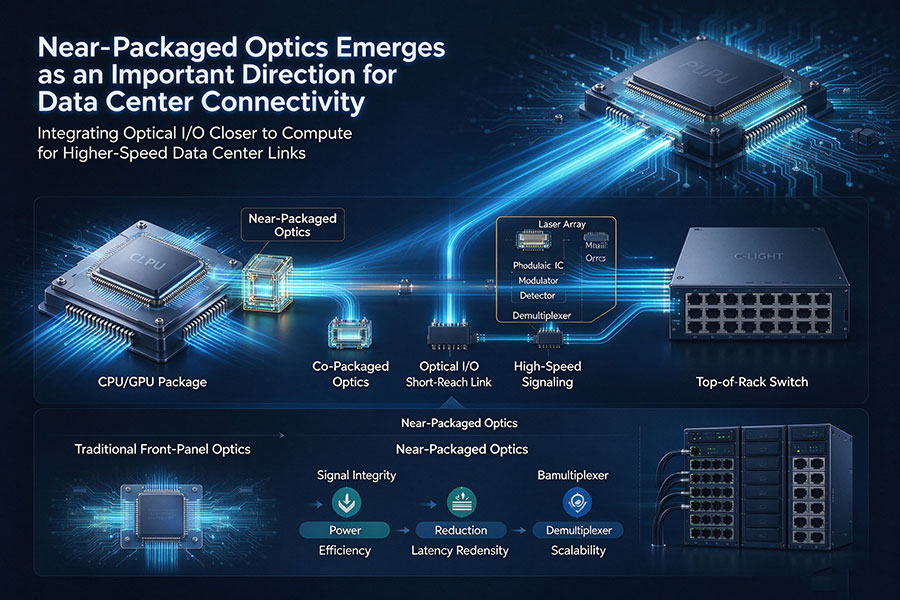
Near-Packaged Optics (NPO)
NPO places optical engines close to the host switch or processor package, while retaining a degree of separation from the main ASIC package. Shorter electrical connections can help address bandwidth-density and power challenges, although serviceability and packaging complexity require attention.
Co-Packaged Optics (CPO)
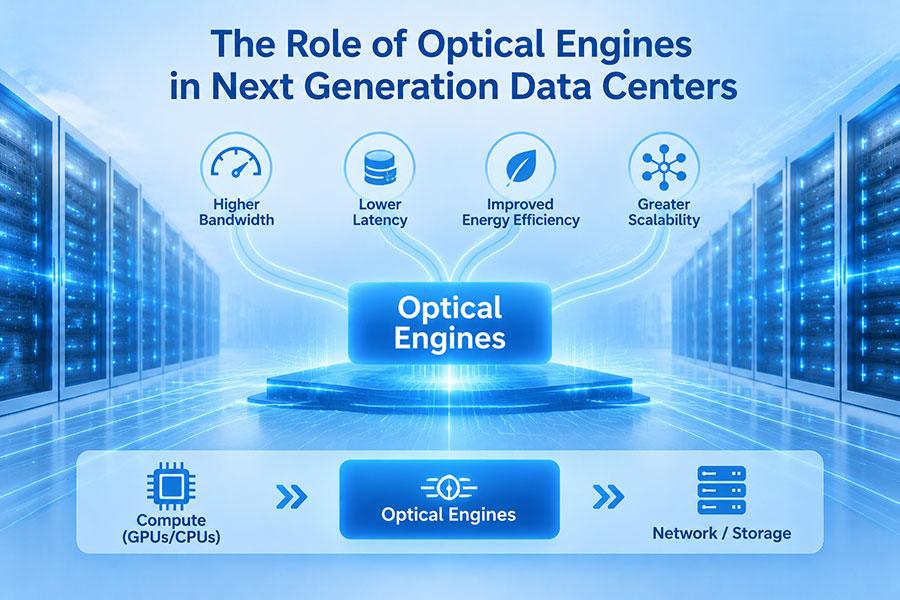
CPO integrates optical engines much closer to, or within the same package assembly as, the switching ASIC. The architecture can reduce high-speed electrical trace lengths and support very high aggregate bandwidth. It also changes system maintenance, thermal design, laser delivery and manufacturing requirements.
These approaches should not be treated as interchangeable products. Pluggable optics, LPO, NPO and CPO serve different system architectures. Their commercial adoption will depend on reliability, operational flexibility, total system cost and the ability to maintain equipment at scale.
8. Optical Interconnects and AI Data Center Architecture
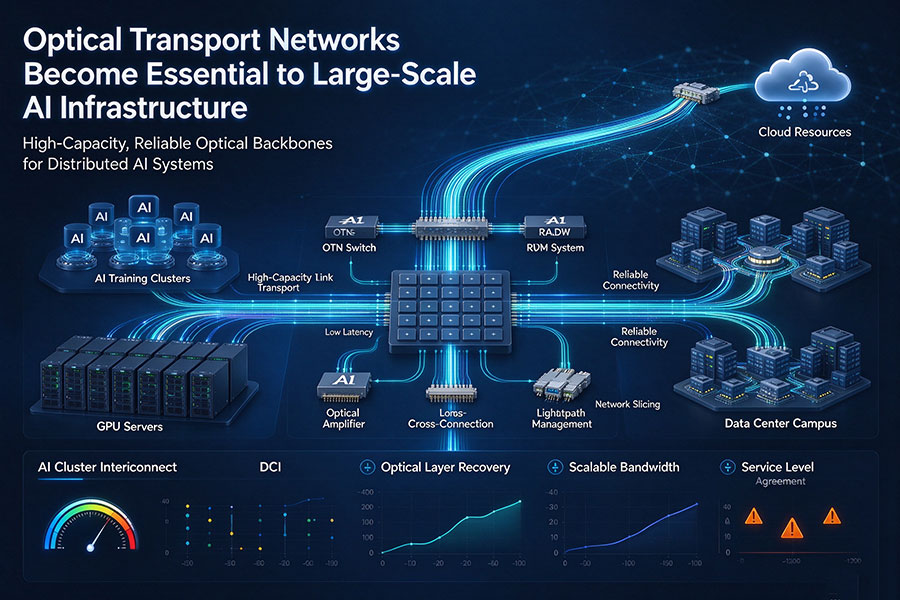
AI data center networks commonly contain multiple communication domains. The scale-up network connects tightly coupled accelerators within a system or rack. The scale-out network connects servers and racks through high-capacity switching fabrics. Scale-across connectivity links separate facilities or geographically distributed data center resources.
Optical interconnects have a particularly important role in scale-out networks, where connections between racks and switches require high bandwidth over distances that exceed practical passive copper reach. They are also relevant to scale-across applications, where coherent optics and dense wavelength-division multiplexing can support high-capacity data center interconnects.
Within scale-up systems, copper and specialized electrical interconnects remain widely used in many architectures. Optical approaches are being developed for selected high-bandwidth and longer-reach connections, but their adoption depends on platform design and system requirements.
Network designers must therefore select the optical interface according to the communication domain rather than assuming that every connection in an AI facility requires the same transceiver generation.
9. Power Consumption and Thermal Management
Power efficiency is one of the most important considerations in the transition from 400G to 1.6T. A higher-speed module may deliver more bandwidth per port, but its electrical and optical components must operate within the thermal limits of the switch or server.
At the system level, total optical power is influenced by the number of modules, module power consumption, cooling overhead and the distribution of connections across equipment. A data center with thousands of high-speed optical ports can experience substantial cumulative power demand even when each individual module operates within its rated specification.
Key engineering considerations include:
Module power consumption under typical and maximum operating conditions.
Airflow direction, heatsink design and thermal interaction between adjacent ports.
Operating temperature at the module case and within the host equipment.
Optical performance stability across the specified temperature range.
Cooling capacity and service access in high-density switch systems.
Power efficiency should be evaluated at both the module and system levels. A lower-power optical module may provide benefits, but its value depends on compatibility, link performance, cooling requirements and the complete network architecture.
10. Supply Chain and Manufacturing Challenges
The transition to higher-speed optical interconnects is increasing demand for advanced optical and electronic components. These include laser chips, photodetectors, DSPs, high-speed drivers, optical subassemblies, fiber arrays and precision packaging materials.
Manufacturing capacity is not determined by transceiver assembly alone. A shortage or yield issue in a specialized laser, DSP or photonic component can affect the output of an entire product family. As the industry moves toward 200G-class electrical lanes, component performance and manufacturing consistency become increasingly important.
Production qualification also becomes more demanding. High-speed modules require testing across electrical performance, optical output, receiver sensitivity, extinction ratio, wavelength, error rate, power consumption and thermal behavior. Automated test systems and repeatable manufacturing processes are essential for supporting volume production.
Supply-chain resilience is consequently becoming a competitive factor. Optical manufacturers and equipment suppliers need qualified component sources, stable production processes and sufficient testing capacity to support customers through successive speed generations.
11. Market Outlook: Coexistence of Multiple Speed Generations
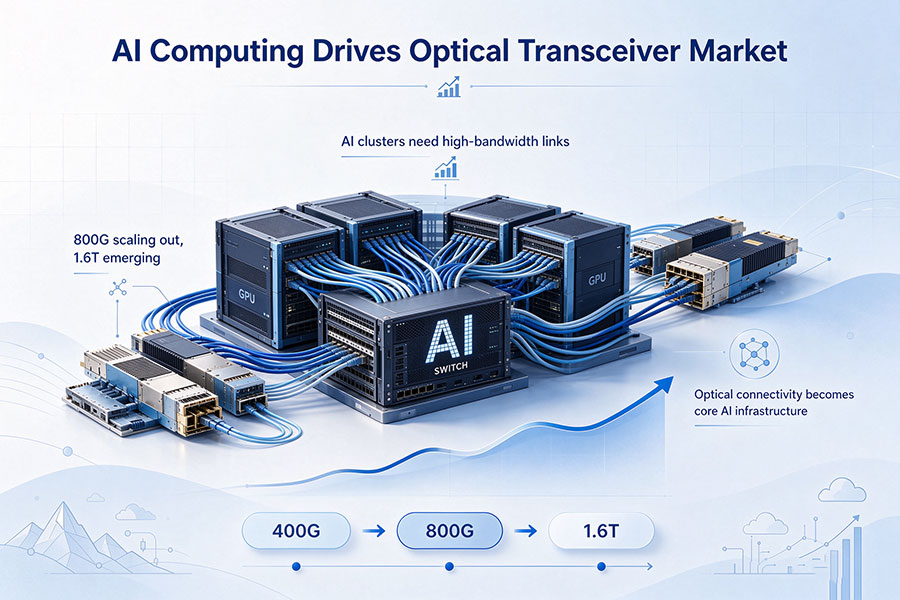
Market research published in 2026 points to strong growth in AI-related optical transceiver demand, particularly for 800G and higher-speed products. TrendForce estimated that the AI-focused optical transceiver market could grow from US$16.5 billion in 2025 to US$26 billion in 2026. This is an analyst projection, not a confirmed final market result, and its scope should not be confused with the entire optical interconnect industry.
Industry commentary also indicates that 1.6T production is expected to gain momentum during the second half of 2026. Actual shipment volumes will depend on host-platform availability, component supply, qualification schedules and manufacturing yields.
Over the next several years, the market is likely to develop along several parallel paths:
400G: Continues to support installed infrastructure, enterprise networks and upgrades where a complete move to 800G is not economically justified.
800G: Gains wider adoption in high-capacity data center switching and AI cluster networks.
1.6T: Expands as compatible switch platforms, 200G-class electrical lanes and optical components become more mature.
Silicon photonics: Gains relevance in high-density optical integration and selected pluggable and co-packaged architectures.
Coherent optics: Supports growing bandwidth requirements in data center interconnect and longer-reach applications.
These developments will not occur at the same pace across all regions and customer segments. Hyperscale operators, telecom carriers, colocation providers and enterprise data centers have different infrastructure lifecycles and investment priorities.
12. What Buyers and Network Designers Should Evaluate
Choosing an optical interconnect requires more than selecting the highest available data rate. A technically suitable product must match the host equipment, transmission distance, fiber plant and operational requirements.
| Evaluation Area | Key Questions |
|---|---|
| Host compatibility | Does the switch or server support the module form factor, data rate, lane mapping and firmware requirements? |
| Transmission distance | Does the optical type support the required reach over the installed fiber? |
| Fiber infrastructure | Are fiber type, connector, polarity and optical loss budget suitable? |
| Optical performance | Are transmit power, receiver sensitivity, wavelength and BER performance within specification? |
| Power and temperature | Can the host system provide sufficient power and cooling under expected operating conditions? |
| Reliability and testing | Has the module been validated for the intended equipment and operating environment? |
| Lifecycle and cost | Does the selected generation align with the network's upgrade schedule and total cost of ownership? |
For multi-vendor networks, compatibility testing is particularly important. Product coding, management interfaces, firmware behavior and host-specific requirements can affect deployment even when two modules share the same nominal optical specification.
For high-speed deployments, customers can review available optical transceiver solutions and evaluate the appropriate interface according to network architecture, distance and equipment compatibility.
13. Conclusion
The transition from 400G to 800G and 1.6T is reshaping the optical interconnect market. AI infrastructure is accelerating demand for higher-capacity connections, while silicon photonics, advanced DSPs and new optical integration architectures are changing how these connections are designed and manufactured.
The market will not move through a simple replacement cycle in which each new generation immediately displaces the previous one. 400G, 800G and 1.6T are expected to coexist across different network layers and deployment stages. For suppliers, equipment manufacturers and data center operators, long-term competitiveness will depend on balancing bandwidth, power efficiency, compatibility, reliability and manufacturing scalability.
For optical connectivity requirements, product selection or technical discussions, Contact C-LIGHT.