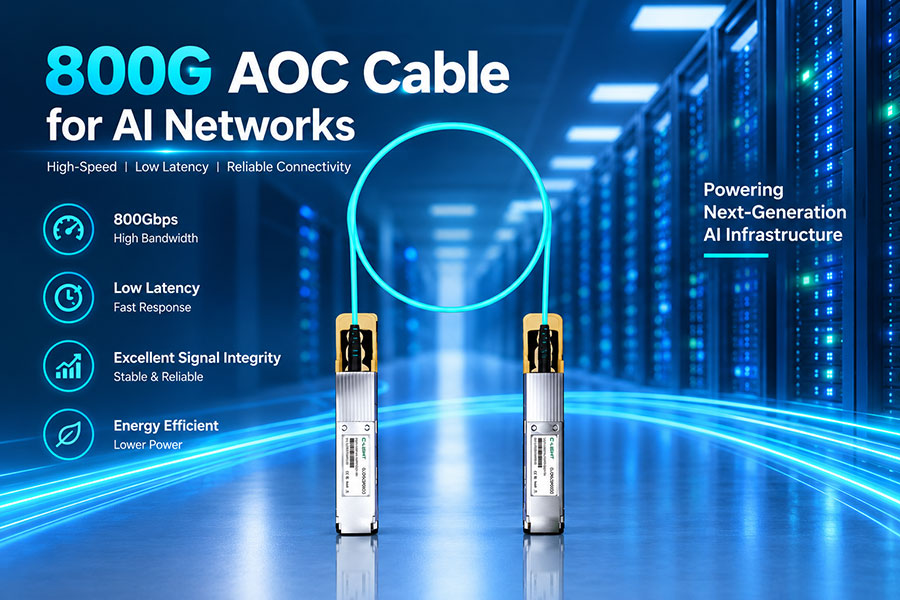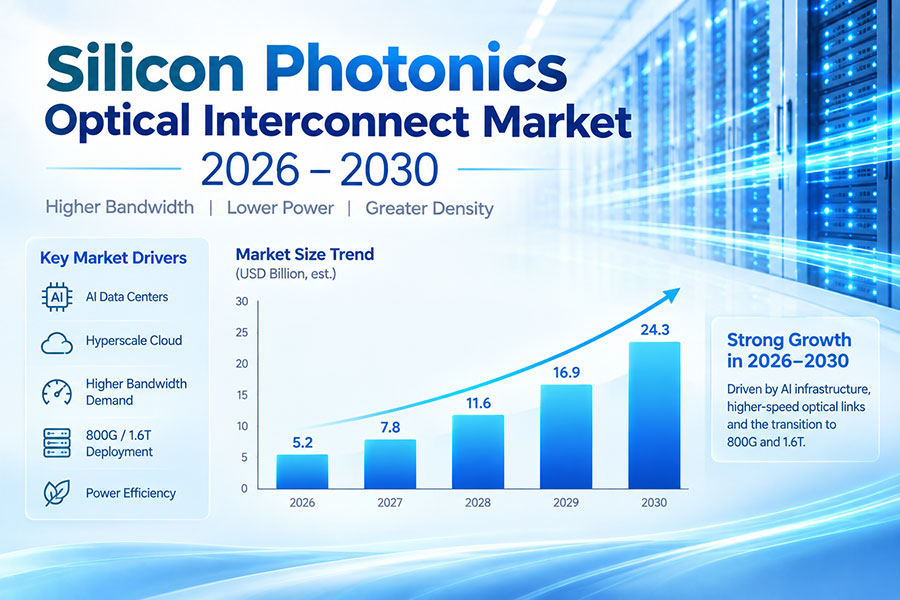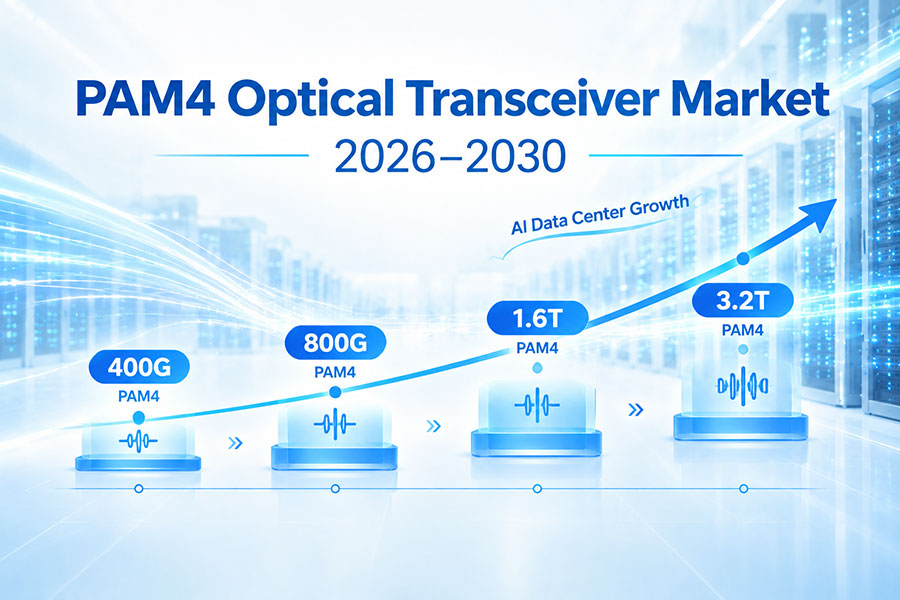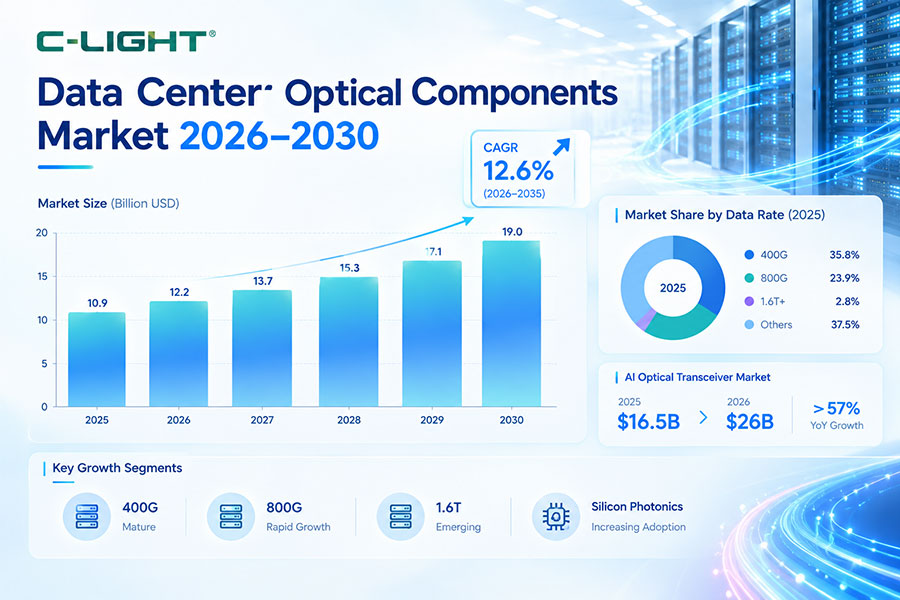

The construction of AI and hyperscale data centers is driving rapid growth in the global AOC market. 400G products have entered a phase of rapid market penetration, while 800G AOCs are expected to achieve commercialization by 2027, accelerating the industry’s iteration toward higher data rates.
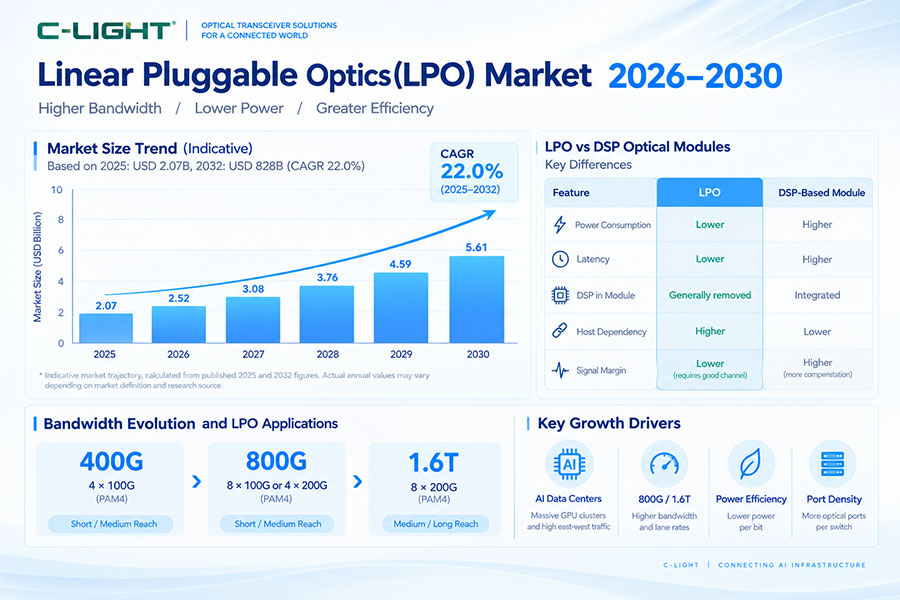
In terms of the competitive landscape, Chinese companies hold a dominant position globally, accounting for over 70% of the market share. North America represents the highest demand, while the Asia‑Pacific region is the fastest‑growing market, serving as the primary growth engine. The adoption of silicon photonics integration technology has significantly driven down costs. However, in terms of technological evolution, 400G AOCs also face challenges and competition from alternative technologies such as 800G/1.6T high‑speed optical modules and LPO (Linear Pluggable Optics).
1、Market Size and Growth Drivers
The global AOC market is expected to reach USD 2.8 billion in 2025, with a cumulative market opportunity exceeding USD 12 billion from 2023 to 2028. The main drivers include:
AI Compute Surge: GPU server shipments are growing at 45% annually, driving a 42% year‑on‑year increase in AOC demand for HPC clusters.
Data Center Upgrades: Deployment of 400G Ethernet ports continues to accelerate.
5G Infrastructure Expansion: The number of global 5G base stations has surpassed 10 million, boosting demand for fronthaul AOCs by 30% annually.
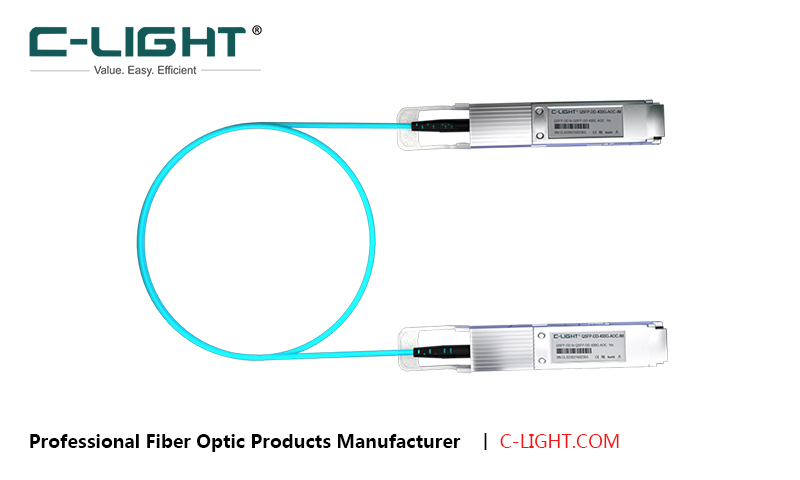
2、Technology Evolution Roadmap
400G AOCs are evolving toward higher performance and lower power consumption. Silicon photonics integration is a key direction. Through collaborative optimization of chips, electrical, optical, and packaging processes, the power consumption of a 400G single port can now be controlled within 8W, and silicon‑photonics‑based AOCs can further reduce overall costs by approximately 30%. The hybrid architecture (Hybrid AOC) represents another important innovation: by using a DSP solution that utilizes only half the channels, power consumption drops to 6.6W — a 20%–25% reduction compared to traditional solutions — while link latency is reduced by nearly 50%. Meanwhile, development of 800G AOCs has already begun, with commercialization expected by 2027.
3、Competitive Landscape Relative to DAC and Optical Transceivers
In data center interconnect solutions, DAC, AOC, and optical transceivers each have distinct roles:
DAC (Direct Attach Copper Cable): Suitable for ultra‑short intra‑rack connections within 3 meters. Lowest cost and power consumption, but distance‑limited and susceptible to electromagnetic interference.
AOC (Active Optical Cable): Suitable for short‑to‑medium reach connections from 3 to 100 meters. Balances cost, power, and performance; provides strong immunity to interference and flexible deployment.
Optical Transceiver + Patch Cord: Suitable for long‑haul transmission beyond 100 meters. Wide coverage, but relatively higher power consumption and cost.
AOC, DAC, and optical transceivers are not mutually exclusive; rather, they form an optimal combination based on scenario characteristics. For common intra‑data‑center distances ranging from a few meters to one hundred meters, AOCs demonstrate greater advantages in total cost of ownership (TCO), taking into account factors such as cabling complexity, power consumption, heat dissipation, port density, and ease of future upgrades and maintenance.
For any questions, please contact us by email or WhatsApp.
Email: sales@c-light.com
WhatsApp: +86 132 6656 7067