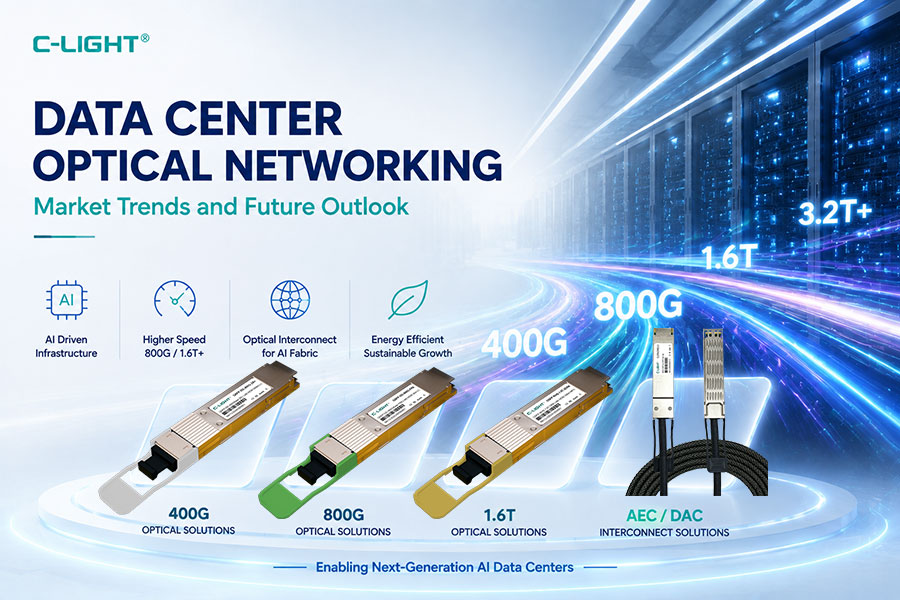
The global data center optical networking market is undergoing a fundamental transformation driven by artificial intelligence (AI), cloud computing, and large-scale computing infrastructure.
Traditional data center networks were primarily designed for web services, enterprise applications, and cloud workloads. However, the rapid growth of generative AI has introduced completely new networking requirements.
AI training and inference workloads require massive data movement between:
GPU clusters
AI servers
High-performance switches
Storage platforms
Distributed computing systems
As computing power increases, network bandwidth has become a critical bottleneck. Optical networking technologies are now becoming the foundation for next-generation AI data centers.
The market is rapidly moving toward:
400G optical networking
800G optical modules
1.6T optical connectivity
Optical interconnect solutions
Silicon photonics
LPO and CPO architectures
AI infrastructure is becoming the primary growth engine for the data center optical networking market.
Data center optical networking refers to the use of optical technologies to enable high-speed communication between servers, switches, storage systems, and data center facilities.
Compared with traditional electrical connections, optical networking provides:
Higher bandwidth capacity
Longer transmission distance
Lower signal loss
Better scalability
Improved energy efficiency
Major optical networking components include:
Optical transceivers
Active Optical Cables (AOC)
Direct Attach Cables (DAC)
Active Electrical Cables (AEC)
Optical switches
Silicon photonics solutions
AI workloads are fundamentally different from traditional applications.
Large AI clusters require continuous communication between thousands of computing nodes.
Key requirements include:
Ultra-high bandwidth
Low latency
High reliability
Low power consumption
Scalable network architecture
As GPU clusters expand from thousands to hundreds of thousands of accelerators, optical connectivity becomes essential for maintaining network performance.
The rapid expansion of AI infrastructure is changing data center networking from traditional server-centric designs toward AI fabric architectures.
Modern AI data centers typically include:
GPU servers
AI accelerators
High-performance processors
Ethernet AI Fabric
InfiniBand networks
High-speed switches
Optical transceivers
DAC solutions
AEC solutions
The increasing scale of AI clusters directly increases optical networking demand.
AI Fabric requires:
Massive east-west traffic capacity
Deterministic latency
High bandwidth density
Optical networking enables:
GPU-to-GPU communication
Rack-to-rack connectivity
Data center interconnect
Future AI networks will increasingly depend on optical technologies rather than traditional copper connections.
The data center optical networking industry is experiencing a major speed transition.
The current roadmap:
100G → 200G → 400G → 800G → 1.6T
400G optical modules remain widely deployed, but AI workloads are accelerating migration toward 800G solutions.
800G optical modules provide:
Double bandwidth compared with 400G
Higher switch port efficiency
Better AI cluster scalability
Lower cost per bit
Industry analysis indicates that 800G and above optical modules are becoming a key component of AI-focused data center deployments.
OSFP has become a preferred form factor for high-performance AI networking.
Advantages:
Higher thermal capability
Suitable for next-generation switches
Supports future speed upgrades
Applications:
AI clusters
Cloud data centers
HPC systems
QSFP-DD provides compatibility with existing networking platforms.
Advantages:
High-density deployment
Flexible migration path
Broad ecosystem support
As AI models become larger, data movement requirements continue increasing.
Future AI networks require:
Higher switch bandwidth
More efficient optical connectivity
Lower power consumption
1.6T optical modules are designed to support:
Next-generation AI clusters
Advanced Ethernet networks
Future hyperscale infrastructure
The optical networking roadmap is evolving toward:
800G → 1.6T → 3.2T
The 1.6T generation is gradually entering commercial deployment as AI infrastructure continues scaling.
Direct Attach Cable (DAC) remains an important solution for short-distance applications.
Advantages:
Low cost
Low latency
Simple installation
Applications:
Server-to-switch connections
Rack-level networking
Short-distance AI links
Active Electrical Cable (AEC) provides enhanced signal performance compared with passive copper solutions.
Advantages:
Longer reach
Signal regeneration
Better high-speed performance
AEC is becoming increasingly important in:
AI server clusters
High-density racks
Large-scale Ethernet networks
As AI clusters expand across multiple buildings and regions, Data Center Interconnect (DCI) is becoming increasingly important.
Optical networking enables:
Campus-scale AI infrastructure
Multi-site GPU clusters
Cloud resource expansion
Silicon photonics is becoming a key technology for future optical networking.
Benefits include:
Higher integration density
Lower power consumption
Improved scalability
Applications:
800G optical modules
1.6T optical engines
CPO architectures
LPO simplifies optical module architecture by reducing DSP dependence.
Advantages:
Lower power consumption
Lower latency
Improved efficiency
LPO is particularly attractive for AI data center networking.
CPO integrates optical components closer to switching ASICs.
Benefits:
Higher bandwidth density
Reduced electrical loss
Better energy efficiency
Although challenges remain in:
Thermal management
Manufacturing
Maintenance
CPO is considered an important future direction for AI networking.
Higher-speed optical modules increase thermal challenges.
Key requirements include:
Lower module power
Improved cooling efficiency
Better optical integration
Advanced optical networking requires:
High-performance lasers
DSP chips
Optical engines
Precision packaging
Supply capacity has become an important factor influencing market growth.
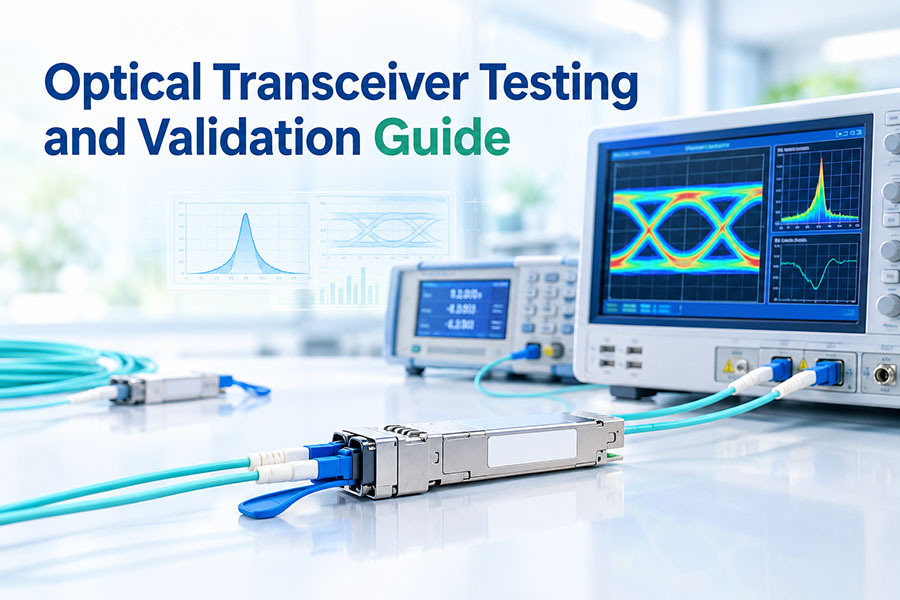
High-speed optical products require comprehensive testing:
BER testing
Eye diagram testing
Signal integrity analysis
Optical performance testing
Thermal validation
Reliable testing ensures stable operation in large AI environments.
C-LIGHT provides high-speed optical connectivity solutions designed for AI infrastructure and next-generation data centers.
Including:
400G Optical Modules
800G OSFP Optical Modules
800G QSFP-DD Optical Modules
1.6T Optical Modules
Including:
800G DAC
800G AEC
1.6T DAC
1.6T AEC
Applications:
AI training clusters
Cloud computing platforms
HPC networks
Ethernet AI Fabric
C-LIGHT focuses on delivering reliable, scalable, and high-performance optical networking solutions for future AI-driven infrastructure.
The data center optical networking market will continue expanding as AI infrastructure develops.
Major future trends include:
Future networks will transition toward:
800G
1.6T
3.2T
Optical technologies will move closer to processors and switches through:
Silicon photonics
LPO
CPO
Future data centers will increasingly adopt:
Optical switching
Advanced optical fabrics
High-density optical interconnect
Optical networking will become one of the most important foundations supporting global AI computing.
Answer: Data center optical networking uses optical technologies to connect servers, switches, storage systems, and computing platforms. It provides high bandwidth, low latency, and efficient communication for modern cloud computing, AI infrastructure, and high-performance data centers.
Answer: AI workloads require massive data exchange between GPUs, servers, switches, and storage systems. Optical networking provides the bandwidth, transmission distance, and scalability required for large-scale AI clusters and next-generation data center architectures.
Answer: The main optical networking products used in modern data centers include:
Optical transceivers
DAC (Direct Attach Copper) cables
AEC (Active Electrical Cable) solutions
AOC (Active Optical Cable) solutions
Silicon photonics-based optical solutions
Answer: 800G optical modules provide higher bandwidth density and improved network scalability for AI data centers and hyperscale cloud infrastructure. They enable faster communication between GPUs, switches, and computing systems to support increasing AI workload requirements.
Answer: The optical networking industry is evolving from 400G to 800G, 1.6T, and future 3.2T solutions. These higher-speed technologies are designed to support advanced AI computing, larger GPU clusters, and ultra-high-bandwidth data center networks.
Answer: AEC (Active Electrical Cable) improves signal transmission performance by integrating active signal conditioning technologies. Compared with traditional DAC solutions, AEC provides better signal integrity and longer reach for high-density AI networking environments.
Answer: C-LIGHT provides comprehensive optical networking and high-speed interconnect solutions for AI data centers, cloud computing, HPC, and next-generation networking applications.
400G optical transceiver solutions
800G QSFP-DD and OSFP optical modules
1.6T next-generation optical modules
DAC and AEC high-speed interconnect cables
AI data center optical networking solutions
Answer: Optical networking will increasingly replace copper solutions in high-speed, long-distance, and high-bandwidth applications. However, copper-based solutions such as DAC and AEC will continue to be widely used for short-distance data center connections due to their cost advantages and low power consumption.
For any questions, please contact us by email or WhatsApp.
Email: sales@c-light.com
WhatsApp: +86 132 6656 7067