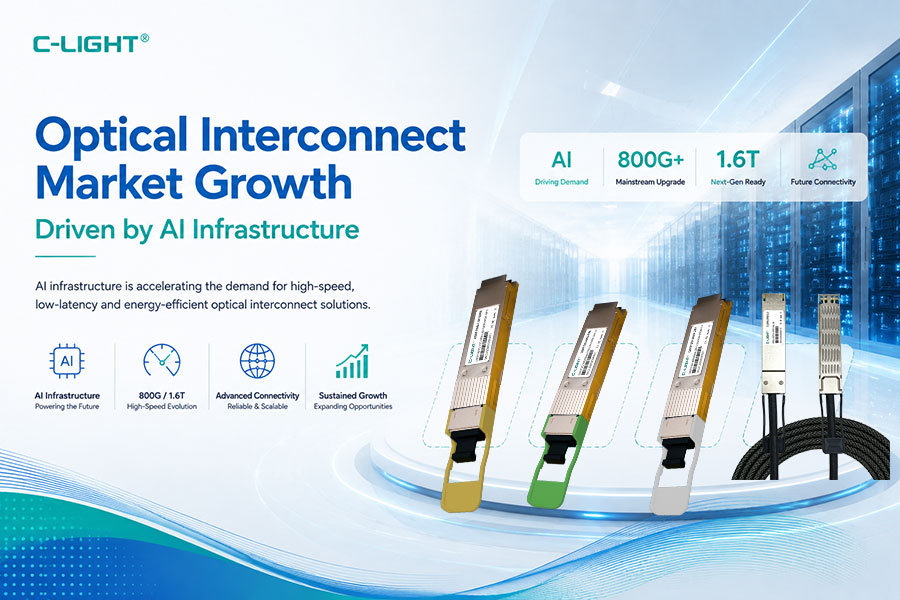
The global optical interconnect market is entering a new growth cycle driven by the rapid expansion of artificial intelligence (AI) infrastructure, hyperscale data centers, and high-performance computing (HPC).
As AI models become larger and computational workloads continue increasing, traditional electrical interconnect technologies are facing limitations in bandwidth, power consumption, and transmission distance.
AI infrastructure requires massive data exchange between:
GPUs and AI accelerators
High-speed switches
Storage systems
Distributed computing nodes
This transformation has made optical interconnect technology a critical foundation for next-generation data centers.
The market is shifting from traditional data center connectivity toward advanced optical solutions supporting:
400G optical interconnect
800G optical modules
Silicon photonics
Co-packaged optics (CPO)
AI infrastructure has become the strongest growth driver for the optical interconnect market.
Optical interconnect refers to the use of optical technologies to transmit data between computing systems, servers, switches, and network infrastructure.
Compared with traditional copper-based connections, optical interconnect provides:
Higher bandwidth
Longer transmission distance
Lower signal loss
Better scalability
Improved energy efficiency
Optical interconnect solutions mainly include:
Optical transceivers
Optical engines
Silicon photonics solutions
With increasing AI workloads, electrical interconnect faces several challenges.
| Feature | Electrical Interconnect | Optical Interconnect |
|---|---|---|
| Bandwidth | Limited scalability | Extremely high bandwidth |
| Distance | Short range | Longer transmission capability |
| Signal Loss | Higher at high speed | Lower attenuation |
| Power Efficiency | Decreases at high speed | Better scalability |
| AI Data Center Suitability | Limited | Excellent |
As AI clusters continue expanding, optical interconnect is becoming the preferred technology for high-performance networking.
The rapid development of generative AI has changed data center architectures.
Large AI models require:
Massive computing resources
Thousands of GPUs
High-speed communication networks
Ultra-low latency connections
Unlike traditional cloud applications, AI workloads generate intensive east-west traffic inside data centers.
This creates strong demand for:
High-speed optical modules
Optical cables
AI networking solutions
AI data centers are becoming the largest application market for optical interconnect technologies.
Modern AI clusters rely on high-speed communication between processors.
A typical AI infrastructure includes:
GPU servers
AI accelerators
Memory systems
High-speed Ethernet switches
InfiniBand networks
AI fabric infrastructure
Optical transceivers
DAC cables
AEC solutions
As GPU density increases, optical connectivity requirements grow exponentially.
400G optical solutions have become widely deployed in current cloud and data center networks.
However, AI applications require significantly higher bandwidth.
The industry roadmap is:
100G → 200G → 400G → 800G → 1.6T
800G optical interconnect has become a key upgrade direction for:
AI clusters
Hyperscale data centers
Cloud computing platforms
HPC networks
Common 800G solutions include:
800G OSFP MSA SR8/DR8/2FR4 Optical Transceiver丨C-LIGHT
Designed for:
AI data center switching
High-density Ethernet networks
Next-generation AI fabrics
Advantages:
High bandwidth density
Improved thermal capability
Support for future upgrades
800G QSFP DD SR8/DR8/FR4 optical transceiver丨C-LIGHT
Applications:
Cloud infrastructure
Enterprise data centers
Network migration
Benefits:
Compatibility with existing platforms
Flexible deployment options
As AI clusters continue scaling, 800G will gradually evolve toward 1.6T optical connectivity.
1.6T solutions are designed for:
Next-generation AI switches
Large-scale GPU clusters
Future Ethernet infrastructure
Future optical interconnect roadmap:
800G → 1.6T → 3.2T
800G/400G/200G/100G/50G/40G/25G/10G DAC Cable丨C-LIGHT
DAC solutions are widely used for short-distance connections.
Advantages:
Low cost
Low latency
Simple deployment
Applications:
Server-to-switch connections
Rack-level networking
Short-distance AI cluster links
800G AEC Active Electrical Cable | OSFP QSFP-DD Cable for AI Data Center丨C-LIGHT
AEC has become increasingly important in AI data centers.
Compared with traditional DAC:
Advantages:
Longer reach
Signal enhancement
Better high-speed performance
AEC is suitable for:
AI server clusters
High-density racks
Next-generation Ethernet networks
Future AI networks will combine multiple technologies:
Optical transceivers
AEC
DAC
CPO
Silicon photonics
Different solutions will coexist depending on:
Distance requirements
Power limitations
Cost considerations
Silicon photonics is becoming an important technology for future optical interconnect.
Key advantages:
High integration density
Lower power consumption
Manufacturing scalability
Applications include:
800G optical modules
1.6T optical engines
CPO systems
LPO reduces dependency on traditional DSP architecture.
Benefits:
Lower power consumption
Reduced latency
Improved efficiency
LPO is attractive for:
AI data center networks
Short-distance optical links
CPO integrates optical components closer to switching ASICs.
Advantages:
Higher bandwidth density
Lower electrical loss
Improved energy efficiency
Although CPO still faces challenges in:
Thermal management
Maintenance
Manufacturing complexity
it remains an important future direction.
Higher-speed optical solutions require advanced thermal management.
Challenges include:
Higher module power
Increased rack density
Cooling requirements
AI data centers are driving demand for:
More efficient optical designs
Better thermal solutions
Advanced optical products require:
High-performance lasers
DSP chips
Optical engines
Precision packaging
Stable supply chains are becoming a competitive advantage.
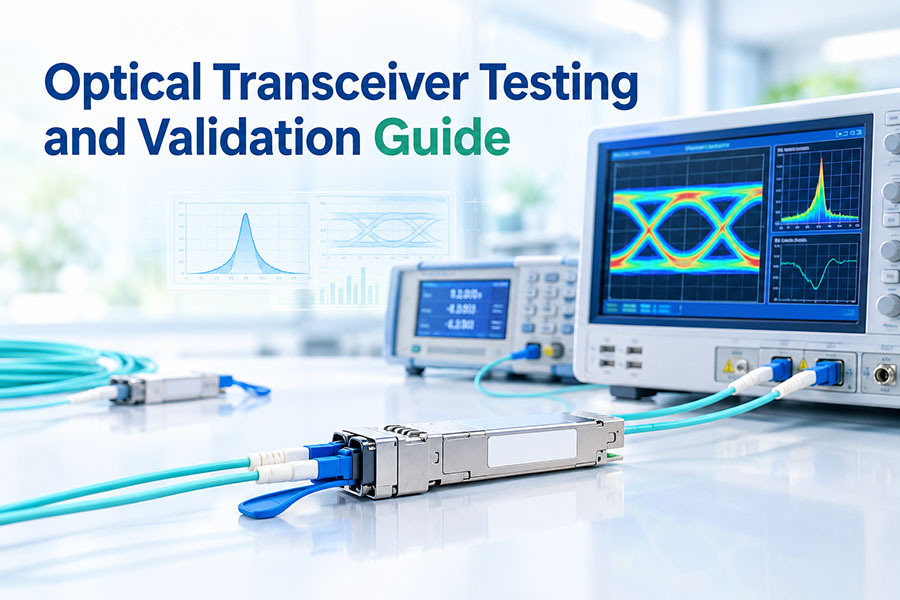
High-speed optical interconnect requires comprehensive validation:
BER testing
Eye diagram analysis
Signal integrity testing
Optical power measurement
Thermal testing
Reliable testing capability ensures stable deployment in AI infrastructure.
C-LIGHT focuses on providing high-performance optical connectivity solutions for next-generation data centers and AI infrastructure.
The product portfolio includes:
400G QSFP-DD Optical Transceiver
400G OSFP Optical Module
800G OSFP Optical Transceiver
1.6T OSFP Optical Module
800G DAC
800G AEC
1.6T DAC
1.6T AEC
These solutions support:
AI training clusters
Cloud computing
HPC systems
Ethernet AI Fabric
The optical interconnect market will continue expanding as AI infrastructure develops.
Key trends include:
The industry will continue moving toward:
800G
1.6T
3.2T
Energy efficiency will become a core requirement for AI networking.
Future solutions will focus on:
Advanced optical integration
Silicon photonics
LPO technologies
Optical technologies will move closer to processors and switches.
Future architectures may combine:
Optical engines
CPO
Advanced packaging
to support massive AI computing requirements.
Answer: Optical interconnect is a high-speed communication technology that uses optical signals to connect servers, switches, storage systems, and computing platforms. Compared with traditional electrical connections, it provides higher bandwidth, lower latency, and longer transmission distance for modern data center networks.
Answer: AI workloads require massive data communication between GPUs, servers, switches, and storage systems. Optical interconnect solutions provide the bandwidth, transmission distance, and energy efficiency required for large-scale AI clusters and high-performance computing networks.
Answer: The main optical interconnect products used in modern data center networks include:
Optical transceivers
DAC (Direct Attach Copper) cables
AEC (Active Electrical Cable) solutions
AOC (Active Optical Cable) solutions
Silicon photonics-based optical solutions
Answer: 800G optical modules provide higher bandwidth density and improved network scalability for AI data centers. They enable faster and more efficient communication between GPUs, switches, and computing systems, supporting next-generation AI infrastructure.
Answer: The optical interconnect industry is evolving from 400G to 800G, 1.6T, and future 3.2T solutions. These higher-speed technologies are designed to support advanced AI computing, larger GPU clusters, and ultra-high-bandwidth data center networks.
Answer: AEC (Active Electrical Cable) improves signal integrity through active components such as retimers and signal conditioning technologies. Compared with traditional DAC solutions, AEC provides longer reach and better performance for high-density AI networking environments.
Answer: C-LIGHT provides high-speed optical interconnect solutions for AI data centers, cloud computing, HPC, and next-generation networking applications.
400G optical transceiver solutions
800G QSFP-DD and OSFP optical modules
1.6T next-generation optical modules
DAC and AEC high-speed interconnect cables
AI data center optical connectivity solutions
Answer: Optical interconnect will increasingly replace copper solutions in high-speed, long-distance, and high-bandwidth applications. However, copper-based solutions such as DAC and AEC will continue to play an important role in short-distance data center connections where cost and power efficiency are critical.
For any questions, please contact us by email or WhatsApp.
Email: sales@c-light.com
WhatsApp: +86 132 6656 7067