
Optical transceiver temperature is an important specification when selecting modules for Ethernet, data center, telecom, industrial, outdoor, and other network applications. A transceiver may operate correctly in a temperature-controlled data center but require a different temperature grade when installed in an outdoor cabinet, industrial facility, transportation system, or other environment with wider temperature variations.
Optical transceivers are commonly classified according to their operating temperature range. Commercial-temperature modules are widely used in controlled indoor environments, while extended- and industrial-temperature modules are designed for applications with wider temperature fluctuations.
The temperature grade affects more than the module's ability to start and operate. Changes in temperature can influence laser characteristics, optical output power, receiver sensitivity, electrical performance, power consumption, and long-term reliability. For high-speed modules, thermal design is also closely related to signal integrity and system cooling.
Optical transceiver temperature grades describe the specified operating temperature range of a module. The most common classifications are Commercial Temperature, Extended Temperature, and Industrial Temperature.
Commercial temperature is generally used for temperature-controlled environments. Industrial temperature covers a significantly wider range and is intended for equipment exposed to low and high ambient conditions.
There is no single universal extended-temperature range used by every manufacturer. For example, Cisco defines C-Temp as 0°C to 70°C, E-Temp as -5°C to 85°C, and I-Temp as -40°C to 85°C for its optics. Other suppliers may use a different extended range, such as -20°C to 85°C. The exact specification should therefore always be checked on the individual module datasheet.
Commercial temperature, commonly abbreviated as C-Temp or COM, is typically specified as 0°C to 70°C for optical transceivers.
This range is widely used for data centers, enterprise networks, server rooms, offices, and other indoor installations where equipment operates in a controlled environment.
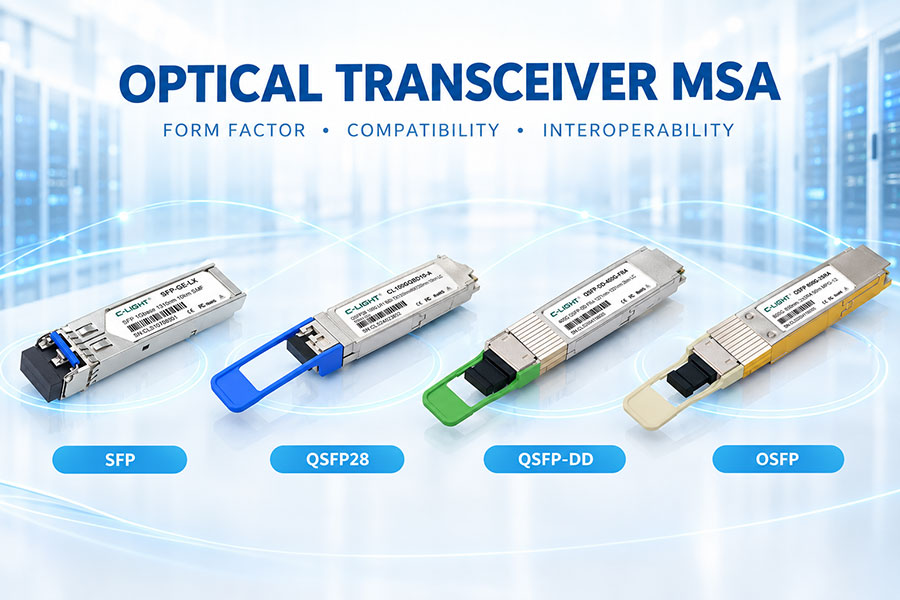
Commercial-temperature modules are widely available across SFP, SFP+, SFP28, QSFP28, QSFP56, QSFP-DD, OSFP, and other form factors.
For a temperature-controlled environment, commercial-temperature modules can provide a practical balance between operating requirements and module design complexity.
Extended temperature is designed for applications where the operating environment is wider than the standard commercial range.
The exact range varies between manufacturers and products. Common specifications include ranges such as -5°C to 85°C or -20°C to 85°C.
Extended-temperature modules are often used in edge networking, telecom equipment, outdoor cabinets with moderate environmental control, and installations where the ambient temperature can move outside the commercial range.
Because extended temperature is not defined by one universal range across all products, the actual minimum and maximum temperatures should always be verified from the product specification.
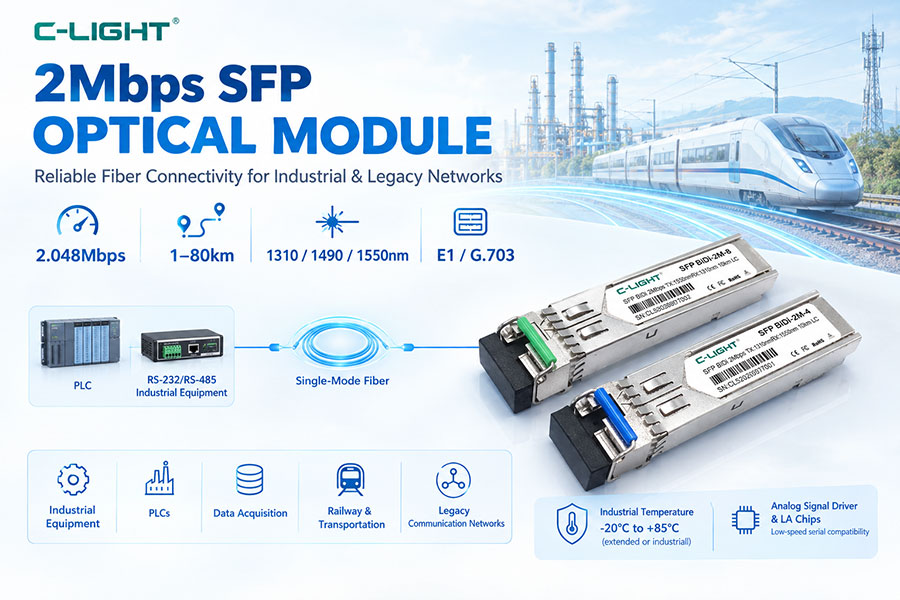
Industrial temperature, commonly abbreviated as I-Temp or IND, is generally associated with an operating case-temperature range of -40°C to 85°C.
This wider range is intended for applications such as industrial automation, utility infrastructure, transportation, outdoor network cabinets, and other environments where temperature control is limited.
Industrial-temperature modules require components and manufacturing processes capable of maintaining specified performance across a much wider temperature range than commercial modules.
| Temperature Grade | Typical Operating Range | Typical Applications |
|---|---|---|
| Commercial (C-Temp) | 0°C to 70°C | Data centers, enterprise networks, indoor equipment |
| Extended (E-Temp) | Varies by manufacturer | Telecom, edge networks, outdoor and less-controlled environments |
| Industrial (I-Temp) | Typically -40°C to 85°C | Industrial, transportation, utility, outdoor infrastructure |
The values above represent commonly used industry classifications rather than a universal requirement for every optical transceiver. The actual temperature range must be confirmed from the module datasheet.
Operating temperature and storage temperature are different specifications and should not be confused.
Operating temperature defines the environmental range in which the module is designed to function. Storage temperature defines the range the unpowered module can withstand during storage or transportation.
A module may have a storage range of -40°C to 85°C even when its operating range is only 0°C to 70°C. This does not mean that the module can operate continuously at -40°C.
When selecting a transceiver, the operating temperature range is the relevant specification for actual network operation.
Optical transceiver temperature specifications are often based on case temperature rather than directly on ambient temperature.
Case temperature is the temperature measured at a defined location on the module housing. Ambient temperature refers to the surrounding environment.
The module case can become significantly hotter than the surrounding air because of internal power dissipation and limited airflow. Cisco notes that the case temperature of optics can be approximately 20°C higher than cabinet ambient temperature under certain operating conditions.
This means that selecting a module based only on the nominal room temperature can lead to an incorrect thermal assessment.
Optical components do not operate independently of temperature. Laser output, wavelength, photodetector characteristics, TIA behavior, and electronic components can all change with temperature.
The module must therefore remain within its specified case-temperature range to meet its guaranteed performance characteristics.
For high-density network equipment, the difference between ambient temperature and module case temperature becomes particularly important because many transceivers may operate simultaneously inside a confined chassis.
Temperature has a direct effect on semiconductor laser characteristics. As temperature changes, the laser's threshold current, efficiency, output power, and wavelength can change.
At higher temperatures, a laser may require more drive current to maintain a given optical output. Temperature can also affect wavelength stability and modulation performance.
For single-mode optical modules and wavelength-sensitive applications, these effects must be considered as part of the transmitter design.
VCSELs are widely used in short-reach multimode optical modules such as many SR transceivers.
VCSEL performance changes with temperature, affecting optical power, efficiency, wavelength, and modulation behavior.
Temperature compensation and appropriate driver design can help maintain stable performance across the specified operating range.
This is one reason why an industrial-temperature module cannot simply be assumed to be equivalent to a commercial-temperature module with a different label.
DML and EML lasers are commonly used in higher-performance single-mode optical modules.
Temperature can affect laser wavelength, output power, modulation characteristics, and electrical drive conditions. For longer-reach modules, maintaining stable optical performance across temperature is particularly important because the available link budget can be relatively limited.
EML-based modules can also require careful control of the laser and modulator operating conditions as temperature changes.
Temperature also affects the receiver side of the optical module. Photodiode responsivity, dark current, TIA characteristics, and other receiver parameters can vary with temperature.
These changes can influence receiver sensitivity and optical dynamic range.
For modules operating near the edge of their optical budget, temperature-related changes in receiver performance can become an important design consideration.
Modern high-speed optical modules may contain DSPs, retimers, laser drivers, TIAs, clock circuits, monitoring devices, and other active electronic components.
These components generate heat during operation, and their electrical characteristics can vary with temperature.
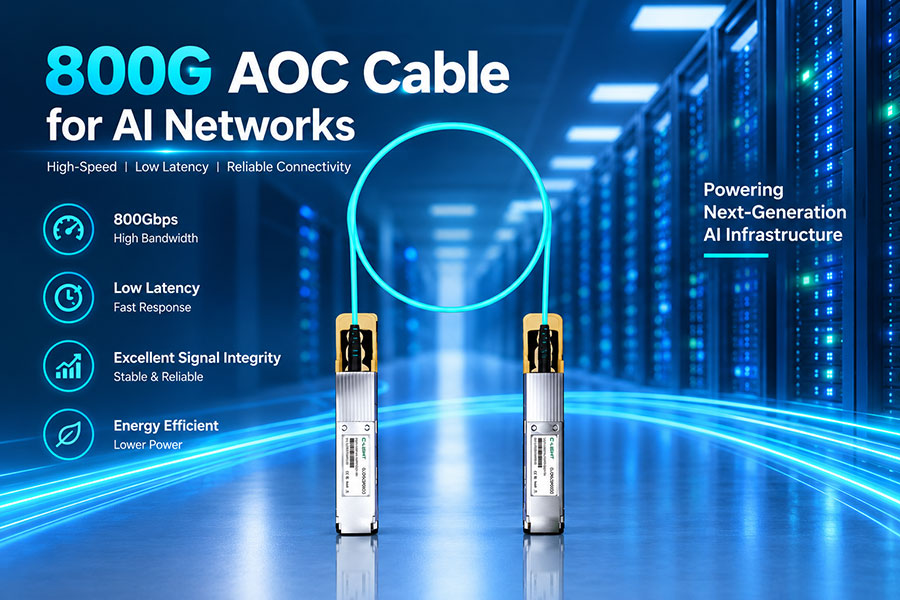
As data rates increase, the combination of higher electrical speeds and higher power consumption makes thermal management increasingly important for 400G, 800G, and 1.6T modules.
Optical output power can vary with temperature because laser efficiency and drive characteristics change as the device temperature changes.
Module designers may use automatic power control, temperature compensation, laser driver control, and other techniques to maintain optical performance within the specified range.
The actual guaranteed optical power range should always be taken from the product datasheet because compensation strategies differ between module designs.
Receiver sensitivity is another parameter affected by temperature. Changes in photodiode responsivity, TIA noise, dark current, and other receiver characteristics can influence the minimum optical power required for reliable detection.
For long-distance optical links, maintaining receiver sensitivity across the complete operating range is especially important because the system may have limited optical margin.
Laser wavelength can shift as the device temperature changes. The amount of wavelength variation depends on the laser technology and module design.
This can be particularly important in wavelength-division multiplexing systems, where multiple optical channels operate within defined wavelength ranges.
Temperature control, laser selection, and wavelength compensation can therefore be important parts of WDM optical module design.
Temperature and power consumption are closely related. Higher power dissipation increases module temperature, while higher temperature can also affect the operating efficiency of electronic and optical components.
In a high-density switch, this creates a combined thermal challenge. A large number of high-power modules operating at the same time can increase the internal chassis temperature and place greater demands on system airflow.
This relationship is particularly important when deploying high-speed 800G and 1.6T optical modules.
High-speed modules typically contain more complex electrical and optical components than earlier generations. As a result, thermal design becomes increasingly important as the module data rate increases.
For example, an 800G or 1.6T module may use high-speed DSPs, multiple optical channels, advanced laser drivers, and other components that generate considerable heat.
The module temperature specification must therefore be considered together with the switch's airflow and power budget.
Thermal design can include heat spreaders, heat sinks, thermal interface materials, airflow optimization, package design, and temperature monitoring.
The objective is to maintain critical components within their specified operating range while minimizing the impact of heat on neighboring components and the complete network system.
For high-density platforms, thermal design is a system-level problem involving the transceiver, cage, PCB, heat sink, fan system, and chassis airflow.
Temperature grade is independent of the basic module form factor. SFP, SFP+, SFP28, QSFP28, QSFP56, QSFP-DD, and OSFP modules can all be available in different temperature grades depending on the product design.
However, high-speed form factors can introduce additional thermal challenges because of their higher power levels and greater component density.
| Form Factor | Possible Temperature Grades | Typical Consideration |
|---|---|---|
| SFP | Commercial / Extended / Industrial | Low-power and industrial networking applications |
| SFP+ | Commercial / Extended / Industrial | 10G network and telecom applications |
| SFP28 | Commercial / Extended / Industrial | 25G data center and telecom applications |
| QSFP28 | Commercial / Extended / Industrial | 100G high-density networking |
| QSFP-DD | Depends on product design | 400G / 800G / 1.6T high-density systems |
| OSFP | Depends on product design | 400G / 800G / 1.6T high-power systems |
Industrial-temperature optical transceivers are used in environments where network equipment can experience large temperature fluctuations or limited environmental control.
Typical applications include industrial Ethernet, factory automation, power and utility networks, transportation infrastructure, outdoor communication cabinets, and remote monitoring systems.
In these environments, temperature is only one of several environmental factors that may need to be evaluated. Humidity, vibration, dust, shock, and electromagnetic interference can also affect system requirements.
Telecom and outside-plant network equipment can experience wider environmental temperature variations than indoor data center systems.
Remote cabinets may be exposed to direct solar heating during the day and low temperatures at night or during winter. The internal equipment temperature can also rise above ambient because of heat generated by switches, routers, power supplies, and optical modules.
For these applications, the required transceiver temperature grade should be based on the actual equipment environment rather than simply the outdoor air temperature.
Most conventional data centers provide controlled temperature and airflow, making commercial-temperature modules common in these environments.
However, a controlled room does not automatically mean that every optical module remains close to room temperature. High-density switches can generate substantial heat, and the temperature near the rear or top of a chassis can differ from the room ambient temperature.
Data center operators should therefore evaluate actual equipment airflow and module case temperature when deploying large numbers of high-power transceivers.
Low-temperature operation can create a distinction between module management access and full optical traffic operation.
Some networking equipment may allow access to low-speed management functions at a lower temperature while requiring the transceiver case temperature to rise before carrying live traffic.
This behavior is platform- and module-dependent, so cold-start requirements should be verified from the equipment and transceiver specifications rather than assumed from the nominal temperature grade.
An optical link is affected by temperature through several interacting parameters, including transmitter output power, receiver sensitivity, wavelength, electrical performance, and component behavior.
As temperature moves toward the limits of the specified range, the available optical margin can change.
A module designed for a wider temperature range must therefore maintain its required optical and electrical performance across that entire range rather than simply remaining powered on.
A wider operating-temperature range generally requires appropriate component selection, qualification, packaging, testing, and thermal design.
Industrial-temperature modules are designed to maintain specified operation across a larger temperature range than commercial-temperature products. This requires the internal optical and electronic components to be suitable for the target environment.
The actual reliability of a module should be evaluated from its component qualification, test coverage, operating specifications, and product documentation rather than from temperature range alone.
Temperature-related qualification can involve operating the module at different temperatures and verifying parameters such as optical output, receiver sensitivity, wavelength, power consumption, alarms, and link performance.
Production testing and qualification methods vary between manufacturers and product families.
For industrial applications, testing across the specified operating range is particularly important because component behavior at room temperature does not necessarily represent performance at the temperature limits.
The first step is to determine the actual temperature around the installed optical module rather than relying only on general room or outdoor temperature.
The second step is to check the module's specified case operating temperature and compare it with the expected system environment.
The third step is to consider chassis airflow, switch power consumption, module density, heat sink performance, and possible temperature rise inside the equipment.
For outdoor, industrial, transportation, and other harsh environments, a wider temperature grade may be required. For a controlled indoor environment, commercial-temperature modules may meet the operating requirements.
One common mistake is to assume that the storage temperature range is the same as the operating range.
Another mistake is to compare module temperature ratings directly with room ambient temperature without considering the temperature rise inside the chassis.
A third mistake is to assume that all modules using the same form factor have the same temperature range. Temperature capability depends on the specific module design and components.
It is also important not to assume that a wider temperature rating automatically means the module has identical optical performance at every temperature. The detailed datasheet should be checked for the guaranteed operating specifications.
| Item | Commercial | Extended | Industrial |
|---|---|---|---|
| Typical Range | 0°C to 70°C | Varies by manufacturer | -40°C to 85°C |
| Temperature Environment | Controlled indoor | Wider environmental range | Harsh and uncontrolled environments |
| Typical Applications | Data center / enterprise | Telecom / edge / outdoor | Industrial / utility / transportation |
| Thermal Requirement | Moderate | Higher | High |
| Component Requirements | Commercial-grade selection | Wider-temperature selection | Industrial-temperature qualified components |
Optical transceiver temperature grades define the environmental range in which a module is designed to operate. Commercial-temperature modules are commonly specified for 0°C to 70°C, while extended-temperature ranges vary by manufacturer and industrial-temperature modules are commonly specified for -40°C to 85°C.
Temperature affects both optical and electrical performance. Laser output, wavelength, receiver sensitivity, photodiode behavior, TIA characteristics, DSP operation, and power consumption can all change with temperature.
For this reason, selecting a transceiver temperature grade requires more than comparing a single temperature number. The actual case temperature, chassis airflow, module power, installation environment, optical link requirements, and manufacturer specifications should all be considered.
For any questions, please contact us by email or WhatsApp.
Email: sales@c-light.com
WhatsApp: +86 132 6656 7067