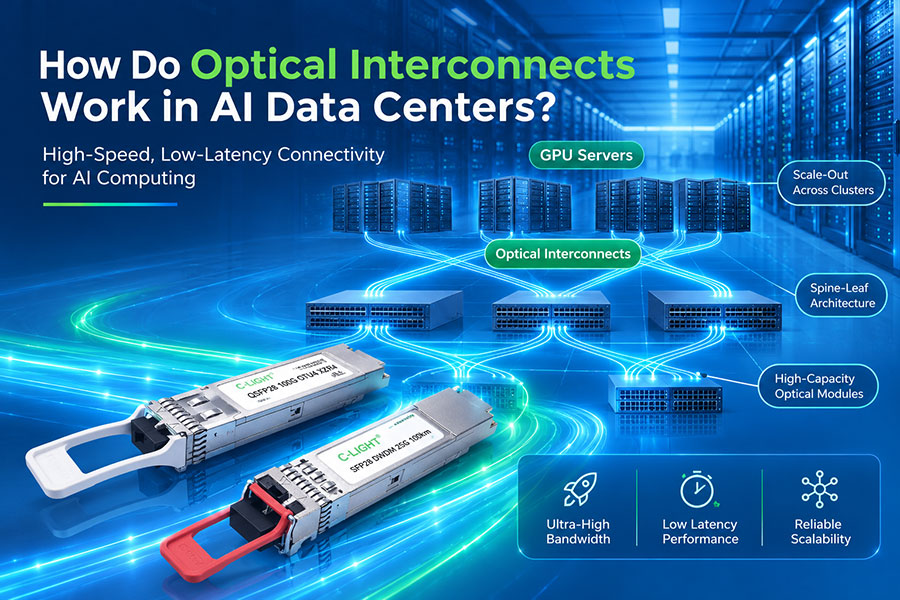
High-performance AI depends not only on faster processors, but also on the ability to transfer enormous volumes of data efficiently between computing, memory, and network systems.
Artificial intelligence infrastructure is undergoing a fundamental shift. Large language models, generative AI, recommendation systems, and distributed inference platforms require extensive communication between GPUs, AI accelerators, memory subsystems, storage platforms, and network switches. As deployments grow from individual servers to thousands of interconnected accelerators, moving data has become a major part of overall system performance.
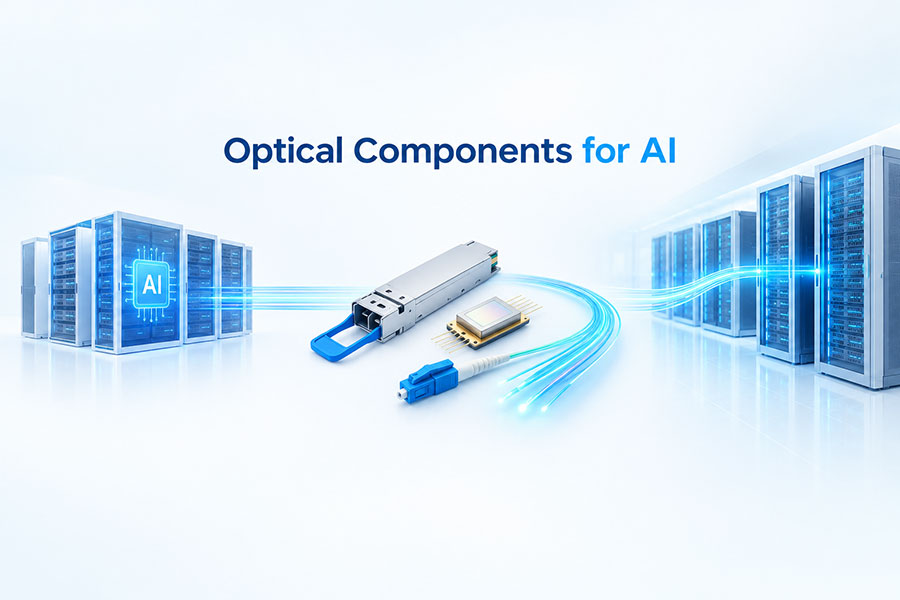
Optical components are becoming critical because they support high-bandwidth communication across the distances and connection densities required by modern AI clusters. Optical transceivers, lasers, photodetectors, fiber-optic connectors, silicon photonics, and optical switching technologies each contribute to the communication infrastructure that keeps distributed computing resources connected.
The transition is not simply about replacing every copper connection with fiber. It is about selecting the right electrical and optical technologies for each link, balancing bandwidth, distance, power consumption, cost, serviceability, and reliability throughout the AI infrastructure.
1. AI Workloads Are Increasing Network Traffic
AI training and inference place different but increasingly demanding requirements on data center networks. During distributed training, accelerators exchange parameters, gradients, activations, and synchronization data. Inference systems coordinate model execution, access memory and storage, and communicate with other services. These operations can generate substantial east-west traffic between servers and racks.
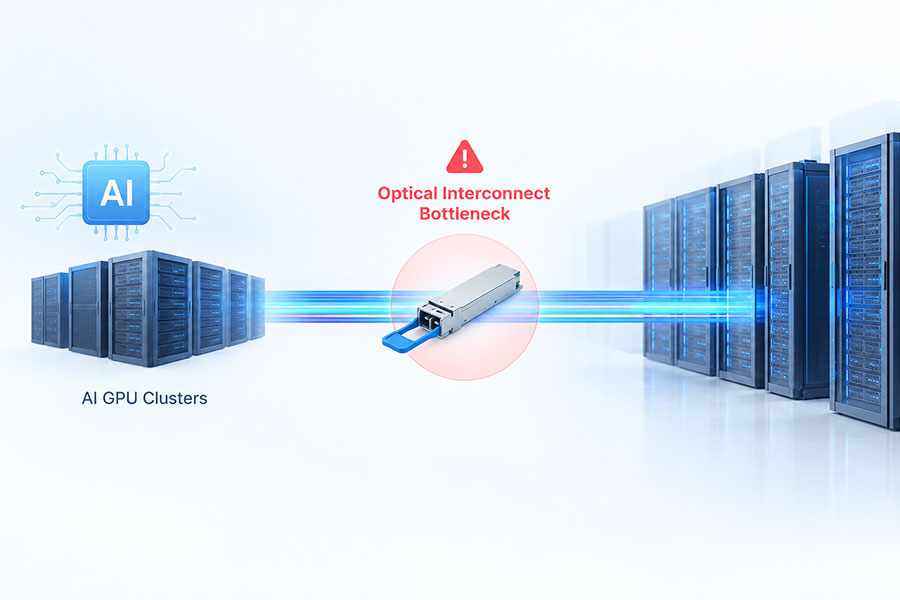
When network bandwidth cannot keep pace with computing capacity, accelerators may spend more time waiting for data instead of performing useful calculations. Network congestion, communication overhead, and inefficient data movement can reduce the throughput of an otherwise powerful AI cluster.
As accelerator counts and per-device performance increase, network infrastructure must support greater aggregate throughput and more simultaneous connections. Higher-speed optical links help provide the bandwidth needed to move data between nodes while maintaining connectivity across larger physical environments.
The infrastructure challenge: More computing power does not automatically produce proportional gains in AI performance. The communication fabric must deliver sufficient bandwidth, predictable behavior, and reliable connectivity to keep distributed resources working efficiently.
2. Optical Components Support Different Levels of AI Connectivity
AI infrastructure uses several networking layers, each with distinct distance and bandwidth requirements. Optical technologies are particularly important as connections extend across racks, rooms, buildings, and separate data center facilities.
| Connectivity Layer | Primary Function | Relevant Optical Technologies |
|---|---|---|
| Scale-up | Connects accelerators and computing resources within a tightly integrated system or rack-scale architecture. | High-density optical interconnects, silicon photonics, and emerging near-package or co-packaged optics where the architecture requires them. |
| Scale-out | Connects servers, switches, and accelerator nodes across racks within a data center. | Pluggable optical transceivers, single-mode or multimode fiber, and high-density fiber connectivity. |
| Scale-across and DCI | Extends AI resources across data halls, buildings, or geographically separated facilities. | Longer-reach optical transceivers, coherent optics where appropriate, DWDM systems, and optical transport components. |
These layers should not be treated as interchangeable. Short connections may remain electrical when copper provides the most practical solution. Optical links become increasingly attractive when electrical reach, signal integrity, cabling density, or power requirements make the existing connection approach difficult to scale.
3. Higher Bandwidth Is Driving Optical Technology Upgrades
AI network roadmaps are progressing from 100G-class connections toward 400G, 800G, and 1.6T optical transceivers. These designations generally describe aggregate data rates, rather than the rate of an individual optical lane. Actual lane configurations and electrical interfaces depend on the transceiver generation, form factor, protocol, and implementation.
Raising aggregate throughput requires coordinated improvements across electrical signaling, optical modulation, photodetection, digital signal processing, packaging, and fiber connectivity. An optical module cannot deliver its intended performance unless its electrical interface, host platform, optical link, and receiving equipment operate as a compatible system.
Optical Transceivers
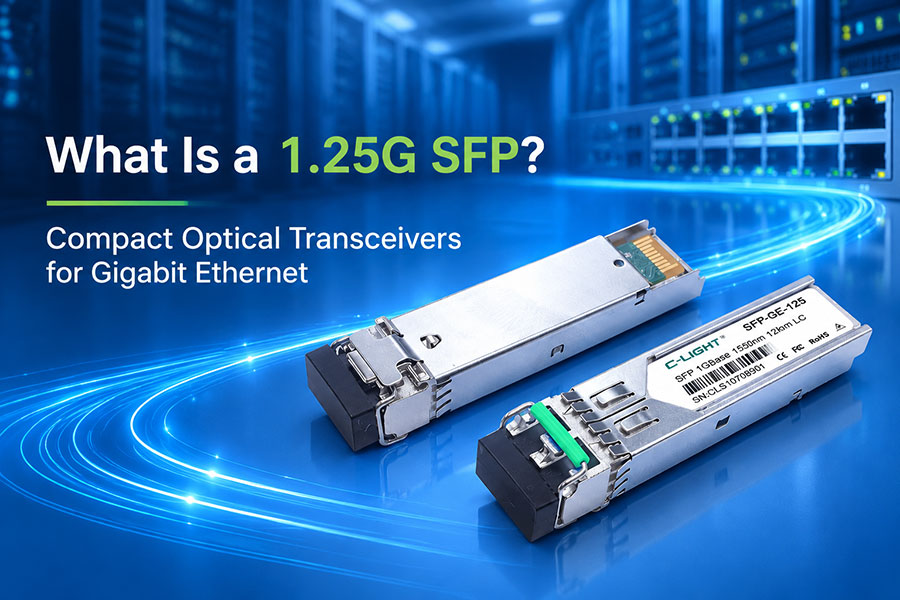
Optical transceivers convert electrical signals into optical signals for transmission and convert received light back into electrical signals. They provide a practical way to connect switches, servers, and network equipment through fiber links.
Different data rates, reaches, wavelengths, and fiber types require different transceiver designs. For AI data centers, 400G and 800G modules are relevant to high-bandwidth connections, while 1.6T designs target emerging requirements for even greater aggregate throughput. The appropriate choice depends on the host platform, link topology, power envelope, and deployment distance.
Lasers and Photodetectors
Lasers generate the optical signal, while photodetectors convert incoming light into an electrical response. Their performance affects link margin, signal quality, receiver sensitivity, operating stability, and overall transceiver reliability.
As lane rates increase, component characteristics such as modulation capability, bandwidth, noise, thermal behavior, and manufacturing consistency become increasingly important. The optical source and receiver must be engineered for the selected transmission technology rather than evaluated as isolated components.
Fiber-Optic Connectors and Cabling
Fiber connectivity carries the optical signal between active devices. LC duplex connectors are widely used for two-fiber links, while MPO/MTP connectivity supports multiple fibers in high-density parallel-optics deployments. The required connector configuration depends on the optical interface and link architecture.
Higher port counts make cable routing, polarity, fiber mapping, bend radius, cleanliness, and connector inspection essential. A poorly managed fiber plant can introduce insertion loss, connection faults, and troubleshooting complexity even when the transceivers themselves meet their specifications.
4. Power Efficiency and Signal Reach Matter as Much as Speed
AI data centers operate under substantial power and cooling constraints. Every additional switch port, transceiver, signal-conditioning circuit, and network hop contributes to the system's operating requirements. As network capacity increases, simply raising bandwidth without controlling energy consumption can make infrastructure expansion more difficult.
Optical links can provide advantages over electrical transmission at suitable distances and data rates because optical signals travel through fiber with low attenuation and avoid the same transmission-line loss mechanisms found in high-speed copper paths. However, the complete energy cost still depends on the transmitters, receivers, DSPs, drivers, thermal design, and network architecture.
Reach also changes the design trade-offs. Copper can be effective for short links, but higher signaling rates make insertion loss, crosstalk, equalization, and signal integrity increasingly demanding. Optical transmission can extend connectivity beyond practical electrical reach while supporting high bandwidth and dense network layouts.
Optics do not automatically guarantee lower latency or lower power in every application. Electrical-to-optical conversion, optical-to-electrical conversion, signal processing, and switching architecture all affect the final result. System-level evaluation is therefore essential when choosing between copper and optical technologies.
5. Integrated Optics Are Changing AI Network Architecture
Traditional pluggable transceivers place optical conversion hardware in a removable module connected to a host's electrical interface. This arrangement provides modularity and serviceability, making it useful for many existing data center deployments. As link speeds rise, however, the electrical distance between the host ASIC and the optical engine becomes an increasingly important design consideration.
Several architectures aim to bring optical conversion closer to the switching or computing silicon. Their purposes overlap, but their integration levels and deployment trade-offs differ.
| Architecture | Design Approach | Key Consideration |
|---|---|---|
| Pluggable Optics | Uses removable optical transceiver modules connected through the host electrical interface. | Established modularity, field replacement, and flexibility, with electrical reach and module power remaining important design factors. |
| LPO / LRO | Uses linear or linear receive-oriented approaches to reduce selected signal-processing functions or simplify portions of the electrical signal path. | Potential power and latency benefits, balanced against system-level signal integrity, interoperability, and host-design requirements. |
| NPO | Places optical engines near the host package while retaining a degree of separation from the main silicon package. | Shorter electrical paths while aiming to preserve practical assembly, maintenance, and sourcing options. |
| CPO | Integrates optical engines closely with a host ASIC package. | High bandwidth density and potential energy benefits, alongside complex thermal design, packaging, testing, and serviceability challenges. |
| Optical Circuit Switching | Uses optical switching to establish configurable optical paths between network endpoints or groups of endpoints. | Can support flexible network topology and resource utilization, but depends on control, scheduling, and application-specific requirements. |
These technologies are not universal replacements for one another. Pluggable optics will remain relevant where modularity and serviceability are valuable, while LPO/LRO, NPO, CPO, and optical circuit switching address different constraints in emerging network designs. Actual deployment depends on system maturity, power targets, reliability, cost, and the operational needs of the AI cluster.
6. Optical Component Quality Directly Affects Network Reliability
AI clusters rely on many interconnected links operating concurrently. A failure or performance issue in an individual connection can trigger retransmissions, link recovery, degraded network performance, or service interruption. With large numbers of ports and fiber connections, component consistency and installation quality become important parts of overall system reliability.
Optical component selection and validation should cover more than nominal data rate. Important parameters include:
Optical transmit power and receiver sensitivity: Confirm that the link provides adequate power margin for its intended reach and fiber path.
Insertion loss and return loss: Evaluate connector, splice, and optical path losses against the link budget.
Bit error rate and FEC behavior: Validate error performance under the intended operating conditions and supported forward error correction settings.
Thermal and power performance: Check module power consumption, temperature limits, airflow, and cooling compatibility.
Host compatibility: Confirm form factor, lane mapping, supported protocol, firmware behavior, and platform requirements.
Monitoring and diagnostics: Use supported diagnostic functions to track operating temperature, supply voltage, laser bias, and optical power where available.
These checks help distinguish a component-level defect from problems involving fiber cabling, host configuration, thermal conditions, or network design. A documented validation process is especially useful when scaling from laboratory evaluation to a large production deployment.
7. Supply Chains and Deployment Planning Are Becoming More Important
Optical infrastructure depends on a broad component ecosystem, including semiconductor lasers, photodetectors, optical materials, fiber, connectors, packaging technologies, and precision assembly and test equipment. As AI data center capacity expands, the availability of these components can influence deployment schedules and the ability to scale network capacity.
Procurement planning should account for qualification lead times, product lifecycle, manufacturing consistency, and second-source strategies where the design permits them. Substituting a component based only on headline data rate can introduce changes in power consumption, link budget, host compatibility, or thermal performance.
For larger deployments, engineering teams should define interface requirements and acceptance criteria before committing to volume production. Representative testing across target platforms, cable assemblies, operating temperatures, and anticipated link distances can reduce the risk of issues emerging only after deployment.
The objective is not simply to secure more optical modules. It is to build a repeatable, validated connectivity system in which transceivers, optical components, fiber assemblies, switches, and monitoring procedures work together reliably.
8. Conclusion
Optical components are becoming critical to AI infrastructure because the growth of accelerator performance and cluster size is increasing the demands placed on data movement. High-speed optical transceivers, laser sources, photodetectors, silicon photonics, fiber connectivity, and optical switching technologies help address bandwidth, reach, density, and power challenges across different parts of the network.
The transition will not follow a single architecture. Copper, pluggable optics, linear optics, near-package optics, and co-packaged optics can each have a role depending on link distance, bandwidth, power limits, cost, and maintenance requirements. The most effective AI infrastructure combines these technologies according to the needs of each connection while validating performance at the system level.
As AI deployments continue to expand, optical component selection, interoperability, quality assurance, and supply-chain planning will remain important factors in building scalable and reliable network infrastructure.
9. Frequently Asked Questions
Why are optical components important for AI data centers?
They enable high-bandwidth data transmission between servers, switches, accelerator systems, and data center facilities. This helps AI clusters scale while addressing reach, cabling density, and signal-integrity requirements.
Will optical connections replace copper in AI infrastructure?
Not entirely. Copper remains useful for many short-reach connections, while optics become increasingly attractive as bandwidth, reach, and cabling-density requirements rise. The appropriate medium depends on the system architecture and operating constraints.
What is the difference between optical transceivers and silicon photonics?
An optical transceiver is a complete device or module that transmits and receives optical signals. Silicon photonics is an integration technology that uses photonic structures fabricated on a silicon platform to implement functions such as modulation, routing, and detection, often alongside other optical and electronic components.
Are CPO and NPO suitable for every AI network?
No. CPO and NPO address particular integration, power, and bandwidth-density challenges. Their suitability depends on port speed, package design, thermal conditions, manufacturing maturity, serviceability, and total system requirements. Conventional pluggable transceivers remain appropriate for many deployments.
What should engineers verify before deploying optical components?
Key checks include data rate, interface and lane mapping, protocol support, fiber type, connector configuration, transmission distance, optical power budget, error performance, power consumption, thermal limits, and compatibility with the target host equipment.
Planning an AI data center connectivity solution?
Review optical transceiver options and interface requirements to identify components suited to your bandwidth, reach, and platform needs.
Contact C-LIGHT