
With the rapid growth of AI computing, data centers are transforming from storage-centric architectures into compute and interconnect-driven infrastructures.
Whether for large-scale AI model training clusters or inference platforms, high-speed, low-latency connectivity has become a critical factor determining overall system performance.
Among various networking solutions, DAC (Direct Attach Copper) cables and AOC (Active Optical Cables) have become essential components for modern AI data center infrastructure.
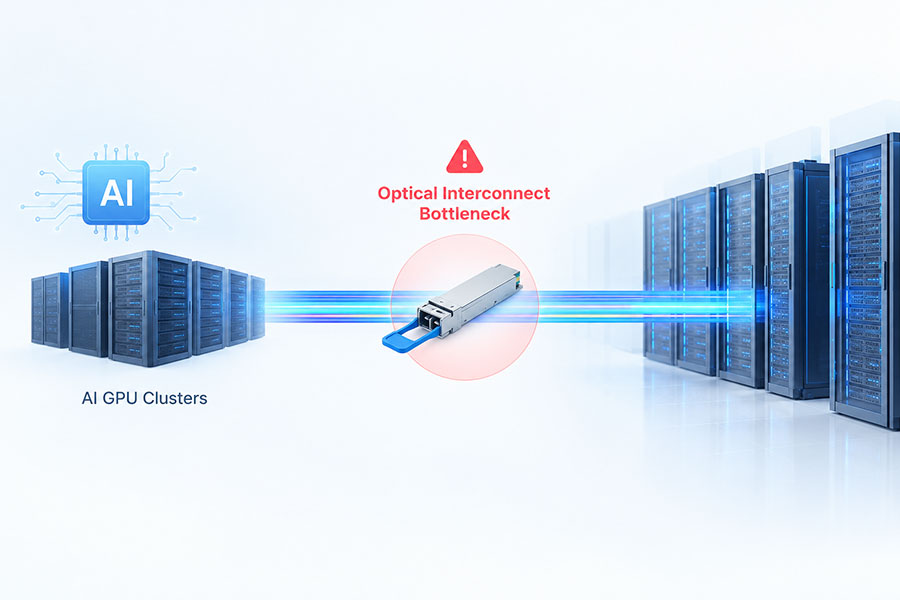
In the past, GPU and CPU performance were considered the primary factors determining computing capability. However, in real-world AI clusters, another critical challenge has emerged:
Data transmission speed often cannot keep pace with computing performance growth.
During large-scale AI model training, such as thousands of GPUs operating in parallel, frequent parameter synchronization through All-Reduce communication is required.
If network bandwidth is insufficient or latency is too high, it can directly result in:
Reduced GPU utilization
Longer AI model training time
Increased energy consumption
This is why the concept of “Network is the Computer” is being revalidated in the AI era.
https://www.c-light.com/products/AOC_DAC/DAC.html
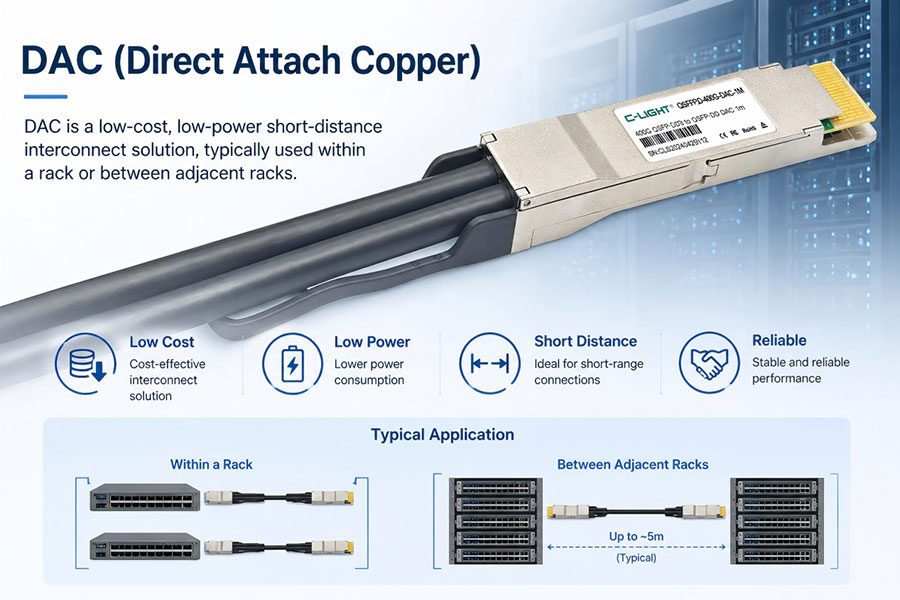
DAC is a low-cost, low-power short-distance interconnect solution, mainly used for connections within the same rack or between adjacent racks.
Ultra-low latency with no active optical components
Extremely low power consumption without optical-electrical conversion
Significant cost advantages
High reliability
ToR switch ↔ Server connections
Internal GPU server interconnects
Short-distance high-speed connections (≤3–5m)
10G / 25G / 100G / 400G networking
In AI clusters, DAC serves as the high-density and cost-efficient connectivity foundation.
https://www.c-light.com/products/AOC_DAC/AOC.html
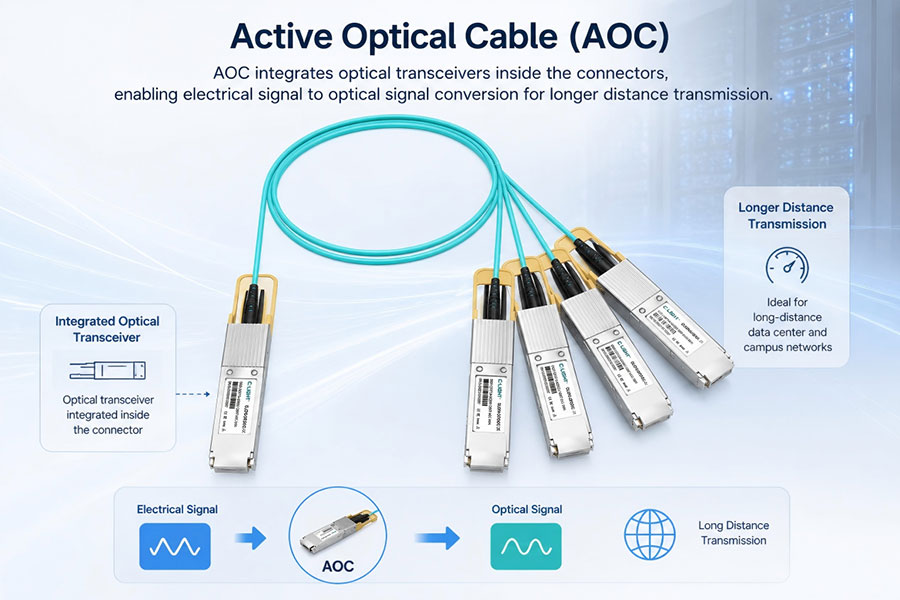
AOC integrates optical transceiver components inside the cable assembly, converting electrical signals into optical signals for longer-distance transmission.
Longer transmission distance (up to 100m+)
Strong resistance to electromagnetic interference
Higher bandwidth scalability (supporting 400G, 800G, and beyond)
Suitable for complex data center cabling environments
Rack-to-rack interconnects in Leaf-Spine architectures
Cross-rack GPU cluster communication
High-speed switch-to-switch connections
AOC acts as the high-bandwidth bridge for medium-distance AI data center interconnects.
AI workloads are driving exponential growth in network bandwidth requirements.
Examples:
Large AI model training requires Tbps-level throughput
GPU-to-GPU communication requires non-blocking networks
DAC and AOC solutions support current and future high-speed standards, including 400G and 800G connectivity, making them practical solutions for next-generation AI networks.
AI data centers are already facing enormous power and thermal challenges.
High-power interconnect solutions can further increase operational costs.
Advantages:
DAC:
Almost zero additional power consumption
AOC:
Lower energy consumption compared with traditional optical transceiver + fiber solutions
At large deployment scales, this directly impacts TCO (Total Cost of Ownership).
Compared with traditional optical transceiver and fiber patch cord solutions:
DAC and AOC provide:
Integrated cable solutions
No additional configuration requirements
Fewer potential failure points
For massive AI clusters with thousands of network ports, simplified deployment and maintenance are extremely important.
Modern AI data centers commonly adopt:
Spine-Leaf network architectures
GPU POD architectures
Large-scale parallel computing clusters
These architectures share one common characteristic:
A dramatic increase in interconnection requirements.
DAC enables high-density short-distance connections, while AOC provides flexible expansion between racks.
Together, they achieve:
Optimized cost
Maximum performance
Flexible network architecture
| Solution | Cost | Power Consumption | Distance | Bandwidth | Application |
|---|---|---|---|---|---|
| DAC | Low | Very Low | Short | High | Intra-rack connectivity |
| AOC | Medium | Low | Medium | Very High | Rack-to-rack connections |
| Optical Transceiver + Fiber | High | Higher | Long | Extremely High | Backbone networks |
DAC and AOC provide the optimal balance between performance, scalability, and deployment cost for AI data centers.
As AI models continue to expand in scale, interconnect technologies are also evolving rapidly.
Future trends include:
Wider adoption of 800G DAC and AOC solutions
Silicon Photonics enabling higher integration levels
Growing interest in CPO (Co-Packaged Optics) technology
However, one thing is clear:
DAC and AOC will continue to coexist and evolve as fundamental interconnect technologies for AI data centers in the foreseeable future.
They will remain critical solutions for building efficient, scalable, and high-performance AI networking infrastructures.
Answer: AI data centers require high-speed interconnect solutions because modern AI workloads generate massive data traffic between GPUs, servers, and network switches.
Large AI clusters rely on continuous communication for:
Large Language Model (LLM) training
Distributed AI computing
GPU synchronization
High-performance computing (HPC)
Traditional network connections cannot efficiently support the increasing bandwidth demand of AI workloads.
DAC and AOC interconnect solutions provide:
High bandwidth
Low latency
Efficient rack connectivity
Reliable GPU cluster communication
They have become essential components in modern AI data center architectures.
Answer: DAC (Direct Attach Copper) is a high-speed copper cable solution designed for short-distance data center connections.
DAC uses direct electrical transmission without optical conversion, providing:
Extremely low power consumption
Low latency
Cost-effective deployment
Simple installation
Typical AI data center applications include:
GPU server to ToR switch connections
In-rack interconnects
Short-distance switch connections
DAC is especially suitable for high-density AI racks where distance is limited and power efficiency is a priority.
Answer: AOC (Active Optical Cable) combines optical fiber transmission with integrated optical components inside the cable assembly.
Compared with DAC, AOC provides:
Longer transmission distance
Better electromagnetic interference resistance
Lighter cable design
Higher installation flexibility
AOC is commonly used for:
Rack-to-rack connections
GPU cluster interconnects
HPC networks
Cloud data center links
For AI infrastructure, AOC provides a balance between transmission distance, performance, and deployment flexibility.
Answer: The main difference between DAC and AOC is the transmission medium and application distance.
| Feature | DAC | AOC |
| Transmission Medium | Copper | Optical Fiber |
| Distance | Short Reach | Medium Reach |
| Power Consumption | Lowest | Low |
| Cost | Lower | Higher |
| Cable Weight | Heavier | Lighter |
| EMI Resistance | Limited | Excellent |
| Main Application | In-rack connections | Rack-to-rack connections |
DAC is preferred for short, cost-sensitive connections, while AOC is better suited for longer and more flexible AI data center deployments.
Answer: AI data centers usually select DAC or AOC based on distance, bandwidth requirements, cost, and deployment environment.
DAC is suitable for:
Short-distance GPU server connections
High-density racks
Cost-sensitive deployments
Low-power applications
AOC is suitable for:
Cross-rack connections
Longer cable distances
High-density cable management
Environments requiring better signal stability
A hybrid deployment of DAC and AOC is commonly used in large AI clusters to optimize performance and cost.
Answer: AI workloads are driving rapid upgrades from traditional 100G/200G networks toward 400G and 800G interconnect architectures.
Higher-speed DAC and AOC solutions help AI data centers achieve:
Higher GPU communication bandwidth
Lower network congestion
Better rack scalability
Improved AI training efficiency
Typical applications include:
400G DAC/AOC
AI server connectivity
Leaf-spine networks
High-performance computing
800G DAC/AOC
Large GPU clusters
Hyperscale AI infrastructure
Next-generation AI fabrics
Answer: AI Fabric requires high-speed, low-latency communication between thousands of GPUs.
DAC and AOC provide the physical layer connectivity required for:
GPU-to-switch communication
Switch-to-switch connections
AI training networks
Distributed computing systems
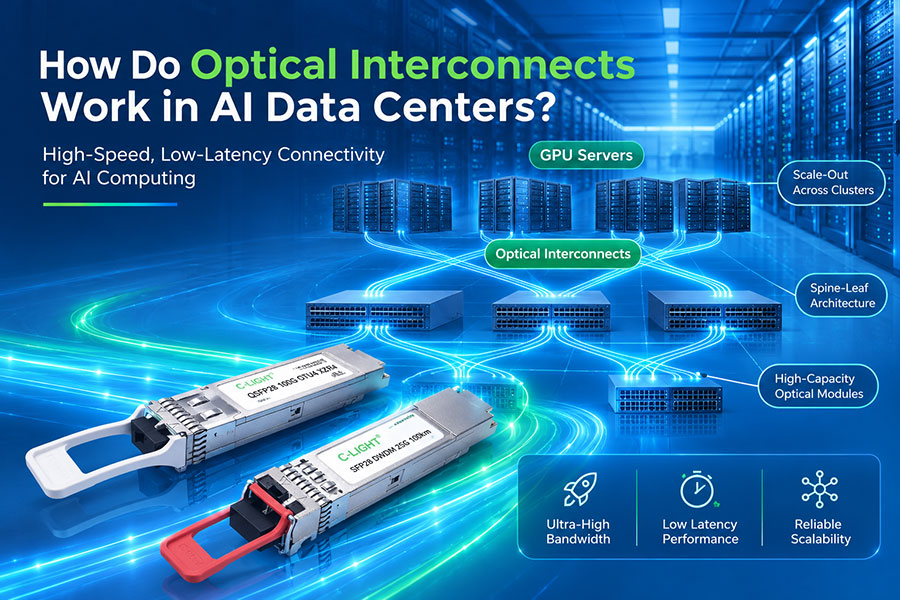
A typical AI data center architecture may include:
GPU Server Layer
→ DAC connections for short-distance links
Rack / Leaf Layer
→ AOC connections for flexible high-speed transmission
Spine Network Layer
→ Optical transceivers for large-scale backbone connectivity
This combination enables scalable AI networking infrastructure.
Answer: DAC and AOC will continue to play important roles as AI data centers evolve toward higher bandwidth architectures.
Future trends include:
800G DAC deployment
800G AOC expansion
1.6T interconnect development
Higher-density GPU clusters
Advanced AI Fabric architectures
DAC will continue providing low-cost, low-power short-reach connectivity, while AOC will support more flexible and scalable optical-based connections.
Together with optical transceivers, DAC and AOC will remain key technologies supporting next-generation AI infrastructure.
For any questions, please contact us by email or WhatsApp.
Email: sales@c-light.com
WhatsApp: +86 132 6656 7067