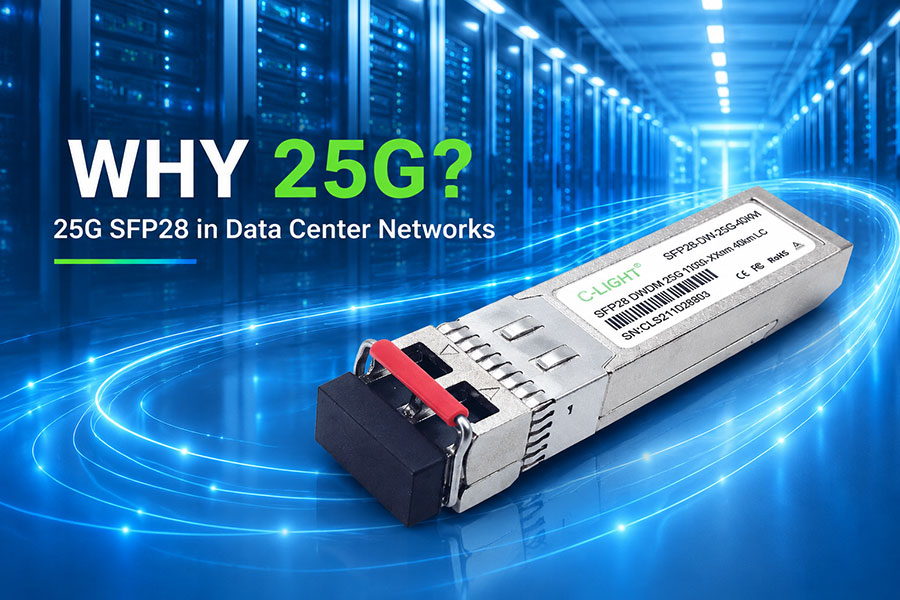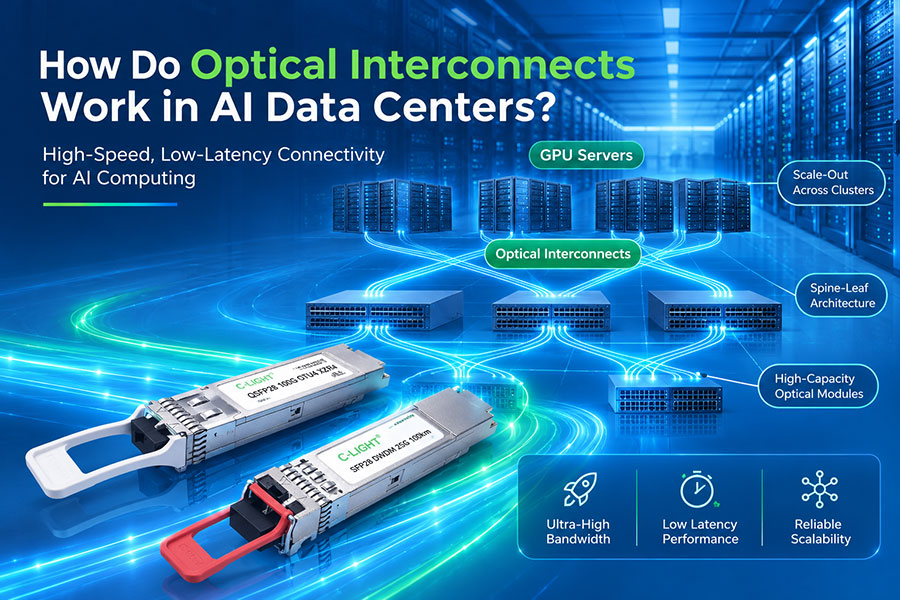

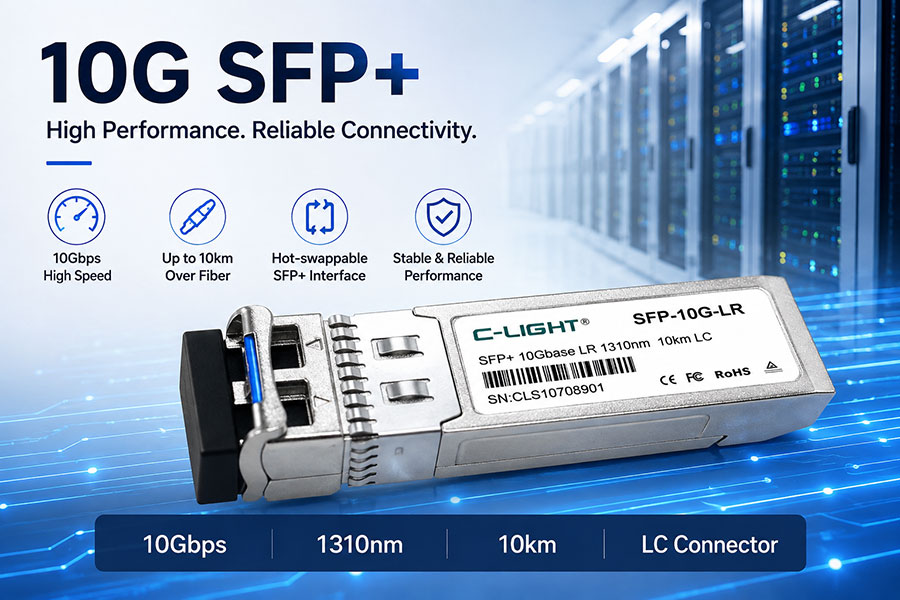
10G SFP+ is a compact, hot-swappable optical or copper transceiver designed to provide 10Gbps network connectivity through an SFP+ port. It is widely used in data centers, enterprise networks, server connections, storage systems, and high-speed Ethernet networks.
Compared with traditional SFP transceivers, 10G SFP+ supports significantly higher data rates while maintaining the compact SFP form factor. Depending on the transmission medium and application, 10G SFP+ modules are available in different optical wavelengths, transmission distances, and interface types.
10G SFP+ Optical Transceiver | 10GbE Ethernet Module for High-Speed Networks丨C-LIGHT
SFP+ stands for Small Form-factor Pluggable Plus. The "+" indicates an enhanced version of the SFP form factor designed for higher-speed applications, including 10GbE and 10G Fibre Channel.
A 10G SFP+ transceiver generally consists of a transmitter, receiver, optical or electrical components, control circuitry, and a standardized host interface. The module converts electrical data from network equipment into optical signals for fiber transmission, or into electrical signals for copper-based Ethernet connections.
Data Rate: Up to 10Gbps
Form Factor: SFP+
Applications: 10GbE, 10G Fibre Channel, data center and enterprise networking
Media: Single-mode fiber, multimode fiber, or copper
Installation: Pluggable and hot-swappable
A 10G SFP+ transceiver operates as the interface between network equipment and the physical transmission medium. On the transmitting side, the module receives electrical signals from a switch, router, server, or network interface card and converts them into optical or electrical signals. At the receiving side, the module converts the incoming signal back into an electrical signal for the host device.
For optical 10G SFP+ modules, the transmitter typically uses a laser such as an FP, DFB, or EML laser depending on the application. The receiver uses a photodetector to recover the incoming optical signal. Copper 10G SFP+ modules instead use electrical signaling over twisted-pair Ethernet cabling.
10G SFP+ modules can be classified according to transmission medium, wavelength, and transmission distance. The most common types include 10GBASE-SR, 10GBASE-LR, 10GBASE-ER, and 10GBASE-T.
10GBASE-SR SFP+ modules are designed for short-distance transmission over multimode fiber. They commonly operate around the 850nm wavelength and are widely used for server-to-switch and switch-to-switch connections inside data centers.
10GBASE-LR SFP+ modules are designed for longer-distance transmission over single-mode fiber. They typically operate at 1310nm and can support transmission distances of up to 10km, depending on the module and network conditions.
10GBASE-ER SFP+ modules are designed for extended-reach Ethernet links over single-mode fiber. They typically operate around 1550nm and can support significantly longer distances than standard LR modules.
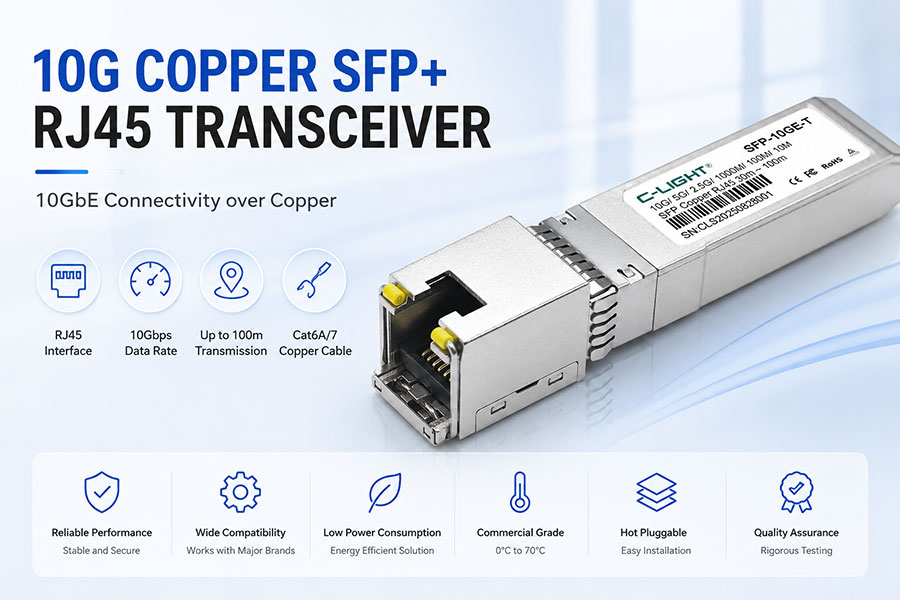
10GBASE-T Copper SFP+ modules provide an RJ45 interface and transmit 10GbE signals over twisted-pair copper cabling. They are particularly useful when existing Cat6A or Cat7 infrastructure needs to be connected to an SFP+ port.
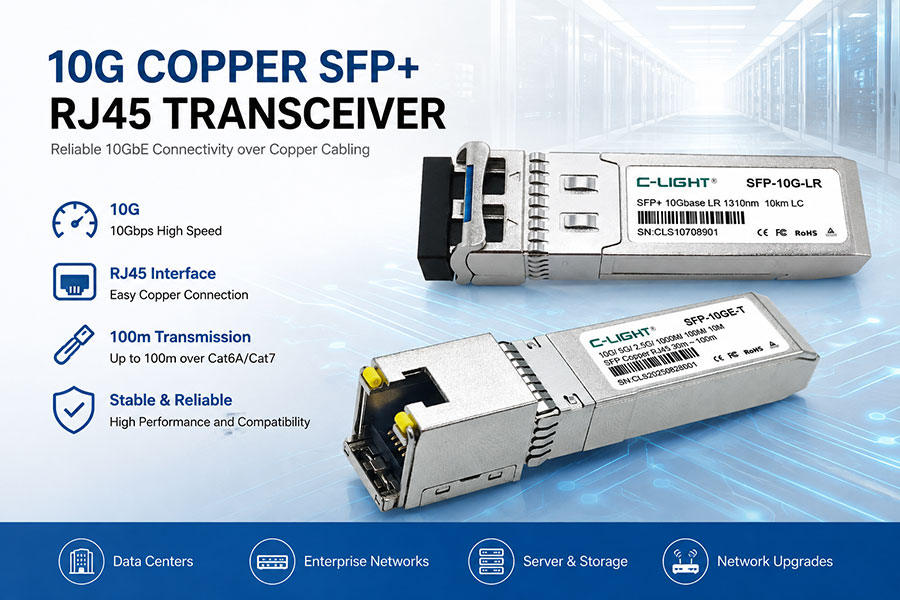
Although both modules use the SFP+ form factor, their transmission methods are different. Optical 10G SFP+ modules use fiber and are generally preferred for longer-distance or fiber-based network connections. Copper SFP+ modules use electrical signaling and RJ45 cabling, making them convenient for short-distance Ethernet connections.
| Feature | 10G Optical SFP+ | 10G Copper SFP+ |
|---|---|---|
| Transmission Medium | Fiber optic cable | Twisted-pair copper cable |
| Connector | LC or other fiber interface | RJ45 |
| Typical Reach | From short-distance links to tens of kilometers | Typically up to 100m |
| Common Applications | Data centers, DCI, enterprise and telecom networks | Enterprise networks, servers and short-distance connections |
The main difference between SFP and SFP+ is the supported data rate. Standard SFP modules are commonly associated with 1Gbps applications, while SFP+ is designed for higher-speed applications such as 10GbE.
SFP+ maintains a similar physical form factor to SFP, which makes it possible for many network devices to provide backward compatibility. However, compatibility depends on the specific switch, router, server, NIC, firmware, and transceiver specifications.
10G SFP+ provides 10Gbps connectivity in a compact pluggable form factor, making it suitable for high-bandwidth network connections and data-intensive applications.
The small SFP+ design allows network equipment manufacturers to integrate a high number of ports into switches, routers, servers, and storage systems.
Different 10G SFP+ modules support multimode fiber, single-mode fiber, and copper cabling. This allows network designers to select the appropriate transceiver according to distance, infrastructure, and application requirements.
Because SFP+ modules are pluggable, network operators can upgrade or replace individual transceivers without replacing the entire networking device.
10G SFP+ transceivers are widely deployed in environments where higher bandwidth and flexible connectivity are required.
Data Centers: Used for switch-to-switch, server-to-switch, and storage network connections.
Enterprise Networks: Provides high-speed uplinks between network switches and aggregation devices.
Server and Storage: Supports high-bandwidth connections for servers, NAS, SAN, and other storage systems.
Data Center Interconnect: Long-reach optical SFP+ modules can be used for connecting geographically separated facilities.
Network Upgrades: Provides a practical path from 1GbE infrastructure toward 10GbE connectivity.
Selecting a 10G SFP+ transceiver requires more than simply checking the 10Gbps data rate. The module should match the host device, transmission medium, connector, wavelength, and required transmission distance.
Check the Host Port: Confirm that the switch, router, server, or NIC supports the required SFP+ module.
Determine the Distance: Select SR, LR, ER, or another suitable module according to the required link distance.
Select the Fiber Type: Use multimode fiber for appropriate short-distance applications and single-mode fiber for longer-distance links.
Consider Copper Connectivity: Choose 10GBASE-T Copper SFP+ when RJ45 connectivity and existing copper cabling are preferred.
Verify Compatibility: Check coding, firmware, EEPROM information, power consumption, and vendor compatibility before deployment.
Although data center networks are increasingly moving toward 25G, 100G, 400G, and higher-speed optical connectivity, 10G SFP+ remains useful for access-layer connections, management networks, legacy infrastructure, and equipment that does not require higher bandwidth.
Its compact form factor, broad ecosystem, and availability in both optical and copper configurations make 10G SFP+ a practical option for maintaining and upgrading existing network infrastructure.
A 10G SFP+ is a compact, pluggable transceiver designed to provide 10Gbps network connectivity. It is available in multiple configurations, including short-reach multimode fiber, long-reach single-mode fiber, extended-reach optical modules, and 10GBASE-T copper modules.
For fiber-based networks, the appropriate 10G SFP+ should be selected according to transmission distance, fiber type, wavelength, and connector. For existing copper infrastructure, a 10G Copper SFP+ with an RJ45 interface can provide a convenient way to connect 10GbE equipment without replacing the copper cabling.
Answer: A 10G SFP+ is a pluggable transceiver designed to provide up to 10Gbps network connectivity through an SFP+ port.
Answer: SFP+ is a transceiver form factor and category commonly used for 10GbE applications. The actual supported speed depends on the specific module and host device.
Answer: The transmission distance depends on the module type. SR is designed for short-distance multimode fiber links, while LR and ER modules support longer single-mode fiber connections.
Answer: Many 10G SFP+ modules use fiber optic cables, but 10GBASE-T Copper SFP+ modules can also provide 10GbE connectivity through RJ45 copper cabling.
Answer: SFP is commonly used for 1Gbps-class applications, while SFP+ is designed for higher-speed applications such as 10GbE. Their physical form factors are similar, but their electrical and performance specifications differ.
Answer: No. Physical compatibility does not guarantee operational compatibility. The host device must support the specific SFP+ module and its operating speed and protocol.
Answer: Optical 10G SFP+ modules use compatible multimode or single-mode fiber, depending on the module. 10GBASE-T Copper SFP+ modules use twisted-pair Ethernet cabling such as Cat6A or Cat7.
Answer: 10G SFP+ transceivers are commonly used in data centers, enterprise networks, servers, storage systems, network uplinks, and other 10GbE infrastructure.
For any questions, please contact us by email or WhatsApp.
Email: sales@c-light.com
WhatsApp: +86 132 6656 7067