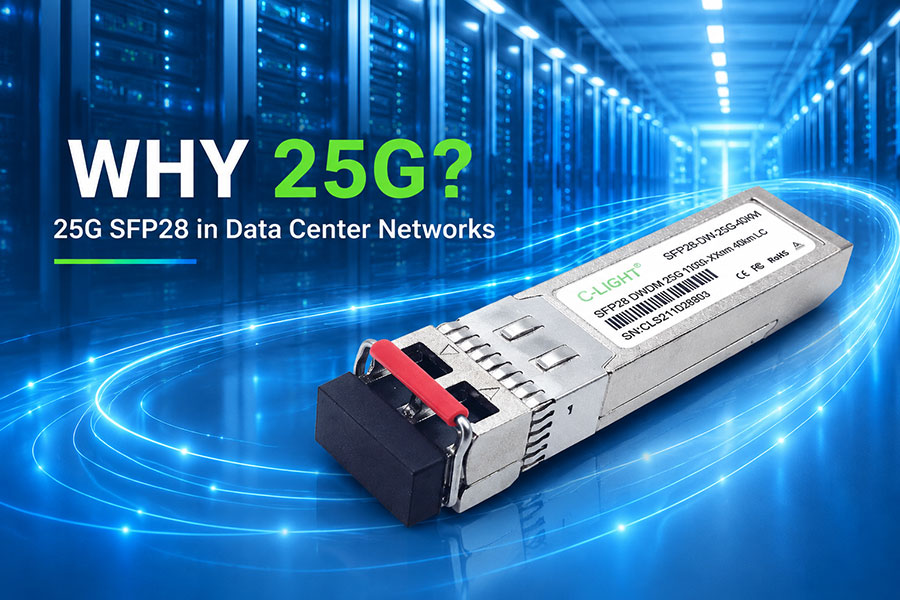
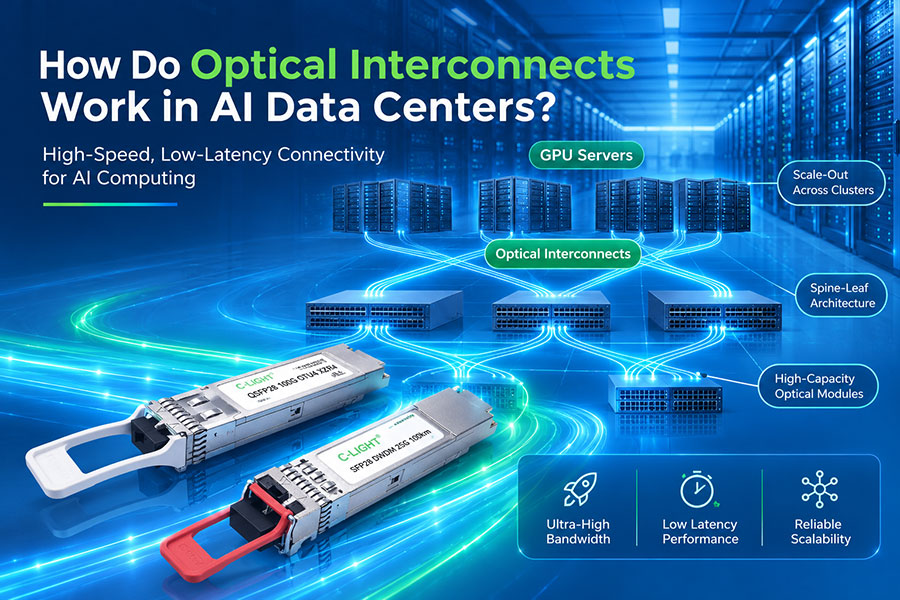
DWDM increases the capacity of data center interconnect networks by carrying multiple independent optical channels over shared fiber infrastructure, supporting scalable connectivity across metro and regional networks.
Cloud computing, artificial intelligence, distributed storage, and enterprise applications are increasing the volume of traffic exchanged between separate data centers. These connections must support high bandwidth, reliable data transfer, predictable performance, and room for future expansion. As traffic grows, installing additional fiber for every new connection can become expensive or impractical.
Dense Wavelength Division Multiplexing (DWDM) addresses this challenge by transmitting multiple optical channels at different wavelengths through the same fiber. Each wavelength can carry an independent data stream, allowing a single fiber pair to support multiple high-capacity connections simultaneously.
When integrated into a Data Center Interconnect (DCI) architecture, DWDM helps operators increase aggregate capacity, make better use of available fiber, and expand optical transport without necessarily installing new fiber for every additional service. The achievable capacity and reach depend on the transceivers, wavelength plan, fiber route, optical line system, and operating requirements.
1. What Is DWDM in Data Center Interconnect?
DCI is the network infrastructure that connects separate data centers. These facilities may be located in neighboring buildings, across a metropolitan area, or in different regions. DWDM is an optical transmission technology that can be used within a DCI network to increase the amount of data carried over shared fiber infrastructure.
Each DWDM channel operates at a designated optical wavelength. A multiplexer combines multiple channels onto a common fiber, and a demultiplexer separates them at the receiving end. With suitable transceivers and line-system components, these wavelengths can carry independent Ethernet or transport traffic between sites.
The approach provides additional capacity without requiring a dedicated fiber pair for every wavelength. It is particularly useful when fiber resources are limited, inter-site traffic is growing, or multiple high-speed services need to share a common optical route.
Core principle: DWDM increases the number of independent optical channels carried over a fiber. Total DCI capacity depends on the usable channel count, the data rate per channel, and the performance of the complete optical transmission system.
2. How DWDM Carries Multiple Data Streams over One Fiber
A DWDM-based DCI link uses several optical components to combine, transport, and separate wavelength channels. A typical arrangement includes the following stages.
Optical Transmitters Generate Wavelength Channels
Each transmitting optical channel converts electrical data into a modulated optical signal. Depending on the system, the transceiver may use a fixed wavelength or a tunable laser configured to operate on a supported DWDM channel.
Each channel must match the optical requirements of the receiving equipment and the wavelength plan of the line system. A tunable module provides wavelength flexibility, but its supported tuning range and channel grid still need to match the intended deployment.
Multiplexers Combine the Channels
A DWDM multiplexer combines signals at different wavelengths into a composite optical signal. The combined signal travels through the same fiber, allowing multiple channels to share the physical route.
Channel spacing determines how closely the wavelengths can be placed within the optical spectrum. Common DWDM systems use defined frequency grids, including 50 GHz or 100 GHz spacing. The actual usable channel count depends on the system's frequency range, channel plan, equipment, and performance requirements.
The Optical Line System Transports the Signal
The multiplexed signal travels through single-mode fiber. Fiber attenuation and component losses reduce optical power along the route. For longer links, optical amplifiers and other line-system components may be needed to maintain transmission performance.
Amplification must be engineered carefully. Optical amplifiers introduce noise, and their gain, input power, output power, and channel loading influence the quality of the received signal. Restoring optical power alone does not guarantee that a long-distance link will operate within its performance limits.
Demultiplexers Separate the Channels
At the receiving site, a demultiplexer separates the combined signal into individual wavelengths. Each channel is then delivered to the corresponding receiver or optical transport endpoint.
The complete transmission path must meet the requirements of each wavelength, including optical power, signal quality, wavelength alignment, and receiver operating limits.
| Component | Role in DCI | Key Design Consideration |
|---|---|---|
| DWDM optical transceiver | Transmits or receives data using a designated optical wavelength. | Data rate, wavelength, modulation, reach, optical power, and endpoint compatibility. |
| DWDM multiplexer | Combines multiple optical channels onto one fiber. | Channel grid, supported wavelength range, insertion loss, and isolation. |
| DWDM demultiplexer | Separates the incoming wavelength channels. | Channel alignment, insertion loss, isolation, and receiver compatibility. |
| Optical amplifier | Compensates for optical power loss where the link design requires amplification. | Gain, noise figure, input/output power, and total channel loading. |
| Optical monitoring and control | Tracks operating conditions and supports fault isolation. | Optical power, alarms, channel performance, and system management integration. |
3. Why DWDM Is Valuable for DCI Networks
Higher Aggregate Capacity
DWDM allows multiple wavelength channels to operate over the same fiber. Rather than transmitting just one data stream over a fiber pair, a network can carry many channels simultaneously. Increasing the data rate of each supported channel can further increase aggregate capacity without requiring a separate fiber pair for every service.
For example, a system carrying 40 independent channels at 100G per channel has a nominal aggregate line rate of 4 Tb/s before accounting for transport overhead and implementation details. This is an illustrative calculation, not a guaranteed capacity for every 40-channel DWDM system.
The number of usable channels and the capacity of each channel must be validated against the optical spectrum, transceiver specifications, line-system design, and required performance margin.
More Efficient Use of Existing Fiber
Fiber construction can be expensive, especially when routes require new ducts, rights of way, or building access. DWDM helps operators add capacity over installed fiber, which can reduce the need to deploy additional physical routes for every traffic expansion.
The benefit is especially important when fiber availability is constrained. However, the existing infrastructure must still provide enough optical performance, supported wavelength capacity, and physical diversity to meet service requirements.
Flexible Capacity Expansion
DWDM can support staged network growth. An operator may activate selected wavelengths initially and add channels as demand increases, provided the installed line system, transceivers, and optical power plan support the additional channels.
Capacity expansion may involve adding transceivers, activating additional wavelengths, upgrading channel rates, or introducing compatible line-system equipment. The appropriate method depends on the existing architecture and available optical margin.
Support for Metro and Regional Connectivity
DWDM is useful for interconnecting data centers over metropolitan and regional distances. When combined with appropriate transceivers, optical amplification, and coherent transport technology, it can support optical paths that extend beyond the reach of many conventional short-reach data center interfaces.
There is no universal distance limit for DWDM. Reach depends on the selected transmission technology, fiber attenuation, optical signal-to-noise ratio, dispersion, channel loading, amplification, and required error performance.
4. How DWDM Increases DCI Capacity
The aggregate capacity of a DWDM system is influenced by two principal factors: the number of usable channels and the data rate carried by each channel. These can be increased through different upgrade strategies.
| Capacity Strategy | How It Works | What Must Be Verified |
|---|---|---|
| Add optical wavelengths | Activates additional supported DWDM channels on the existing fiber. | Available spectrum, channel spacing, multiplexer capacity, optical power, and channel interference. |
| Increase per-channel data rate | Replaces or upgrades existing channel equipment to carry more data per wavelength. | Transceiver support, modulation, OSNR, FEC, line-system capability, and reach. |
| Deploy coherent optics | Uses coherent modulation and detection to support higher spectral efficiency and demanding optical links. | Coherent standard, host interface, optical line system, supported baud rate, and interoperability. |
| Upgrade the optical line system | Improves the wavelength transport infrastructure to support additional channels or new transmission requirements. | Amplifier capacity, noise performance, multiplexers, fiber conditions, and monitoring capability. |
| Add diverse fiber routes | Provides additional physical capacity and can improve resilience when routes are genuinely independent. | Route separation, available fibers, service cost, and redundancy requirements. |
Adding wavelengths is not always sufficient. As channel count and channel data rates increase, the line system must maintain appropriate optical power and signal quality across the operating spectrum. Engineering must account for the combined behavior of the fiber, amplifiers, multiplexers, and all active wavelengths.
5. The Role of Coherent Optics in DWDM DCI
Coherent optical technology has become an important option for high-capacity DCI. A coherent receiver uses a local optical reference and digital signal processing to recover information encoded in the amplitude and phase of an optical signal. Depending on the implementation, coherent modulation can increase spectral efficiency and improve transmission performance over demanding optical paths.
Digital Coherent Optics (DCO) integrates coherent transmission functions into a pluggable transceiver. Depending on the form factor, optical standard, and host platform, a coherent module can connect directly to suitable network equipment and a compatible optical line system.
Coherent technology can support higher-capacity channels, but it does not remove the limits of the physical fiber route. Optical signal-to-noise ratio (OSNR), fiber attenuation, nonlinear effects, channel spacing, amplifier characteristics, and the selected modulation and FEC implementation all influence the achievable reach.
The right choice between direct-detect and coherent optics depends on the data rate, distance, available spectrum, optical infrastructure, power budget, and overall cost. Not every DCI link needs coherent equipment; shorter or lower-capacity connections may be served by simpler optical interfaces.
6. DWDM vs. Direct Optical DCI
DWDM is not mandatory for every data center connection. Direct optical links using compatible transceivers can be suitable when the required capacity and reach fit within the module specifications and available fiber infrastructure. DWDM becomes attractive when multiple services need to share a fiber route or the network requires greater aggregate capacity.
| Characteristic | Direct Optical DCI | DWDM-Based DCI |
|---|---|---|
| Optical channel arrangement | Often uses a dedicated optical link for each connection, subject to interface design. | Combines multiple wavelength channels over shared fiber. |
| Fiber utilization | Depends on the number of links and available fiber pairs. | Can increase capacity per fiber pair by carrying multiple wavelengths. |
| System complexity | Can be simpler for links that require no additional optical line equipment. | Requires wavelength planning and compatible mux/demux or line-system equipment. |
| Capacity expansion | May require additional fiber, ports, or higher-rate interfaces. | May allow more wavelengths or higher-capacity channels to be activated on existing fiber. |
| Typical consideration | Suitable when capacity, distance, and available fiber make direct connectivity practical. | Useful when fiber efficiency and aggregate transport capacity are important. |
The choice should be based on the complete cost and performance of the link. DWDM can reduce the need for additional fiber, but multiplexers, amplifiers, monitoring, and maintenance introduce costs that may not be justified for a small number of short connections.
7. Optical Engineering Considerations for DWDM DCI
A DWDM system must meet both the optical power requirements and the signal-quality requirements of every active channel. A link budget is necessary, but it is not sufficient for evaluating every long-distance or amplified system.
Optical power budget: Calculate the transmitter output, fiber attenuation, connector and splice losses, multiplexer losses, and receiver sensitivity. Confirm that the resulting margin is sufficient for the intended operating conditions.
OSNR and amplifier noise: Evaluate optical signal-to-noise ratio and amplifier performance across the full path. Adequate received power does not necessarily indicate adequate signal quality.
Wavelength compatibility: Confirm the transceiver wavelength, channel spacing, tuning capability, and compatibility with the mux/demux and line system.
Channel loading: Evaluate total optical power and per-channel power when activating or removing wavelengths. Amplifiers and line systems must operate within their supported conditions.
Dispersion and nonlinear effects: Assess the relevant transmission impairments for the selected fiber route, channel rate, optical power, and modulation technology.
Receiver overload: Ensure received power remains within the receiver's specified operating range, using attenuation where the design requires it.
Resilience: Verify that redundant links use adequately independent routes and that monitoring and failover procedures meet operational requirements.
Amplified coherent systems often require detailed system-level analysis rather than a simple transmitter-to-receiver power calculation. OSNR, amplifier placement, total channel loading, spectral characteristics, and the transceiver's supported optical operating range all contribute to link feasibility.
8. Related DWDM Products from C-LIGHT
C-LIGHT offers DWDM transceiver families for different data rates and optical network architectures. The following products are relevant starting points for evaluating DCI applications. Exact suitability depends on the selected model, optical reach, wavelength plan, host equipment, and line-system requirements.
DWDM DCO Coherent Transceivers: 100G to 800G
C-LIGHT's DWDM DCO portfolio includes 100G, 200G, 400G, and 800G coherent transceiver options in form factors that include QSFP28, CFP2, QSFP-DD, and OSFP. The product family uses tunable C-band DWDM technology and lists support for coherent application families such as 400ZR, 800ZR, and OpenZR+.
These products are relevant when a DCI deployment requires coherent transmission, higher-capacity optical channels, or tunable wavelength flexibility. A specific module's supported reach depends on the applicable variant, optical standard, line system, fiber route, and operating conditions. Compatibility with the target switch or router should be checked before selection.
View C-LIGHT DWDM DCO Coherent TransceiversDWDM 100G / 40G / 25G Optical Transceivers
This product family covers 25G SFP28, 40G QSFP+, and 100G QSFP28 options, including fixed-wavelength and tunable DWDM configurations. The portfolio is relevant to existing metro networks, regional optical transport, enterprise networks, and selected DCI links.
Some configurations are designed for shorter links, while others target longer optical paths. Before choosing a module, confirm the exact wavelength, distance specification, optical budget, connector, and whether the planned deployment requires a DWDM multiplexer or a compatible line system.
View C-LIGHT DWDM 100G / 40G / 25G TransceiversOptical Transceiver Product Portfolio
For network designs that do not require DWDM, C-LIGHT also provides other optical transceiver families for different data rates, fiber configurations, and link distances. Comparing direct optical interfaces with DWDM-based designs can help determine whether additional wavelength multiplexing equipment is justified.
View C-LIGHT Optical Transceiver ProductsFor all options, confirm the latest datasheet, interface standard, form factor, host compatibility, optical power limits, and intended fiber route. Product-family support does not mean every variant is interchangeable or suitable for every DCI deployment.
9. Conclusion
DWDM supports Data Center Interconnect by allowing multiple independent optical channels to share the same fiber infrastructure. This increases aggregate transmission capacity, improves fiber utilization, and provides a flexible foundation for network expansion across metropolitan and regional distances.
Standard DWDM transceivers, tunable wavelength modules, coherent DCO optics, multiplexers, and optical line systems each serve different roles. The appropriate combination depends on the required data rate, distance, channel count, wavelength plan, and availability of existing fiber infrastructure.
A successful deployment requires more than adding wavelengths. Optical power, OSNR, channel loading, receiver limits, equipment interoperability, and route resilience must all be evaluated. With appropriate system design, DWDM can help data centers expand inter-site capacity while making more efficient use of their optical fiber resources.
10. Frequently Asked Questions
How does DWDM increase DCI capacity?
DWDM transmits multiple optical wavelengths through the same fiber. Each wavelength can carry an independent data stream, increasing aggregate capacity without requiring a separate fiber pair for every channel.
Does every DCI network need DWDM?
No. A direct optical link may be sufficient when the required data rate, distance, and fiber availability fit the chosen transceivers. DWDM becomes more valuable when multiple channels must share a fiber route or higher aggregate capacity is required.
Can DWDM support 400G and 800G DCI?
Yes. Suitable coherent or other supported high-speed optical interfaces can carry high-capacity channels in DWDM systems. The specific transceiver must match the host interface, wavelength plan, optical line system, and link performance requirements.
What is the difference between DWDM and coherent optics?
DWDM is a technology for combining multiple wavelengths onto shared fiber. Coherent optics is a transmission technology that uses coherent modulation and detection to recover optical signals. Coherent transceivers can operate as channels within a DWDM system when their specifications are compatible.
Does adding more DWDM wavelengths always increase usable capacity?
Not automatically. The line system must support the additional channels and maintain sufficient optical power and signal quality. Available spectrum, channel spacing, amplifier performance, OSNR, and total channel loading can limit practical capacity.
Which C-LIGHT products are relevant to DWDM DCI?
C-LIGHT offers DWDM DCO coherent transceivers from 100G to 800G and a 100G/40G/25G DWDM optical transceiver family. The right selection depends on the link distance, required bandwidth, wavelength arrangement, host compatibility, and optical line system.
Planning a DWDM-based Data Center Interconnect?
Review the data rate, transmission distance, wavelength plan, and host equipment requirements to identify compatible optical transceiver options.
Contact C-LIGHT