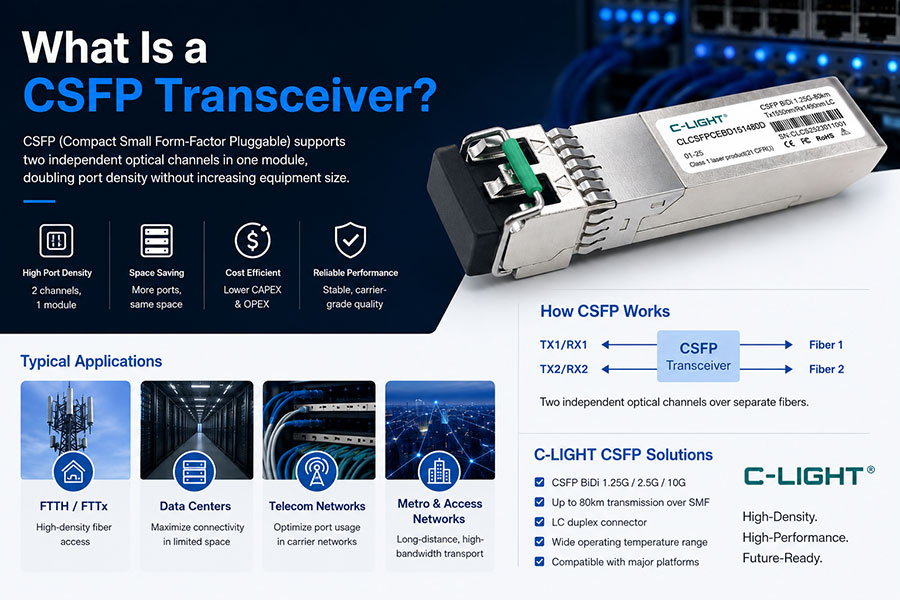
CSFP (Compact Small Form-Factor Pluggable) is an advanced optical transceiver form factor designed to significantly increase port density in networking equipment. Unlike traditional SFP modules that support a single optical channel, a CSFP module can support two independent optical channels within the same physical footprint.
This innovative architecture allows network operators to double the number of fiber connections without increasing equipment size, making CSFP technology particularly valuable in environments where rack space and port availability are limited.
As telecom networks continue evolving toward higher subscriber densities and fiber-to-the-home (FTTH) deployments, CSFP modules have become an attractive solution for maximizing infrastructure utilization while controlling deployment costs.
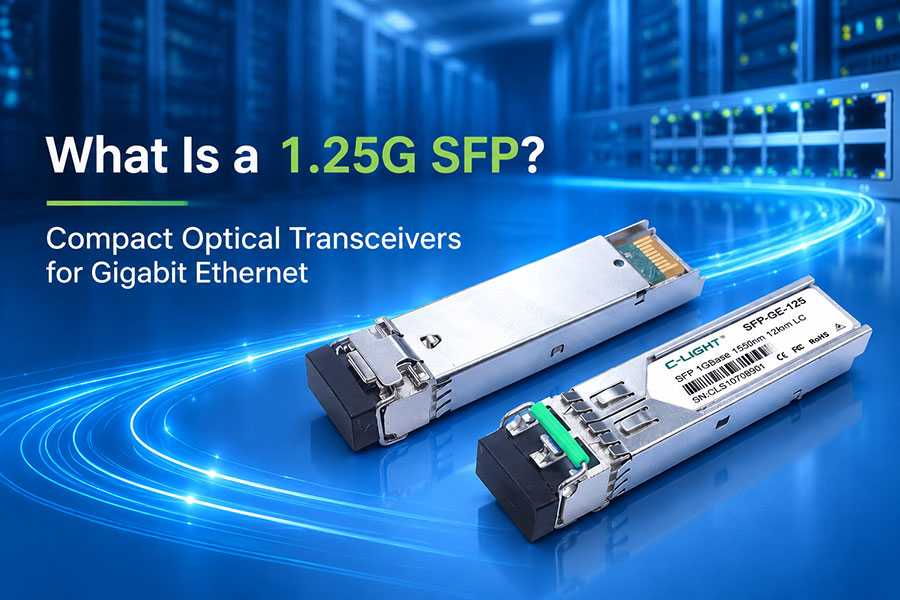
For access networks requiring Gigabit connectivity, the C-LIGHT 1.25G CSFP Optical Transceiver offers a compact and efficient solution for increasing port density while maintaining reliable optical performance:
https://c-light.com/products/details/1.25G_CSFP.html
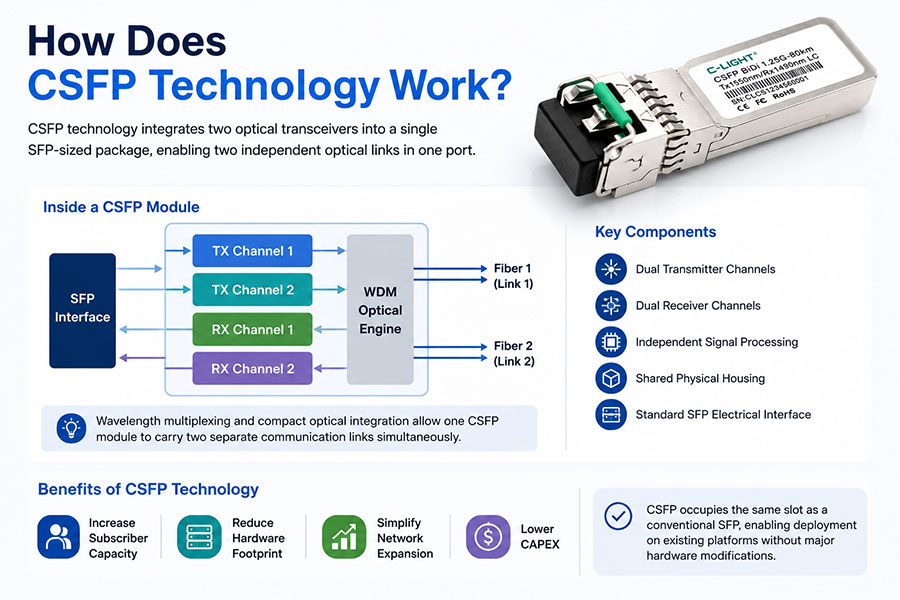
The key innovation behind CSFP technology lies in its ability to integrate two optical transceivers into a single SFP-sized package.
A typical CSFP module consists of:
Dual transmitter channels
Dual receiver channels
Independent signal processing paths
Shared physical housing
Standard SFP electrical interface
Through wavelength multiplexing and compact optical integration, a single CSFP module can handle two separate communication links simultaneously.
This design enables network operators to:
Increase subscriber capacity
Reduce hardware footprint
Simplify network expansion
Lower capital expenditures (CAPEX)
Because the module occupies the same slot as a conventional SFP, existing platforms can often support CSFP deployments without major hardware modifications.
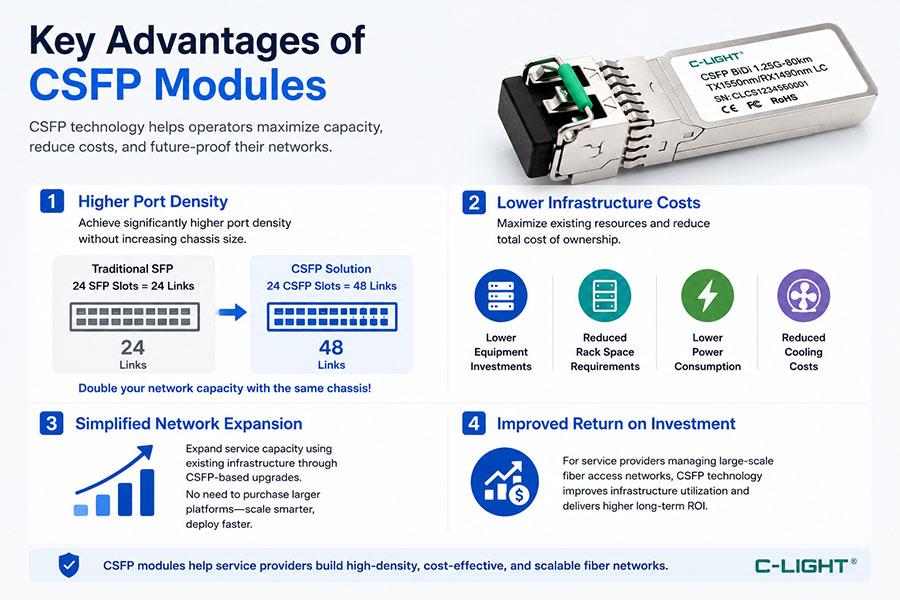
One of the primary reasons network operators adopt CSFP technology is the ability to achieve significantly higher port density.
For example:
24 SFP slots = 24 links
24 CSFP slots = 48 links
This effectively doubles network capacity without increasing chassis size.
By maximizing existing switch and OLT port resources, CSFP deployments help reduce:
Equipment investments
Rack space requirements
Power consumption
Cooling costs
Instead of purchasing larger network platforms, operators can expand service capacity using existing infrastructure through CSFP-based upgrades.
For service providers managing large-scale fiber access networks, CSFP technology can substantially improve infrastructure utilization and long-term ROI.
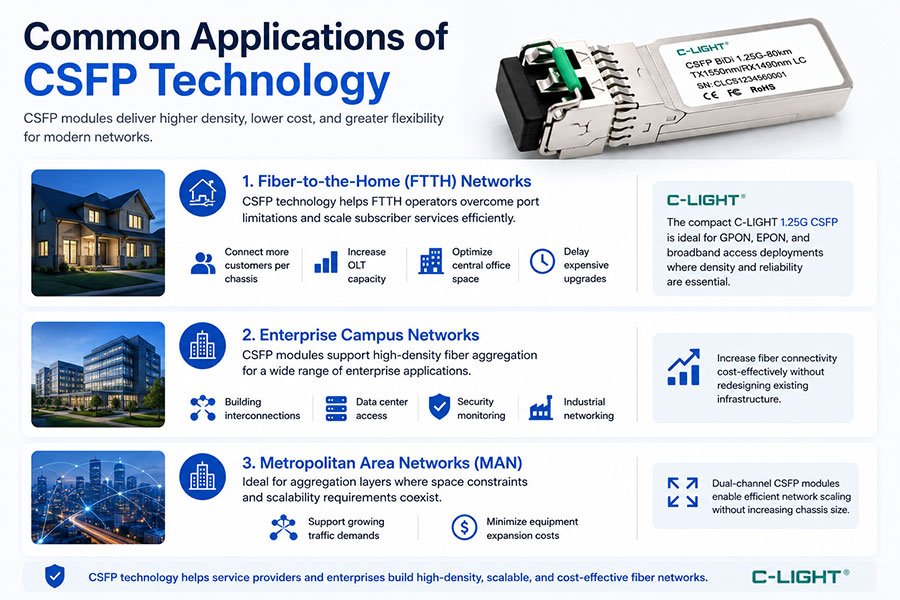
FTTH operators often face challenges related to port availability as subscriber numbers grow.
CSFP modules allow operators to:
Connect more customers per chassis
Increase OLT capacity
Optimize central office space
Delay expensive hardware upgrades
The compact design of the C-LIGHT 1.25G CSFP makes it particularly suitable for GPON, EPON, and broadband access deployments where density and reliability are critical.
Product Link:
https://c-light.com/products/details/1.25G_CSFP.html
Large enterprise networks frequently require high-density fiber aggregation for:
Building interconnections
Data center access
Security monitoring systems
Industrial networking
CSFP modules provide a cost-effective way to increase fiber connectivity without redesigning existing infrastructure.
Metro network providers often deploy CSFP technology in aggregation layers where space constraints and scalability requirements coexist.
By utilizing dual-channel optical modules, providers can support growing traffic demands while minimizing equipment expansion costs.
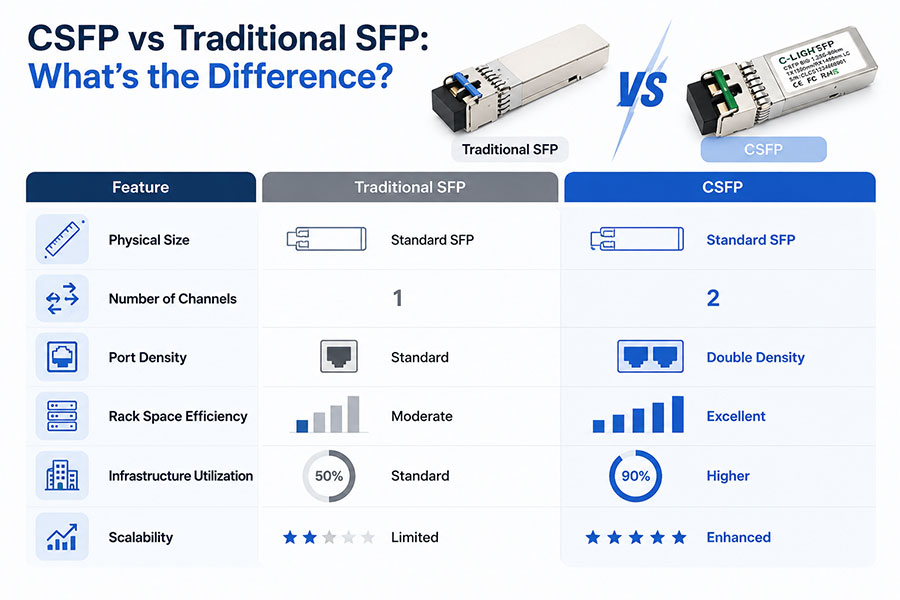
The most significant advantage of CSFP is that it delivers twice the connection capacity without requiring additional physical slots.
For operators facing increasing bandwidth and subscriber demands, this efficiency can translate into substantial cost savings over time.
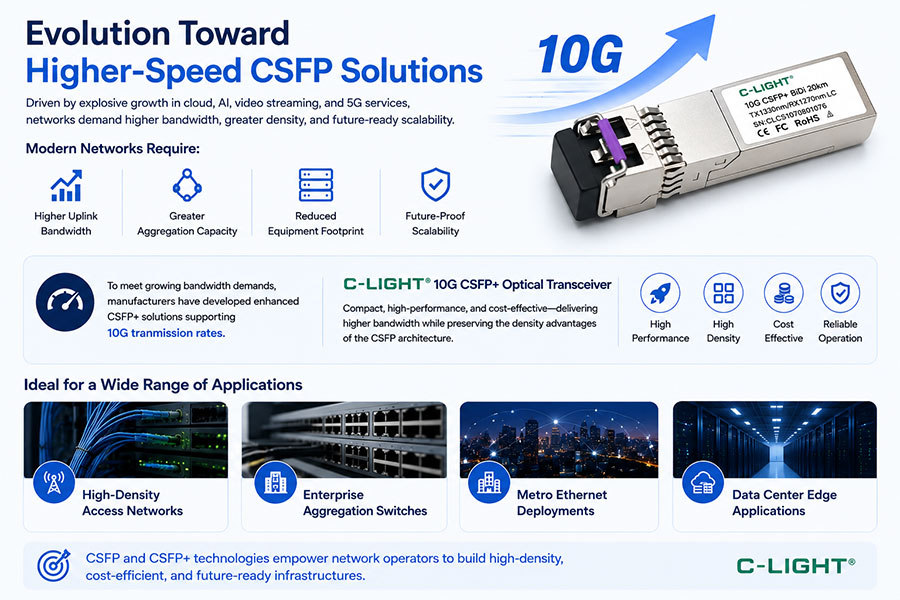
As network traffic continues to grow due to cloud computing, AI workloads, video streaming, and 5G services, demand for higher-speed compact optical modules is increasing.
Modern network architectures increasingly require:
Higher uplink bandwidth
Greater aggregation capacity
Reduced equipment footprint
Future-proof scalability
To address these requirements, manufacturers have developed enhanced CSFP+ solutions capable of supporting 10G transmission rates.
The C-LIGHT 10G CSFP+ Optical Transceiver provides a compact, high-performance option for operators seeking higher bandwidth while maintaining the density advantages of the CSFP architecture.
Product Link:
https://c-light.com/products/details/10G_CSFP.html
These modules are particularly beneficial in:
High-density access networks
Enterprise aggregation switches
Metro Ethernet deployments
Data center edge applications
Several industry trends continue driving CSFP adoption worldwide:
Broadband penetration continues expanding globally, increasing the need for scalable access infrastructure.
Many central offices and telecom facilities have limited physical space available for network expansion.
Operators seek solutions that maximize existing investments while delaying costly platform upgrades.
The rapid growth of FTTH, FTTB, and enterprise fiber deployments requires higher-density optical connectivity solutions.
CSFP technology directly addresses all of these challenges by providing greater capacity within existing infrastructure footprints.
When selecting a CSFP transceiver, network engineers should evaluate:
Transmission distance
Operating wavelength
Compatibility requirements
Environmental specifications
Network architecture
Future bandwidth demands
For Gigabit access deployments, the C-LIGHT 1.25G CSFP provides a proven solution for maximizing port density and reducing infrastructure costs.
For higher-capacity aggregation and transport applications, the C-LIGHT 10G CSFP+ delivers enhanced bandwidth while preserving the compact advantages of the CSFP platform.
By choosing the appropriate CSFP solution, operators can build scalable, cost-effective optical networks that support future growth without excessive infrastructure investment.
CSFP technology represents one of the most efficient methods of increasing optical network density without expanding equipment footprints. By integrating dual optical channels into a standard SFP-sized module, CSFP transceivers enable telecom operators, ISPs, enterprises, and metro network providers to significantly improve capacity utilization and deployment efficiency.
Whether deploying Gigabit access services with the C-LIGHT 1.25G CSFP or upgrading network aggregation with the C-LIGHT 10G CSFP+, CSFP technology continues to offer a practical and cost-effective path toward higher-density optical networking.
Answer: CSFP (Compact Small Form-Factor Pluggable) is a high-density optical transceiver designed to provide multiple optical channels within a compact SFP-sized package.
Unlike traditional SFP modules that support one optical link per port, CSFP integrates two independent bidirectional optical channels into a single module.
The main advantages of CSFP include:
Higher port density
Reduced equipment footprint
Improved fiber resource utilization
Lower deployment costs
CSFP is mainly designed for high-density access networks, FTTH deployments, and telecom aggregation applications where space and port capacity are critical.
Answer: CSFP works by integrating two independent optical transceiver channels inside the same SFP form factor.
A typical CSFP module includes:
Dual optical transmitter channels
Dual receiver channels
Dual BOSA optical components
Independent communication paths
Standard SFP mechanical interface
Through compact optical integration and bidirectional transmission technology, one CSFP module can provide the functionality of two traditional SFP modules while occupying only one optical port.
This allows network operators to increase connectivity density without expanding equipment size.
Answer: The main difference between CSFP and traditional SFP is the number of optical channels supported within the same physical footprint.
| Feature | Traditional SFP | CSFP |
| Optical Channels | One channel | Two independent channels |
| Port Density | Standard | Up to 2× higher |
| Package Size | SFP | Same SFP footprint |
| Fiber Efficiency | Normal | Improved |
| Main Application | General networking | High-density access networks |
CSFP allows operators to double connection capacity without increasing rack space or replacing existing equipment platforms.
Answer: Telecom operators adopt CSFP technology because it helps solve space and capacity challenges in access networks.
Key benefits include:
Higher Port Density
CSFP enables more optical connections within the same equipment panel.
Lower Infrastructure Costs
Operators can reduce:
Rack space requirements
Equipment expansion costs
Power consumption
Cooling requirements
Simplified Network Expansion
Existing network platforms can support more subscribers without major hardware upgrades.
These advantages make CSFP attractive for FTTH, broadband access, and metro network deployments.
Answer: CSFP modules are commonly used in high-density optical access networks.
Typical applications include:
FTTH Networks
GPON access networks
EPON deployments
Broadband subscriber connections
Enterprise Networks
Campus fiber networks
High-density access switches
Building connectivity
Metro Networks
Aggregation networks
Fiber resource optimization
Space-limited telecom facilities
CSFP is especially valuable where operators need more optical connections without increasing equipment footprint.
Answer: CSFP modules use the same physical dimensions as standard SFP modules, but they require network equipment support for CSFP protocols.
If a device supports CSFP functionality:
Both optical channels can operate normally.
The module can provide dual-link communication.
If the equipment only supports standard SFP:
The module may not recognize the second channel.
Full CSFP functionality cannot be achieved.
Therefore, compatibility between CSFP modules and network equipment is an important consideration during deployment.
Answer: CSFP technology has evolved from traditional Gigabit access applications toward higher-speed network requirements.
Common CSFP solutions include:
1.25G CSFP for Gigabit access networks
2.5G CSFP for enhanced broadband applications
10G CSFP for higher-bandwidth access networks
As cloud computing, video services, 5G, and AI-driven applications increase network traffic, higher-speed compact optical modules are becoming increasingly important.
Answer: CSFP will continue playing an important role in high-density optical access networks.
Future network trends include:
Increasing fiber subscriber density
Higher bandwidth requirements
Limited equipment space
More efficient infrastructure utilization
CSFP provides a practical solution by improving port density while maintaining the compact SFP form factor.
For telecom operators and service providers, CSFP remains an effective technology for building scalable, cost-efficient fiber networks.
For any questions, please contact us by email or WhatsApp.
Email: sales@c-light.com
WhatsApp: +86 132 6656 7067