Coherent optical technology is an advanced optical communication technology that uses coherent detection, complex modulation formats, and digital signal processing to transmit large amounts of data over optical fiber. It is widely used in high-capacity metro, long-haul, DCI, and optical transport networks.
Coherent optical technology recovers both the amplitude and phase information of an optical signal at the receiver. This allows more information to be encoded into the optical carrier and enables advanced digital signal processing to compensate for transmission impairments.
Compared with traditional direct-detection systems, coherent technology can provide higher capacity and longer transmission distances.
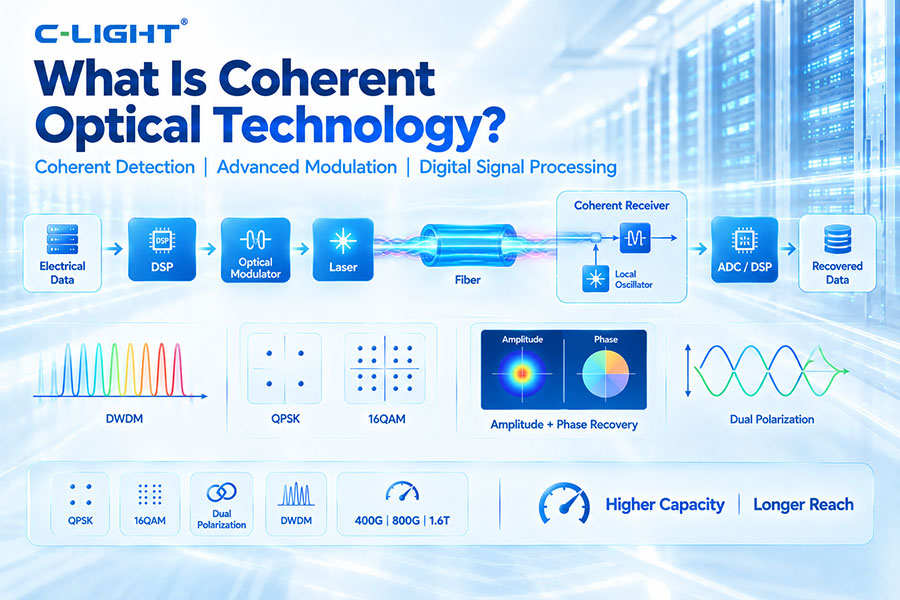
A simplified coherent optical transmission path is:
Electrical Data → DSP → Optical Modulator → Laser → Fiber → Coherent Receiver → ADC/DSP → Recovered Data
The transmitter converts electrical data into a complex optical waveform. At the receiver, the incoming optical signal is mixed with a local oscillator laser and detected by a coherent receiver. High-speed DSP then reconstructs the transmitted data.
Coherent detection uses a local oscillator laser at the receiver to mix with the incoming optical signal. This allows the receiver to recover information about both the amplitude and phase of the received light.
The additional information available from coherent detection enables advanced modulation and digital compensation techniques.
The local oscillator, or LO, is a stable laser source inside the coherent receiver. It provides a reference optical signal that is mixed with the incoming signal.
The resulting electrical signals contain the information required by the DSP to recover the transmitted optical waveform.
DSP is one of the most important components in a coherent optical system. It processes the received electrical signals and compensates for various transmission impairments.
Typical DSP functions include:
Chromatic dispersion compensation
Polarization demultiplexing
Polarization tracking
Equalization
Carrier recovery
Frequency offset compensation
Phase recovery
FEC processing in supported architectures
Chromatic dispersion causes different spectral components of an optical signal to travel at different velocities through fiber. Over long distances, this can significantly distort the received waveform.
Coherent DSP can digitally compensate for chromatic-dispersion effects, making long-distance transmission more practical.
Light traveling through optical fiber can exist in different polarization states. Environmental changes and fiber characteristics can alter these states during transmission.
Coherent systems can detect and digitally process multiple polarization components, allowing polarization effects to be compensated at the receiver.
Dual-polarization coherent transmission uses two orthogonal polarization states to carry independent data streams over the same optical channel.
This effectively doubles the amount of information that can be transmitted compared with a single-polarization system at the same symbol rate.
QPSK, or Quadrature Phase Shift Keying, is a coherent modulation format that uses four phase states to represent two bits per symbol.
QPSK has been widely used in coherent optical systems because of its robustness and suitability for long-distance transmission.
16QAM, or 16-state Quadrature Amplitude Modulation, uses multiple amplitude and phase combinations to carry four bits per symbol.
Compared with QPSK, 16QAM increases spectral efficiency but requires a higher optical signal-to-noise ratio.
64QAM uses 64 distinct modulation states and can carry six bits per symbol in an idealized constellation.
Higher-order modulation increases spectral efficiency but generally requires better signal quality and limits the achievable transmission reach compared with more robust lower-order modulation formats.
A coherent optical transceiver is a module that integrates the optical and electronic components required for coherent transmission and reception.
It typically includes a laser, optical modulator, coherent receiver, DSP, drivers, TIAs, and related control and monitoring circuitry.
A coherent optical module provides high-capacity optical transmission using advanced modulation and coherent detection. Modern coherent modules are available in different pluggable and line-system formats depending on the application.
They are widely used in metro networks, data center interconnects, and optical transport systems.
A coherent optical system commonly includes:
High-speed DSP
Narrow-linewidth laser
Optical modulator
Coherent receiver
Local oscillator
Photodetectors
Driver and TIA electronics
FEC
Optical amplifiers where required
An optical modulator changes the amplitude, phase, or polarization characteristics of light according to the electrical data signal.
In coherent systems, advanced modulators are used to generate complex optical waveforms corresponding to formats such as QPSK and QAM.
An IQ modulator controls the in-phase and quadrature components of an optical signal. By independently controlling these components, it can generate different amplitude and phase states.
IQ modulation is widely used in coherent optical transmission.
| Feature | Direct Detection | Coherent Detection |
|---|---|---|
| Detected information | Primarily optical intensity | Amplitude and phase |
| Local oscillator | Not required | Required |
| DSP | Limited or architecture-dependent | Extensive |
| Modulation | Typically simpler | Advanced modulation formats |
| Typical reach | Shorter | Metro and long-haul |
Coherent technology combines sensitive detection with advanced DSP. The receiver can recover phase and polarization information and compensate for several transmission impairments.
This allows coherent systems to maintain performance over longer fiber spans than many direct-detection architectures.
Optical Signal-to-Noise Ratio, or OSNR, compares the power of an optical signal with the noise power within a specified optical bandwidth.
OSNR is an important parameter in coherent optical systems because transmission distance and modulation format depend strongly on the available optical signal quality.
Coherent DSP uses digital algorithms to estimate and compensate for impairments introduced by the optical channel.
Depending on the architecture, DSP can compensate for chromatic dispersion, polarization effects, frequency offset, phase noise, equalization errors, and other signal impairments.
Forward Error Correction adds redundant information to the transmitted data so the receiver can correct certain errors.
Coherent optical systems commonly use FEC together with DSP to achieve the required post-FEC error performance over demanding optical links.
Coherent optical technology is widely used with DWDM systems. DWDM provides multiple wavelength channels, while coherent technology provides high-capacity transmission on each channel.
Combining the two allows optical transport networks to achieve very high aggregate capacity over a small number of fiber pairs.
Coherent DWDM combines coherent modulation and detection with Dense Wavelength Division Multiplexing.
Each DWDM wavelength can carry a high-speed coherent signal, while multiple wavelengths share the same optical fiber.
400G coherent optical systems can use advanced modulation formats, dual polarization, and high-speed DSP to achieve 400Gbps-class transmission.
The exact architecture depends on the wavelength, symbol rate, modulation format, FEC, optical reach, and system implementation.
800G coherent systems require higher symbol rates, more efficient modulation, or a combination of both. Advanced coherent DSP and optical components are essential for maintaining signal quality at these speeds.
800G coherent technology is particularly relevant to high-capacity data center interconnect and optical transport applications.
Coherent architectures can be extended toward 1.6T-class transmission by increasing symbol rates, modulation efficiency, optical bandwidth, or combinations of these techniques.
At higher capacities, optical signal quality, component bandwidth, DSP performance, power consumption, and thermal management become increasingly demanding.
Coherent DCI uses coherent optical transceivers to connect data centers across metro or regional distances.
It can provide much higher capacity and longer reach than short-reach Ethernet optics, especially when combined with DWDM transport.
Coherent optical technology is commonly used in:
Long-haul optical transport
Metro networks
Data center interconnects
Telecom backbone networks
Cloud infrastructure
Regional optical networks
High-capacity DWDM systems
The main advantages include:
High spectral efficiency
Long transmission distance
High per-channel capacity
Digital compensation of transmission impairments
Efficient use of fiber infrastructure
Support for advanced modulation formats
Compatibility with modern DWDM networks
Coherent technology also introduces greater complexity.
Higher DSP power consumption
More complex optical components
Greater thermal requirements
Higher implementation cost
More demanding testing
Complex system configuration
Coherent systems require high-speed DSP and advanced optical components, which can consume significant power.
As data rates increase, reducing DSP and optical engine power becomes an important focus for next-generation coherent modules.
Coherent and PAM4 pluggable optics address different transmission requirements. PAM4 direct-detection modules are widely used for short and medium data center links, while coherent optics are typically preferred for applications requiring higher spectral efficiency or longer reach.
The distinction depends on the target application, reach, data rate, optical budget, and network architecture.
Coherent optical technology continues to evolve toward higher per-channel speeds, greater spectral efficiency, lower power consumption, and more compact pluggable implementations.
Advances in DSP, photonic integration, modulation, laser technology, packaging, and thermal management will support future high-capacity optical transport and DCI networks.
Coherent optical technology uses coherent detection, advanced modulation formats, and high-speed DSP to transmit large amounts of data over optical fiber. By recovering both amplitude and phase information and digitally compensating for transmission impairments, coherent optics can support high-capacity 400G, 800G, and future 1.6T-class networks. It is particularly important for DWDM, metro, long-haul, and data center interconnect applications.
For any questions, please contact us by email or WhatsApp.
Email: sales@c-light.com
WhatsApp: +86 132 6656 7067