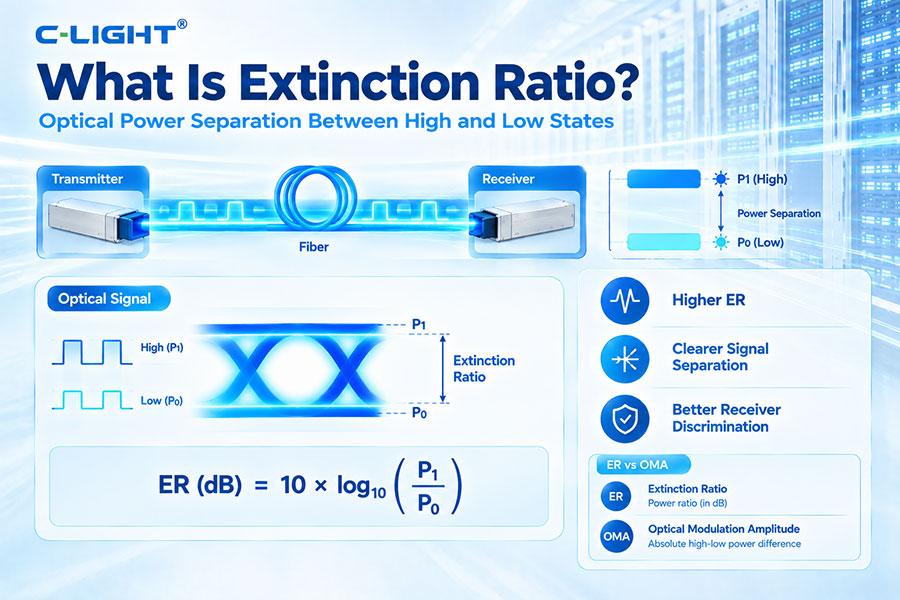
Extinction ratio is an optical transmitter parameter that describes the relationship between the optical power of the high and low signal states. It is commonly expressed in dB and is used to evaluate optical modulation quality in fiber optic communication systems.
Extinction ratio, or ER, compares the optical power associated with a logical high state to the optical power associated with a logical low state.
In a simplified two-level optical signal, a larger difference between the high and low optical power levels produces a higher extinction ratio.
For a conventional two-level optical signal, extinction ratio can be expressed as:
ER(dB) = 10 × log10(P1 / P0)
Where P1 is the optical power of the high level and P0 is the optical power of the low level.
A higher extinction ratio generally indicates greater separation between the two optical power states.
Extinction ratio affects the separation between optical signal states and therefore influences how easily the receiver can distinguish transmitted data.
It is an important transmitter parameter together with average optical power, optical modulation amplitude, wavelength, noise, and other signal-quality specifications.
A high extinction ratio means that the optical power in the high state is significantly greater than the optical power in the low state.
This generally provides better optical level separation for a two-level signal, assuming other transmitter and receiver conditions remain comparable.
A low extinction ratio means that the optical power difference between the high and low states is smaller.
This can reduce signal discrimination and may contribute to degraded receiver performance when the system operates close to its optical margin.
Extinction ratio and average optical power are different parameters. Average optical power describes the overall optical power level, while extinction ratio describes the relationship between different signal states.
A transmitter can therefore have adequate average power but still have an unsuitable extinction ratio.
| Parameter | Extinction Ratio | OMA |
|---|---|---|
| Full name | Extinction Ratio | Optical Modulation Amplitude |
| Measures | Power ratio between high and low states | Difference between high and low optical power levels |
| Typical unit | dB | mW or dBm-related specifications |
Both parameters describe aspects of optical modulation, but they use different representations.
OMA focuses on the absolute difference between optical high and low levels, while extinction ratio expresses their power relationship in logarithmic form.
Average optical power is the mean optical power of the transmitted signal. Extinction ratio describes how the optical power changes between signal states.
Both parameters are normally evaluated together when characterizing an optical transmitter.
A suitable extinction ratio helps maintain clear separation between transmitted optical states. Poor separation can make signal detection more difficult and may increase the probability of bit errors.
Actual BER depends on many additional factors, including receiver sensitivity, noise, dispersion, jitter, and signal processing.
The receiver must distinguish the different optical signal levels arriving from the transmitter.
A suitable extinction ratio can provide useful signal separation, while an unsuitable value may reduce the available detection margin.
The optical transmitter converts electrical data into modulated light. Depending on the architecture, the modulation can be performed by directly modulating a laser or by using a separate optical modulator.
The transmitter design determines important parameters such as average power, modulation amplitude, extinction ratio, wavelength, and noise.
Extinction ratio can be influenced by components including:
Laser source
Electro-optic modulator
Optical driver
Bias control circuit
Optical coupling components
Temperature-control circuitry
Laser bias conditions affect the optical output level and modulation behavior. Changes in bias current can alter both the high and low optical power states.
Correct bias control is therefore important for maintaining the specified transmitter performance.
Temperature can change laser threshold current, output efficiency, modulation characteristics, and other transmitter parameters.
As temperature changes, extinction ratio can vary, which is why optical transceivers are normally specified across a defined operating temperature range.
For NRZ optical signaling, the transmitter generally uses two optical power states. Extinction ratio directly describes the separation between these high and low states.
It is therefore a commonly used transmitter specification for traditional two-level optical communication systems.
In an NRZ optical signal, a higher optical level represents one binary state while a lower optical level represents the other.
Extinction ratio quantifies the relationship between these two optical levels and helps characterize transmitter modulation quality.
PAM4 uses four optical amplitude levels rather than two. Because of this, a single two-level extinction-ratio number does not fully describe the signal quality of a PAM4 transmitter.
PAM4 systems are commonly evaluated using additional metrics such as optical modulation amplitude, eye diagrams, and TDECQ, depending on the applicable specification.
With four signal levels, there are three eye openings and multiple adjacent amplitude relationships instead of one simple high-to-low transition.
Therefore, transmitter quality in PAM4 systems requires a broader set of measurements rather than relying only on conventional NRZ extinction ratio.
Optical Modulation Amplitude describes the optical power difference between defined PAM4 levels according to the relevant measurement method.
OMA is especially useful for evaluating the available optical signal swing in high-speed PAM4 systems.
TDECQ, or Transmitter and Dispersion Eye Closure Quaternary, is an optical transmitter performance metric used for PAM4 systems.
It evaluates the quality of the transmitted PAM4 signal after considering transmitter distortion and dispersion-related effects under the defined test methodology.
400G and 800G optical systems commonly use PAM4 signaling. The four-level waveform has tighter signal margins and therefore requires careful control of transmitter distortion and signal quality.
TDECQ provides a more comprehensive evaluation of PAM4 transmitter quality than a conventional two-level extinction-ratio measurement alone.
Many 100G optical transceivers use different modulation architectures depending on the reach and application. For two-level optical transmitters, extinction ratio can be an important transmitter specification.
The required value depends on the applicable optical standard and module design.
Many 400G optical transceivers use PAM4. In these systems, transmitter performance is evaluated using a combination of parameters rather than a conventional NRZ extinction ratio alone.
OMA, TDECQ, optical power, and other measurements may be more directly relevant to PAM4 transmitter validation.
800G optical transceivers typically use multiple high-speed PAM4 lanes or other advanced optical architectures.
Because the signal contains multiple amplitude levels, transmitter evaluation requires careful measurement of level separation, modulation amplitude, distortion, and overall optical eye quality.
| Parameter | Extinction Ratio | TDECQ |
|---|---|---|
| Primary use | Two-level optical transmitter characterization | PAM4 transmitter characterization |
| Signal levels | Typically two | Four |
| Measurement concept | Power ratio | PAM4 eye-closure performance |
| Typical unit | dB | dB |
Extinction ratio is measured by determining the optical power of the relevant high and low signal states and calculating their ratio.
A typical test setup may include:
Optical transmitter under test
High-speed optical detector
Optical test instrument
Oscilloscope or sampling system
Specified data pattern
Measurement results can depend on:
Wavelength
Bias current
Modulation amplitude
Temperature
Data pattern
Measurement bandwidth
Optical detector characteristics
Test methodology
Poor extinction-ratio performance can result from:
Incorrect laser bias
Insufficient modulation amplitude
Laser degradation
Driver problems
Temperature variation
Optical component degradation
Improper transmitter calibration
Extinction ratio can be improved through proper transmitter design and calibration.
Optimize laser bias
Optimize modulation amplitude
Maintain stable temperature
Use suitable optical components
Calibrate the transmitter correctly
Maintain stable driver performance
Receiver sensitivity determines the minimum optical input required to achieve a defined performance level. Extinction ratio describes the relationship between optical transmitter levels.
These parameters are different, but transmitter modulation quality can affect the signal available to the receiver near its sensitivity limit.
Transmitter optical power describes the overall launched optical power, while extinction ratio describes the relative difference between signal states.
Both parameters should be considered together because changing the bias or modulation conditions can affect both average optical power and extinction ratio.
RIN, or Relative Intensity Noise, measures fluctuations in laser optical power. Extinction ratio measures the relative separation between optical signal states.
They represent different transmitter characteristics, but both can influence the quality of the optical signal received by the system.
For applicable two-level optical systems, extinction ratio helps characterize the quality of the transmitted optical waveform.
However, complete link design must also consider optical power, receiver sensitivity, insertion loss, return loss, OSNR, dispersion, BER, and other relevant parameters.
As optical networks move toward higher data rates and increasingly use PAM4 and other advanced signaling formats, transmitter evaluation is becoming more comprehensive.
Conventional extinction ratio remains important for suitable two-level optical systems, while high-speed PAM4 systems increasingly rely on metrics such as OMA, TDECQ, eye diagrams, and BER-related measurements.
Extinction ratio is an important optical transmitter parameter that describes the relationship between high and low optical power states. It is commonly expressed in dB and is particularly useful for conventional two-level optical signals. In modern PAM4-based 400G and 800G systems, transmitter performance requires broader metrics such as OMA, TDECQ, eye quality, and BER. Extinction ratio should therefore be evaluated together with optical power, receiver sensitivity, noise, and other signal-quality parameters.
For any questions, please contact us by email or WhatsApp.
Email: sales@c-light.com
WhatsApp: +86 132 6656 7067