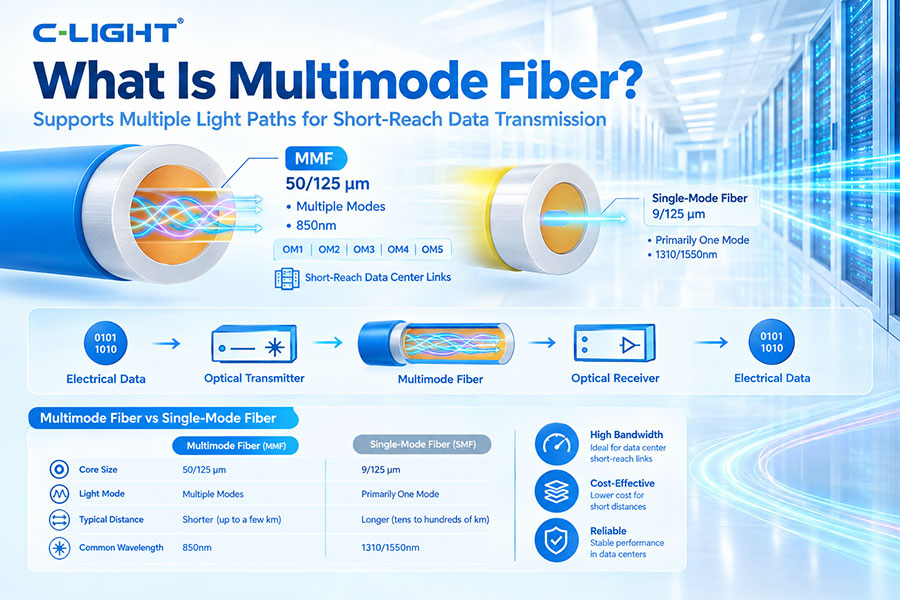
Multimode fiber, or MMF, is an optical fiber designed to transmit multiple propagation modes of light through a relatively large fiber core. It is widely used for short-distance communication in data centers, enterprise networks, storage systems, and high-speed server connections.
Multimode fiber is a type of optical fiber with a larger core than single-mode fiber. The larger core allows multiple light modes to propagate through the fiber at the same time.
MMF is mainly designed for short- and medium-distance optical links where cost, density, and ease of deployment are important.
The basic transmission process is:
Electrical Data → Optical Transmitter → Light Through Multimode Fiber → Optical Receiver → Electrical Data
The transmitter converts electrical data into optical signals. Multiple propagation modes travel through the multimode fiber and are converted back into electrical signals by the receiver.
It is called multimode fiber because the relatively large fiber core allows multiple optical propagation paths, or modes, to travel through the fiber.
Different modes can follow different paths through the core, which contributes to modal dispersion as transmission distance increases.
Common multimode fiber types use a core diameter of approximately 50 micrometers or 62.5 micrometers.
Modern data center multimode fiber is commonly based on a 50/125 μm construction, with a 50 μm core and 125 μm cladding.
| Feature | Multimode Fiber | Single-Mode Fiber |
|---|---|---|
| Core | Larger | Much smaller |
| Light propagation | Multiple modes | Primarily one mode |
| Typical use | Short-distance links | Long-distance links |
| Typical wavelength | 850nm in many data center applications | 1310nm or 1550nm in many applications |
| Transmission distance | Generally shorter | Generally longer |
Common multimode fiber categories include OM1, OM2, OM3, OM4, and OM5. These categories differ in bandwidth characteristics, construction, and supported applications.
OM1 is an older multimode fiber type with a 62.5 μm core. It was widely used in earlier Ethernet and fiber networking systems.
OM1 has lower bandwidth performance than newer OM3 and OM4 fiber and is less common in modern high-speed data centers.
OM2 is a 50/125 μm multimode fiber designed for higher bandwidth than OM1. It has been used for Gigabit Ethernet and other short-distance optical applications.
For modern high-speed data center networks, OM3 and OM4 are generally more suitable.
OM3 is a laser-optimized 50/125 μm multimode fiber developed for high-speed applications using VCSEL-based optical transmitters.
It is widely used for data center Ethernet and other short-reach optical connections.
OM4 is a higher-bandwidth laser-optimized multimode fiber that provides improved performance over OM3.
It is commonly used in high-speed data center networks where longer multimode transmission distances are required.
OM5 is a wideband multimode fiber designed to support shortwave wavelength division multiplexing applications across a broader wavelength range than conventional multimode fiber.
OM5 can support applications that use multiple short wavelengths, although its practical advantages depend on the specific network architecture and optical modules.
Multimode fiber data center applications commonly use 850nm optical transmission, particularly with VCSEL-based optical transceivers.
Some applications can use additional short wavelengths, depending on the fiber type and optical system.
850nm is widely used with multimode fiber because VCSELs can provide an efficient and practical optical source for short-distance high-speed communication.
This combination is particularly common in data centers and enterprise networks.
VCSEL stands for Vertical-Cavity Surface-Emitting Laser. It is a semiconductor laser technology widely used in short-reach multimode optical communication.
VCSELs are well suited to high-density data center applications because of their compact size, efficiency, and suitability for parallel optical transmission.
The maximum distance depends on the fiber category, optical transceiver, data rate, and system design.
Modern OM3 and OM4 fibers can support significantly longer distances than older MMF types for selected high-speed applications, while the actual reach must always be checked against the applicable transceiver and fiber specifications.
The main limitation is modal dispersion. Different propagation modes can travel through the fiber along different paths and arrive at slightly different times.
As distance increases, this difference can cause pulse spreading and make it harder for the receiver to distinguish adjacent symbols.
Modal dispersion is the spreading of an optical pulse caused by different modes traveling through the fiber at different effective propagation velocities.
It is a major reason why multimode fiber is generally used for shorter links than single-mode fiber.
| Feature | OM3 | OM4 |
|---|---|---|
| Core | 50/125 μm | 50/125 μm |
| Fiber type | Laser-optimized MMF | Higher-bandwidth laser-optimized MMF |
| Typical use | Data center links | Higher-speed and longer MMF links |
| Bandwidth | Lower than OM4 | Higher than OM3 |
Yes. Multimode fiber is widely used in data centers for short-distance connections between servers, switches, storage systems, and other networking equipment.
Its combination of compact optical components, high bandwidth, and suitable short-reach performance makes it practical for dense data center environments.
Many short-reach optical transceivers use multimode fiber, including:
10G SFP+ SR
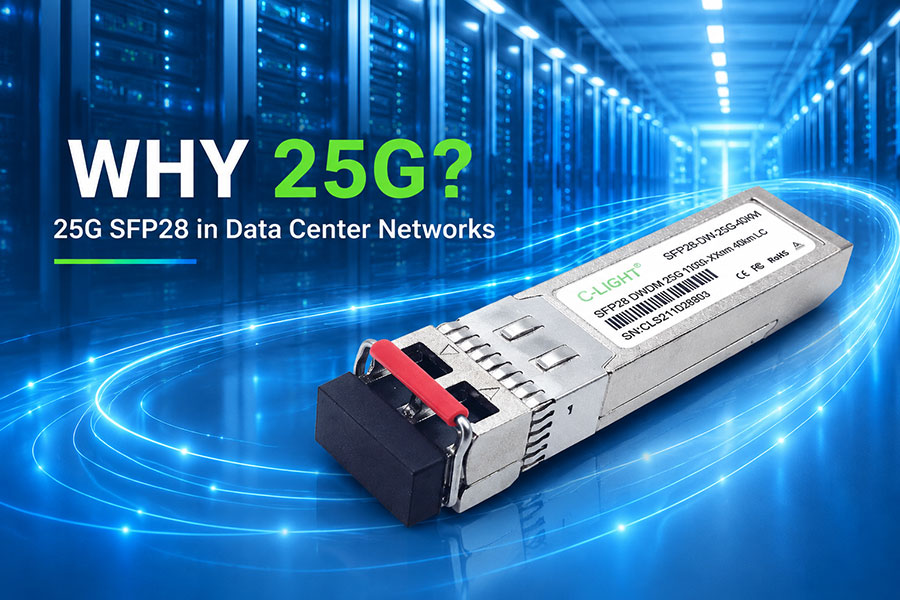
25G SFP28 SR
40G QSFP+ SR4
100G QSFP28 SR4
200G SR4 and related short-reach solutions
400G SR8 and other multimode solutions
800G SR8 and related high-speed architectures
SR optical modules are generally designed for short-reach multimode fiber links and commonly operate around 850nm. DR optical modules are typically designed for single-mode fiber and use around 1310nm optical wavelengths.
The appropriate option depends on the required transmission distance, fiber infrastructure, transceiver architecture, and network standard.
100G multimode fiber links commonly use parallel optical transmission over multiple multimode fibers. A typical 100G SR4 architecture uses four optical lanes for transmission and four for reception over an MPO-based connection.
These links are designed for short-distance data center applications.
400G multimode solutions can use multiple optical lanes operating at high-speed PAM4 signaling. For example, 400G SR8 uses eight optical lanes for transmission and eight for reception, depending on the specific optical architecture.
These solutions are designed for short-reach data center and AI networking applications.
800G multimode solutions can use multiple high-speed optical lanes to provide an aggregate 800Gbps data rate. An 800G SR8 architecture can use eight 100G-class optical lanes and multimode fiber for short-reach connectivity.
The exact supported reach depends on the transceiver specification and the OM fiber category used.
Multimode fiber can use several connector types depending on the application.
LC connectors are common for duplex links, while MPO or MTP-style multi-fiber connectors are frequently used for parallel-optics applications such as 40G, 100G SR4, 400G SR8, and other high-density interfaces.
The main advantages include:
Suitable for short-distance high-speed transmission
High bandwidth for data center applications
Compatibility with compact VCSEL-based optics
Lower optical component cost in suitable applications
High-density parallel optical connectivity
Simple deployment within data center environments
The main limitations are shorter transmission distance and higher modal-dispersion effects compared with single-mode fiber.
MMF is therefore not normally selected for long-distance telecom or metro optical transport applications.
| Parameter | Multimode Fiber | Single-Mode Fiber |
|---|---|---|
| Core size | Typically 50 or 62.5 μm | About 9 μm in common telecom fiber |
| Modes | Multiple | Single dominant mode |
| Typical wavelength | 850nm | 1310nm or 1550nm |
| Typical application | Data center and enterprise | Metro, telecom, DCI, long distance |
| Distance | Shorter | Longer |
Yes. Multimode fiber can support short-reach connections within AI data centers, particularly where high-density optical links are required between servers, accelerators, and switches.
For longer links between facilities or network locations, single-mode fiber and longer-reach optical technologies are generally more appropriate.
Selection should consider:
Required data rate
Transmission distance
OM fiber category
Optical transceiver type
Connector type
Fiber polarity
Optical link budget
Future bandwidth requirements
Multimode fiber will remain relevant for short-reach optical connectivity as data center bandwidth continues to increase.
Higher-speed VCSELs, parallel optical architectures, and improved multimode fiber performance can continue to support dense 100G, 200G, 400G, and 800G applications, especially inside data centers.
Multimode fiber is a large-core optical fiber designed to carry multiple propagation modes of light. It is widely used for short-distance high-speed connectivity in data centers and enterprise networks, typically with 850nm VCSEL-based optical transceivers. OM3, OM4, and OM5 provide improved performance for modern high-speed applications, including selected 100G, 400G, and 800G multimode optical links.
For any questions, please contact us by email or WhatsApp.
Email: sales@c-light.com
WhatsApp: +86 132 6656 7067