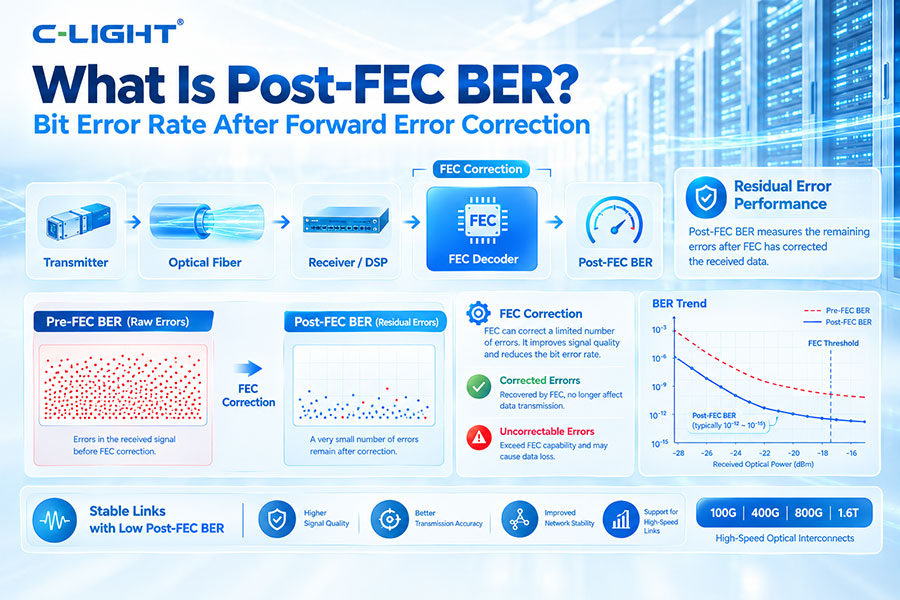
Post-FEC BER is the Bit Error Rate measured after Forward Error Correction has processed the received data. It represents the residual error performance of an optical communication link after supported transmission errors have been detected and corrected. Post-FEC BER is an important parameter for high-speed 100G, 400G, 800G, and 1.6T optical systems.
Post-FEC BER is the bit error rate observed after the FEC decoder has completed its error-correction process.
It shows how many bit errors remain after the communication system has corrected errors within the capability of its FEC scheme.
BER, or Bit Error Rate, is the ratio of incorrectly received bits to the total number of transmitted bits.
A simplified expression is:
BER = Number of Bit Errors / Total Number of Transmitted Bits
Post-FEC BER specifically refers to this error rate after FEC correction.
The basic signal path is:
Transmitter → Optical Fiber → Receiver/DSP → FEC Decoder → Post-FEC BER
The receiver first processes the incoming optical signal. The FEC decoder then uses redundant information in the received data to correct supported errors. The remaining errors are reflected in the post-FEC BER.
Post-FEC BER provides a view of the final error performance after error correction. It is therefore closely related to the quality of the data delivered to higher layers of the communication system.
A very low post-FEC BER indicates that the complete link, including the physical channel and FEC mechanism, is successfully maintaining the required error performance.
| Parameter | Pre-FEC BER | Post-FEC BER |
|---|---|---|
| Measurement position | Before FEC correction | After FEC correction |
| Represents | Raw link errors | Residual errors |
| Typical value | Higher | Much lower after successful FEC |
| Main purpose | Evaluate raw physical-layer quality | Evaluate corrected link performance |
FEC adds redundant information during transmission. The receiver uses this redundancy to identify and correct certain errors.
When the received error level remains within the correction capability of the FEC scheme, many or most of the raw errors are corrected, resulting in a much lower post-FEC BER.
FEC is directly responsible for reducing the number of correctable errors that remain in the received data.
The quality of the final post-FEC BER therefore depends on both the raw link performance and the correction capability of the selected FEC scheme.
Every FEC code has a finite ability to correct transmission errors. The decoder can successfully correct errors only when their number and pattern remain within the supported correction capability.
If the error level becomes too high, the decoder may produce uncorrectable codewords and the post-FEC error rate can increase sharply.
A high post-FEC BER means that errors remain after FEC processing. Depending on the network architecture, this can result in packet corruption, packet loss, degraded application performance, or link failure.
For Ethernet systems, the required post-FEC performance is determined by the applicable standard and system design.
| Error Type | Meaning |
|---|---|
| Corrected error | An error successfully corrected by FEC |
| Uncorrectable error | An error condition beyond the FEC decoder capability |
Corrected errors may not affect the data delivered to higher layers, while uncorrectable errors can result in actual data corruption or packet loss.
Not necessarily. The required post-FEC BER depends on the communication standard and system architecture.
Many high-speed communication systems are designed to achieve extremely low residual error rates after FEC, but the exact target should always be taken from the relevant specification.
There is no universal post-FEC BER value for every optical system. The acceptable target depends on the Ethernet standard, FEC architecture, application, and required reliability.
The correct value should therefore be evaluated against the specification of the complete system rather than a general rule.
PAM4 uses four signal levels to transmit two bits per symbol. Its smaller signal-level spacing makes it more sensitive to noise, jitter, distortion, and inter-symbol interference than NRZ.
FEC is therefore particularly important in many high-speed PAM4 systems, and post-FEC BER provides an indication of the residual error performance after correction.
400G optical systems commonly use PAM4 signaling and multiple high-speed lanes. These links are more sensitive to physical-layer impairments than many earlier NRZ systems.
Post-FEC BER shows whether the complete 400G link can maintain the required residual error performance after FEC processing.
800G systems commonly use multiple 100G-class PAM4 lanes with demanding signal-integrity requirements.
Monitoring post-FEC BER helps verify that the optical transmitter, receiver, electrical channel, DSP, and FEC system are collectively delivering reliable data.
1.6T-class interfaces operate at even higher electrical and optical data rates. Signal margins become tighter, making reliable error correction and residual error monitoring increasingly important.
Post-FEC BER can help determine whether the link is operating within its required error-performance range.
Insufficient received optical power can increase the raw error rate before FEC. If the resulting pre-FEC BER remains within the FEC correction capability, post-FEC BER may still remain very low.
If the optical power becomes too low and raw errors exceed the correction capability, post-FEC errors can increase significantly.
Receiver sensitivity indicates the minimum optical input required to achieve a defined performance condition.
Operating near or below the receiver sensitivity can increase pre-FEC BER and eventually result in higher post-FEC BER when the FEC decoder can no longer correct all errors.
Poor Optical Signal-to-Noise Ratio can increase the raw error rate of an optical link. FEC can correct some of these errors, but only within its available correction capability.
When OSNR becomes too low, pre-FEC BER can exceed the FEC threshold and post-FEC BER may rise.
DSP can compensate for signal impairments such as electrical channel loss, inter-symbol interference, chromatic dispersion, and other distortions depending on the system architecture.
Better signal processing can reduce the raw error rate presented to the FEC decoder and help maintain a lower post-FEC BER.
FEC margin describes how far the system is operating from the point where the FEC decoder can no longer maintain the required corrected error performance.
A stable and very low post-FEC BER generally indicates that the system has sufficient margin, while rising corrected errors or uncorrectable errors can indicate that the margin is being reduced.
Pre-FEC BER describes the raw error condition entering the FEC decoder. Post-FEC BER describes the residual errors remaining after FEC correction.
The two values should be evaluated together because a low post-FEC BER can hide a link that is operating close to its FEC correction limit.
Yes. A link can maintain a very low post-FEC BER while the FEC decoder is correcting a relatively high number of errors.
This is why monitoring corrected-codeword statistics, pre-FEC BER, and FEC margin can provide more useful information than looking only at post-FEC BER.
A corrected codeword is an FEC codeword that contained errors but was successfully recovered by the decoder.
A rising corrected-codeword count can indicate that the physical link is experiencing increasing error activity even when post-FEC BER remains low.
An uncorrectable codeword contains an error condition that exceeds the correction capability of the FEC decoder.
Uncorrectable codewords are a strong indication that the link is operating outside its intended error-performance range.
Post-FEC BER can be measured by comparing the recovered data after FEC decoding with the known transmitted data or by using supported diagnostic counters and test equipment.
Depending on the platform, post-FEC statistics may be available through the optical module, DSP, switch ASIC, or dedicated network test equipment.
Controlled test patterns such as PRBS sequences can be used to evaluate the complete physical link before and after FEC processing.
The selected test pattern and measurement method should match the target interface and applicable test specification.
The required test duration depends on the target BER and the statistical confidence required. Extremely low BER targets require longer observation periods because errors may occur very infrequently.
Testing should use an appropriate measurement duration and sample size for the target performance.
Improving post-FEC BER normally requires improving the underlying physical link and maintaining the raw error rate within the FEC correction range.
Improve optical power levels
Reduce fiber and connector loss
Improve transmitter quality
Improve receiver performance
Reduce electrical channel loss
Optimize equalization
Reduce jitter and crosstalk
Improve thermal stability
Post-FEC BER can help determine whether errors are successfully corrected or are reaching the data delivered to higher layers.
When post-FEC BER rises together with pre-FEC BER, corrected-codeword counts, or uncorrectable errors, engineers can use these trends to identify degradation in the optical or electrical link.
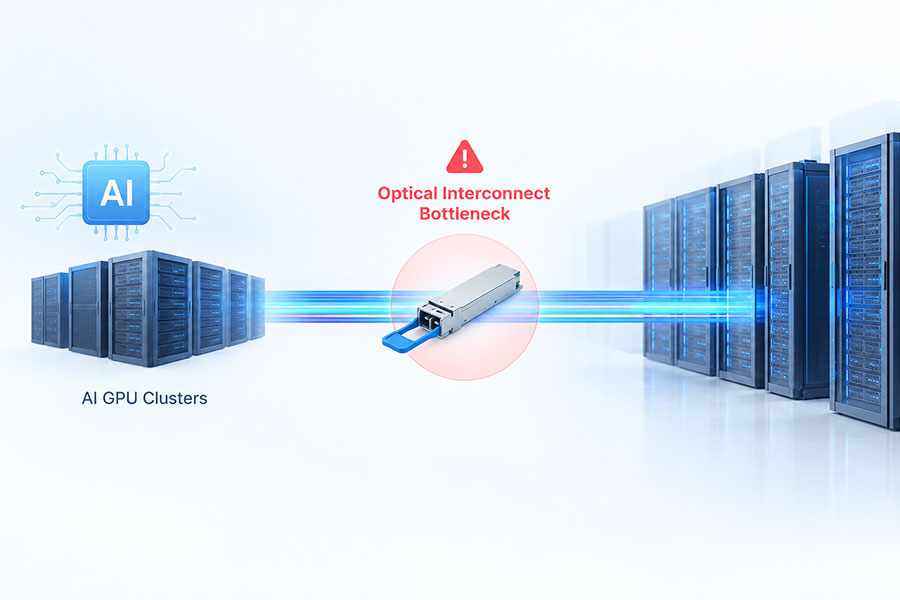
AI data centers use large numbers of high-speed optical connections between GPUs, switches, servers, and other systems. Reliable error performance is critical because link problems can affect large-scale distributed workloads.
Post-FEC BER provides an important indication of the residual error performance of these high-speed links.
| Parameter | Post-FEC BER | Packet Error Rate |
|---|---|---|
| Measurement unit | Bits | Packets |
| Measurement stage | After FEC correction | Higher network layer |
| Primary purpose | Evaluate residual bit errors | Evaluate packet-level delivery errors |
As 400G, 800G, and 1.6T networks become more widespread, monitoring both raw and corrected error performance will become increasingly important.
Advanced DSP telemetry, switch diagnostics, FEC counters, and real-time link monitoring can provide earlier visibility into links approaching their error-performance limits.
Post-FEC BER is the residual Bit Error Rate measured after Forward Error Correction. It indicates how many transmission errors remain after the FEC decoder has corrected errors within its capability. For high-speed 400G, 800G, and 1.6T optical networks, post-FEC BER should be evaluated together with pre-FEC BER, corrected-codeword counts, uncorrectable errors, and FEC margin to obtain a complete view of link performance.
For any questions, please contact us by email or WhatsApp.
Email: sales@c-light.com
WhatsApp: +86 132 6656 7067