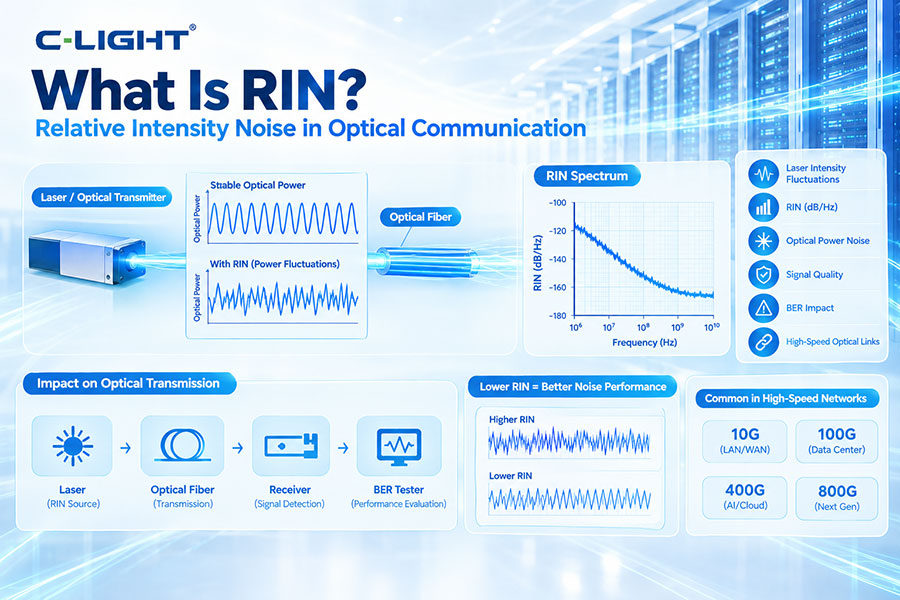
RIN, or Relative Intensity Noise, is a parameter used to describe fluctuations in the optical power of a laser over time. It is an important performance metric for optical transmitters, laser sources, and high-speed optical communication systems, particularly in 100G, 400G, 800G, and emerging 1.6T applications.
RIN stands for Relative Intensity Noise. It measures the random fluctuations of a laser's optical intensity relative to its average optical power.
In an ideal optical transmitter, the output power would remain perfectly stable. In practice, spontaneous emission and other physical effects cause small variations in the optical power, producing intensity noise.
RIN evaluates the variance of optical power fluctuations relative to the average optical power. A simplified relationship is:
RIN = Noise Power Density / Average Optical Power²
RIN is commonly expressed in units such as dB/Hz.
A lower RIN value generally indicates a cleaner and more stable optical source.
Laser intensity fluctuations can degrade the quality of the transmitted optical signal. In high-speed communication systems, excessive intensity noise can reduce signal-to-noise ratio and increase the probability of bit or symbol errors.
As data rates increase and signal margins become smaller, controlling transmitter noise becomes increasingly important.
RIN can originate from several physical mechanisms inside and around the laser source.
Spontaneous emission
Carrier density fluctuations
Laser mode competition
Power supply noise
Temperature variations
Optical feedback
Device and driver noise
Laser RIN describes the relative intensity fluctuations generated by a semiconductor laser. It is an important specification when evaluating the optical performance of a transmitter.
The RIN characteristic depends on the laser design, bias current, modulation condition, wavelength, temperature, and operating point.
The laser is responsible for generating the optical carrier. If the optical power varies unpredictably, the transmitted waveform contains additional noise.
This noise can reduce the quality of the received signal and may limit the achievable transmission performance, especially in systems with tight optical and electrical margins.
Optical power describes the average amount of optical energy being transmitted. RIN describes fluctuations around that average power.
A transmitter can therefore have adequate average optical power but still exhibit excessive intensity noise.
RIN is commonly specified as a noise power spectral density normalized to the square of the average optical power. It is usually expressed in dB/Hz.
Because RIN is a spectral density measurement, the measurement bandwidth must be considered when interpreting the total noise contribution.
A RIN value in dB/Hz represents the relative intensity noise density within a 1Hz measurement bandwidth.
For example, a specification such as -130 dB/Hz represents a lower noise density than -120 dB/Hz. More negative RIN values indicate lower relative intensity noise.
Lower RIN means that the laser's optical output has smaller relative power fluctuations.
Lower transmitter intensity noise generally provides a cleaner optical signal and can improve the overall noise performance of the communication link.
Excessive RIN adds noise to the received optical signal. This can reduce the distinction between signal levels and increase the probability of incorrect bit or symbol decisions.
As a result, high RIN can contribute to increased BER, particularly in systems operating close to their performance limits.
PAM4 uses four optical or electrical amplitude levels to represent two bits per symbol. Because the spacing between adjacent levels is smaller than in a two-level signal, PAM4 has tighter noise margins.
RIN can therefore have a noticeable impact on PAM4 signal quality, especially in high-speed optical transmitters.
400G and 800G optical systems commonly use PAM4 signaling and multiple high-speed lanes. The required signal quality becomes more demanding as lane rates increase.
Low RIN optical sources help maintain the signal-to-noise performance required by these high-speed links.
1.6T optical interfaces require even higher aggregate bandwidth and typically operate with very tight signal margins.
As lane speeds and system complexity increase, laser intensity noise becomes an increasingly important transmitter parameter.
Signal-to-Noise Ratio, or SNR, compares the desired signal power with the total noise power.
RIN is one contributor to the total transmitter noise. Higher RIN can therefore reduce the available SNR, while lower RIN helps preserve signal quality.
| Parameter | RIN | BER |
|---|---|---|
| Meaning | Relative optical intensity noise | Bit error rate |
| Measurement | Noise spectral density | Ratio of incorrect bits to transmitted bits |
| Primary purpose | Characterize transmitter intensity noise | Evaluate communication errors |
RIN describes fluctuations in optical intensity, while laser linewidth describes the spectral width associated with the laser's optical frequency and phase noise characteristics.
They are different laser performance parameters and affect communication systems in different ways.
RIN and Relative Intensity Noise are the same parameter. RIN is simply the common abbreviation for Relative Intensity Noise.
RIN describes intensity fluctuations generated by the optical source, while ASE, or Amplified Spontaneous Emission, is noise generated by optical amplifiers and other optical amplification processes.
Both can contribute to overall optical noise but originate from different mechanisms.
Laser operating conditions can influence RIN. The relative intensity noise characteristics may change with bias current and modulation level because the laser's carrier and photon populations change with operating point.
RIN measurements therefore need to specify the relevant operating conditions.
Temperature can change semiconductor laser characteristics such as threshold current, efficiency, wavelength, and noise behavior.
As a result, RIN can vary with operating temperature, making thermal control important for high-speed optical transmitters.
Reflected optical power entering the laser can disturb laser operation and increase intensity fluctuations under certain conditions.
Good optical isolation, connector quality, and proper system design can help control unwanted optical feedback.
RIN can be specified for various optical transmitters and laser sources, including:
DFB lasers
EML transmitters
VCSELs
Integrated optical transmitters
High-speed optical engines
VCSEL and EML are different optical transmitter technologies, and their RIN characteristics depend on the specific device design and operating conditions.
RIN should therefore be evaluated from the actual transmitter specification rather than assumed solely from the laser technology.
In an optical transceiver, RIN primarily describes the intensity noise of the optical transmitter. It contributes to the total noise generated by the transmit path.
The transceiver's complete performance also depends on transmitter power, extinction ratio, optical modulation amplitude, receiver sensitivity, and other parameters.
RIN is typically measured by monitoring the optical output of the laser and analyzing the noise power spectral density relative to the average optical power.
A typical measurement setup may include:
Stable laser operating condition
Optical attenuator where required
High-speed photodetector
Electrical spectrum analyzer
Appropriate measurement bandwidth
Power monitoring equipment
Accurate RIN measurement requires control of several factors:
Laser bias current
Modulation condition
Temperature
Optical power
Measurement bandwidth
Detector response
Electrical instrument noise
Optical feedback
For high-speed optical modules, RIN testing is normally performed under defined operating conditions and measurement bandwidths.
The results are compared with the applicable module specification or optical communication standard to determine whether the transmitter meets the required noise performance.
DSP can compensate for certain signal impairments, but it does not physically remove the source of laser intensity noise.
RIN is primarily a transmitter characteristic. Digital processing can improve overall system performance, but excessive physical-layer noise may still limit the achievable link quality.
RIN contributes to the overall noise floor of the optical receiver. When RIN becomes significant compared with the desired signal, the available signal-to-noise margin decreases.
This can affect BER, eye opening, receiver sensitivity, and the maximum achievable transmission performance.
RIN is a transmitter intensity-noise parameter, while TDECQ is an optical transmitter performance metric used for PAM4 systems to evaluate signal quality after accounting for transmitter and dispersion-related effects.
RIN can influence TDECQ, but the two measurements are not interchangeable.
Excessive RIN can lead to:
Reduced optical signal-to-noise ratio
Smaller eye openings
Higher BER
Reduced receiver margin
Lower transmission performance
Reduced system reliability
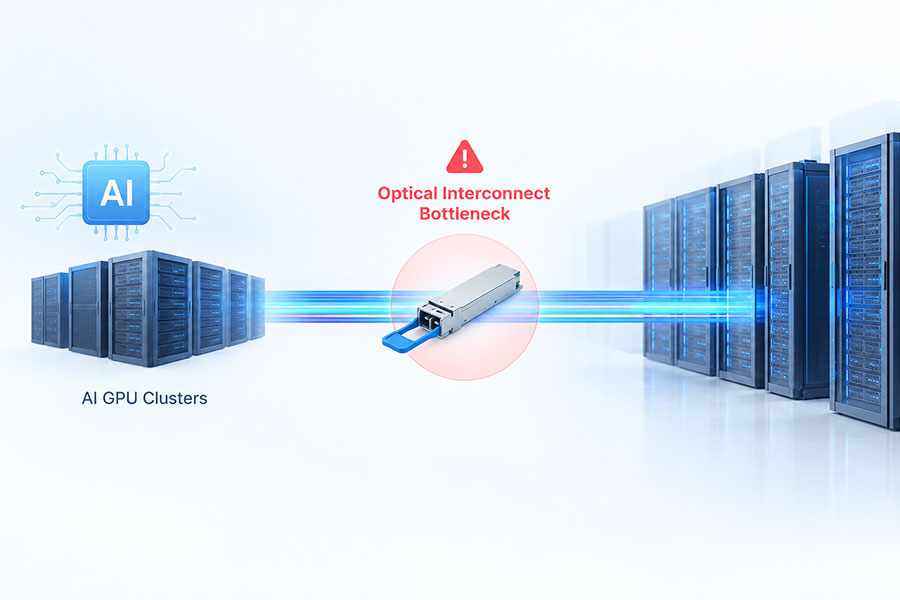
AI data centers increasingly rely on high-speed optical links such as 400G and 800G. These systems use high-speed signaling with tight signal margins and large numbers of parallel optical connections.
Low transmitter noise, including low RIN, helps maintain the optical signal quality required by these high-density networks.
As optical data rates increase, laser and transmitter designs will continue to focus on lower noise, higher linearity, wider bandwidth, and improved thermal stability.
Better RIN performance will remain important for maintaining signal quality in next-generation 800G and 1.6T optical communication systems.
RIN, or Relative Intensity Noise, measures fluctuations in the optical power of a laser relative to its average output power. It is an important transmitter parameter because excessive RIN can reduce signal-to-noise ratio, increase BER, and limit the performance of high-speed optical links. As 400G, 800G, and 1.6T optical systems continue to evolve, maintaining low RIN and stable laser performance becomes increasingly important.
For any questions, please contact us by email or WhatsApp.
Email: sales@c-light.com
WhatsApp: +86 132 6656 7067