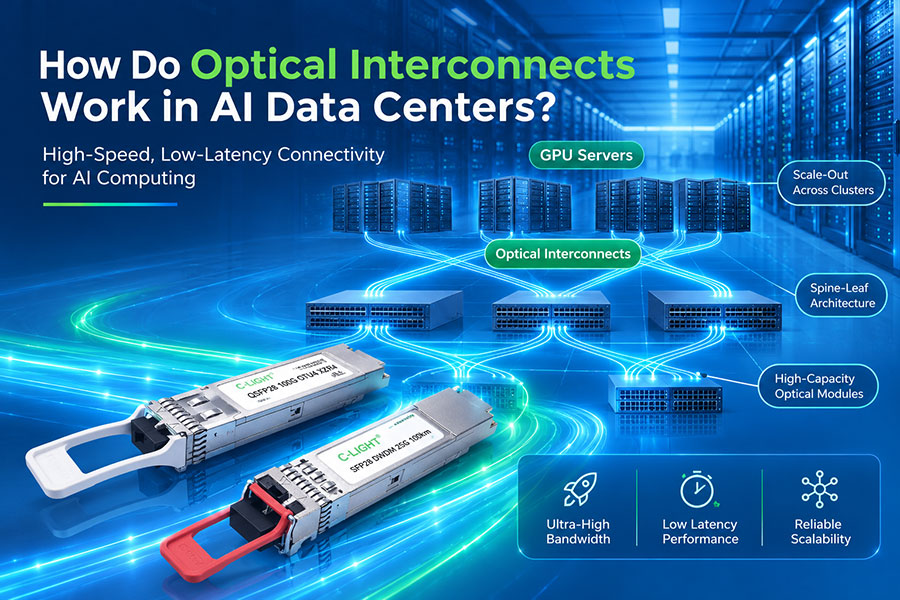
A 6G CPRI SFP+ is a pluggable optical transceiver designed for compatible Common Public Radio Interface links, supporting high-speed digital radio transport over fiber.
Wireless radio access networks depend on reliable connections between radio equipment and baseband processing systems. These connections transport digitized radio information and associated control data between distributed network elements. In traditional CPRI-based architectures, optical fiber is commonly used to connect remote radio equipment to centralized or distributed baseband processing equipment.
A 6G CPRI SFP+ optical transceiver provides the optical interface for a CPRI-class link operating at approximately 6.144 Gbps. The module converts electrical signals from the host equipment into optical signals for fiber transmission and converts received optical signals back into electrical form.
The term "6G CPRI" refers to the approximately 6 Gbps CPRI line-rate class, commonly associated with CPRI Option 6. It does not mean sixth-generation cellular technology. The module's suitability depends on the supported line rate, host interface, fiber type, transmission distance, and compatibility with the radio equipment.
Important distinction: CPRI and eCPRI are related to radio transport but are not interchangeable protocols. CPRI uses a defined digital radio interface, while eCPRI uses an Ethernet-based transport approach. A module must be verified against the actual protocol and interface supported by both endpoints.
1. What Does 6G CPRI Mean?
CPRI stands for Common Public Radio Interface. It was developed to define an interface for transporting digitized radio signals and control information between radio equipment and radio equipment controllers in wireless base stations.
CPRI specifies a set of line rates known as options. CPRI Option 6 has a line rate of 6.144 Gbps, making it the rate class commonly associated with the term "6G CPRI." The nominal line rate includes the protocol's defined transmission structure and should not be interpreted as application payload throughput.
The SFP+ designation identifies the module form factor. It does not by itself guarantee support for 6.144 Gbps CPRI, nor does it establish compatibility with every Ethernet, Fibre Channel, or radio transport interface. The module electronics and host equipment must support the intended line rate and interface behavior.
| Term | Meaning | Engineering Relevance |
|---|---|---|
| CPRI | Common Public Radio Interface for radio equipment transport. | Defines radio data transport behavior and supported line rates. |
| CPRI Option 6 | CPRI line-rate option operating at 6.144 Gbps. | Relevant when qualifying optical links for equipment supporting this specific rate. |
| SFP+ | Small Form-factor Pluggable Plus module form factor. | Defines mechanical and electrical interface characteristics but not the full protocol compatibility. |
| eCPRI | An Ethernet-based radio transport interface. | Requires the relevant Ethernet interface and eCPRI support; it should not be assumed equivalent to classic CPRI. |
2. How Does a 6G CPRI SFP+ Work?
A 6G CPRI SFP+ operates as the optical transmission component within a compatible radio transport link. The host equipment provides the electrical signal, and the transceiver converts it into light for transmission through fiber. The receiver at the opposite endpoint converts the incoming optical signal back into an electrical signal.
Electrical Signal Input
The radio or baseband equipment supplies the electrical interface signal to the SFP+ module. The host's high-speed interface must support the selected CPRI line rate and the electrical characteristics required by the transceiver.
Optical Transmission
Inside the transceiver, the transmitter drives a laser operating at the specified wavelength. Depending on the product variant, the optical signal may be transmitted over multimode or single-mode fiber. Wavelength, optical output, receiver sensitivity, and reach are determined by the module specification.
Optical Reception
At the receiving endpoint, a photodetector converts the light into an electrical signal. The receiving equipment processes the signal according to the supported CPRI interface and line-rate configuration.
For a complete bidirectional connection, both endpoints need compatible transceivers and fiber connections. Matching the data rate alone is insufficient if the wavelength, fiber type, optical power budget, or protocol support differs.
3. Where Are 6G CPRI SFP+ Transceivers Used?
Wireless Fronthaul
CPRI optical transceivers can transport digitized radio information between radio equipment and baseband processing systems. Fiber connectivity allows these components to be physically separated while maintaining the required communications link.
The optical reach must account for the installed fiber path, connector losses, optical budget, and the timing and latency requirements of the radio system. The transceiver does not independently guarantee that an entire fronthaul implementation will meet its synchronization or performance requirements.
Radio Access Network Infrastructure
Traditional radio access network architectures may use optical transceivers to connect remote radio heads or radio units with baseband equipment. A 6G CPRI SFP+ can be considered when the radio equipment requires a supported CPRI line rate and the transceiver's optical specification matches the fiber link.
Newer network architectures may use Ethernet-based fronthaul, eCPRI, or other transport interfaces. These implementations have different protocol requirements, so selecting a module by the "6G CPRI" label alone is not sufficient.
Specialized Fiber Links
The same nominal optical data rate may be available in different reach configurations. Short links may use multimode fiber, while longer links typically use single-mode fiber. Each option must be selected according to the required physical distance and the transceiver's specified optical characteristics.
4. C-LIGHT 6G CPRI SFP+ Product Options
C-LIGHT offers a dedicated 6G CPRI SFP+ optical transceiver family. Its published product table lists 3.3–6.14 Gbps operating-rate configurations, LC optical connectors, and both single-mode and multimode variants for different transmission distances.
6G CPRI SFP+ Optical Transceiver
The product family includes 850nm, 1310nm, and 1550nm options. Short-reach configurations use multimode fiber, while the listed 2km, 10km, 40km, and 80km variants use single-mode fiber.
| Model | Fiber Type | Data Rate | Wavelength | Listed Reach | Connector |
|---|---|---|---|---|---|
| CLSFP156GZX80 | SMF | 3.3–6.14 Gbps | 1550nm | 80km | LC |
| CLSFP156GEX40 | SMF | 3.3–6.14 Gbps | 1550nm | 40km | LC |
| CLSFP136GLW10 | SMF | 3.3–6.14 Gbps | 1310nm | 10km | LC |
| CLSFP136GLW02 | SMF | 3.3–6.14 Gbps | 1310nm | 2km | LC |
| CLSFP856GSW | MMF | 3.3–6.14 Gbps | 850nm | Under 300m | LC |
| CLSFP136GLWM | MMF | 3.3–6.14 Gbps | 1310nm | Under 220m | LC |
The table reflects the configurations listed on C-LIGHT's product page. Verify the current datasheet for operating conditions, exact optical specifications, supported protocol, and compatibility with the target radio or baseband equipment before ordering.
View C-LIGHT 6G CPRI SFP+ Transceivers6G CPRI BiDi SFP+
For deployments where fiber-strand availability is limited, a bidirectional optical module may be considered. A BiDi transceiver transmits and receives using different wavelengths over a single fiber strand, subject to the module's design and complementary wavelength configuration at the opposite endpoint.
C-LIGHT also lists a 6G CPRI BiDi SFP+ product family with reach options that vary by model. The two ends of a BiDi connection must use compatible transmit and receive wavelengths; two identical wavelength configurations should not be assumed to form a working link.
View C-LIGHT 6G CPRI BiDi SFP+ Transceivers5. Single-Mode vs. Multimode Fiber for 6G CPRI
The fiber type is a fundamental selection parameter for CPRI optical connectivity. Multimode and single-mode fiber have different optical characteristics and are intended for different reach and transceiver configurations.
| Characteristic | Multimode Fiber (MMF) | Single-Mode Fiber (SMF) |
|---|---|---|
| Common wavelength options in the listed C-LIGHT range | 850nm and a listed 1310nm configuration. | 1310nm and 1550nm. |
| Listed distance configurations | Under 220m and under 300m. | 2km, 10km, 40km, and 80km. |
| Typical application | Short equipment connections and suitable short-reach optical links. | Longer fronthaul or transport links where the module supports the required reach. |
| Selection requirement | Confirm fiber category, wavelength, connector, and module reach. | Confirm fiber route, wavelength, optical loss budget, and receiver limits. |
The listed distances are module-specific values, not general reach limits for every MMF or SMF link. A longer route requires a suitable optical interface and adequate link margin. Fiber type, connectors, splices, and installed-path losses must all be considered.
6. 6G CPRI SFP+ vs. Ethernet SFP+ and eCPRI
An SFP+ package can be used in modules supporting different interfaces and operating rates. Although the modules may look physically similar, a CPRI transceiver is not automatically interchangeable with a conventional 10G Ethernet SFP+ or an eCPRI-based optical link.
| Interface | Primary Function | Key Compatibility Requirement |
|---|---|---|
| 6G CPRI SFP+ | Provides optical connectivity for compatible CPRI line-rate links, including the 6.144 Gbps rate class. | Verify the exact CPRI option, electrical interface, framing, and host support. |
| 10G Ethernet SFP+ | Provides optical connectivity for supported Ethernet standards and data rates. | Must support the required Ethernet standard, rate, and host configuration. |
| eCPRI optical link | Carries radio-related traffic using an Ethernet-based transport approach. | Verify the Ethernet interface, eCPRI support, host configuration, and required traffic behavior. |
Protocol naming deserves particular attention during procurement. C-LIGHT's product page uses the term eCPRI Ethernet in its general description while listing the module as a 6G CPRI SFP+. Because classic CPRI and eCPRI are different interfaces, the exact protocol support and host compatibility should be confirmed against the current product datasheet instead of assuming the module supports every CPRI and eCPRI implementation.
7. Key Parameters to Verify Before Deployment
Selecting an optical transceiver for radio transport requires matching the module specification to the complete link. The nominal "6G" label is only one part of that decision.
CPRI line rate: Confirm support for 6.144 Gbps if the host equipment requires CPRI Option 6.
Protocol and framing: Verify classic CPRI or the required Ethernet-based eCPRI implementation, as applicable.
Host compatibility: Check module coding, electrical interface, firmware, and support from the baseband or radio equipment.
Fiber type: Confirm single-mode or multimode fiber according to the exact product variant.
Wavelength: Match the required wavelength and, for BiDi links, ensure the transmit and receive wavelengths form a compatible pair.
Transmission distance: Select a model whose specified reach covers the installed fiber route.
Optical power budget: Account for transmitter power, receiver sensitivity, fiber attenuation, connector loss, and any intermediate components.
Operating temperature: Verify the module's case-temperature range and the actual thermal environment of the equipment.
Link operation: Confirm that both ends use compatible modules and that the complete path meets the radio system's timing and performance requirements.
Where a link must meet strict synchronization, latency, or availability requirements, optical reach alone does not establish suitability. The complete radio transport system must be validated under its intended configuration.
8. Conclusion
A 6G CPRI SFP+ is a pluggable optical transceiver intended for compatible CPRI-class communication links, commonly associated with the 6.144 Gbps CPRI Option 6 line rate. It provides electrical-to-optical conversion so digitized radio information can travel over fiber between supported network elements.
C-LIGHT offers 6G CPRI SFP+ configurations across multimode and single-mode fiber, with listed reach options from under 220m to 80km. A separate 6G CPRI BiDi family may be relevant when a compatible single-fiber connection is required.
The right module must match the actual line rate, radio interface, wavelength, fiber type, optical power budget, temperature range, and host equipment. Because CPRI and eCPRI are different interfaces, confirming the exact protocol supported by the selected module is essential before deployment.
9. Frequently Asked Questions
Does 6G CPRI mean sixth-generation cellular technology?
No. In this product context, 6G refers to the approximately 6.144 Gbps CPRI line-rate class associated with CPRI Option 6. It is not a reference to sixth-generation cellular radio technology.
What is the line rate of CPRI Option 6?
CPRI Option 6 has a defined line rate of 6.144 Gbps. This is the physical line rate, not the same as application payload throughput.
What transmission distances does C-LIGHT list?
The published product table lists reach options of under 220m, under 300m, 2km, 10km, 40km, and 80km across different single-mode and multimode configurations. Exact specifications should be verified for the selected model.
Can a 6G CPRI SFP+ be used in any SFP+ port?
No. Physical fit does not guarantee compatibility. The host must support the module's operating rate, electrical interface, protocol, and required configuration.
What is the difference between a 6G CPRI SFP+ and a 6G CPRI BiDi SFP+?
A conventional duplex optical configuration generally uses separate transmit and receive fibers. A BiDi design sends and receives over a single fiber strand using different wavelengths, requiring compatible complementary modules at the two endpoints.
Is 6G CPRI the same as eCPRI?
No. Classic CPRI and eCPRI are distinct interface approaches. CPRI uses a defined radio transport interface, while eCPRI is Ethernet-based. Confirm the exact protocol and host requirements for the particular optical module.
Which C-LIGHT product should be selected for a CPRI link?
Choose according to the required line rate, protocol, distance, fiber type, wavelength, and host equipment. C-LIGHT lists standard 6G CPRI SFP+ and 6G CPRI BiDi SFP+ families; the current datasheet should be checked before ordering.
Looking for a 6G CPRI optical transceiver?
Confirm the CPRI line rate, equipment compatibility, fiber distance, wavelength, and connector requirements before choosing a module.
Contact C-LIGHT