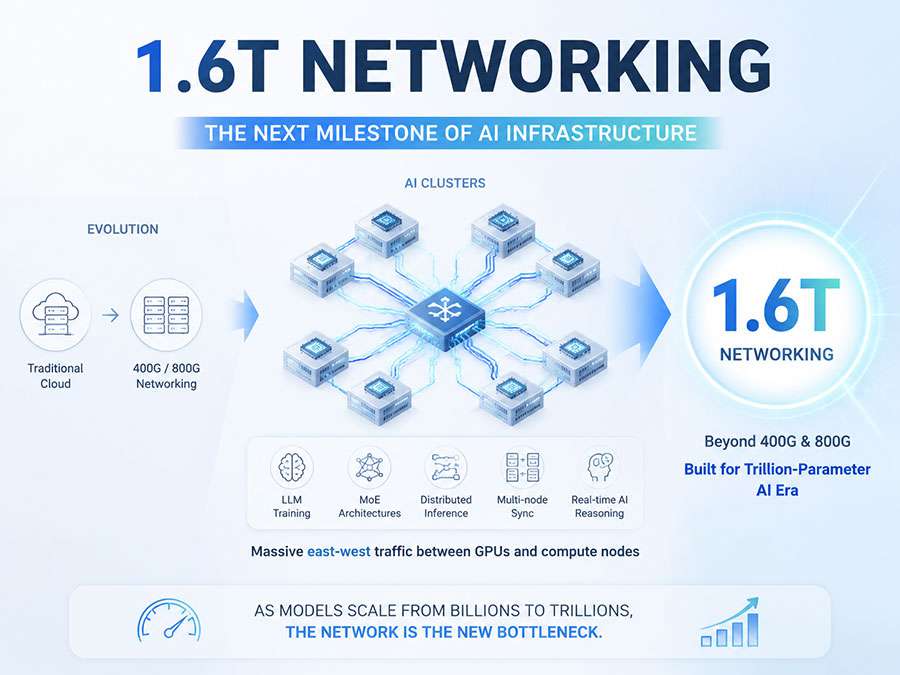
Artificial Intelligence is entering a new phase of exponential growth. The transition from traditional cloud computing to GPU-dominated AI clusters has fundamentally changed data center networking requirements.
Modern AI workloads such as:
Large Language Model (LLM) training
Mixture of Experts (MoE) architectures
Distributed inference pipelines
Multi-node parameter synchronization
Real-time AI reasoning systems
require massive east-west traffic exchange between GPUs and compute nodes.
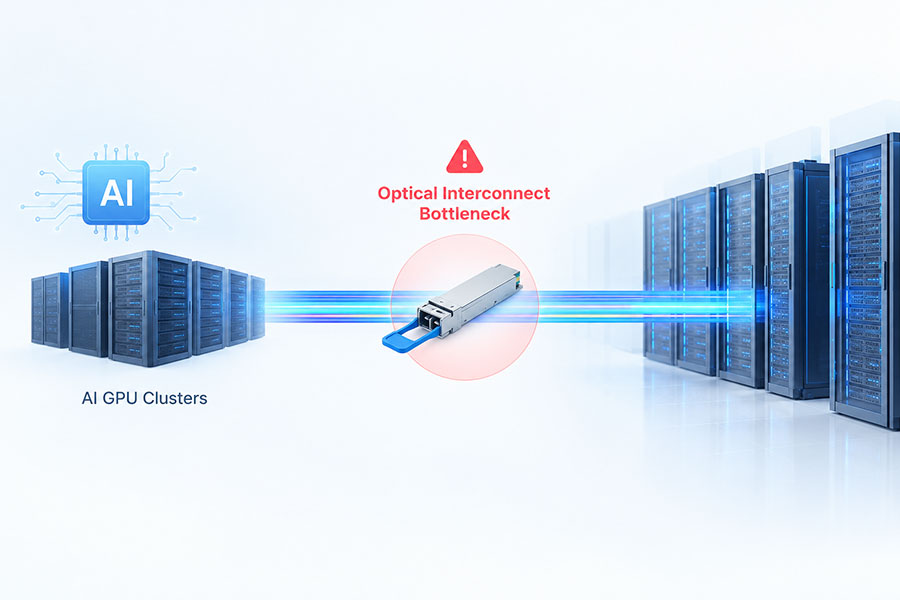
As model sizes move from billions to trillions of parameters, the network becomes the primary bottleneck—not compute.
This is where 1.6T networking emerges as the next critical milestone beyond 400G and 800G.
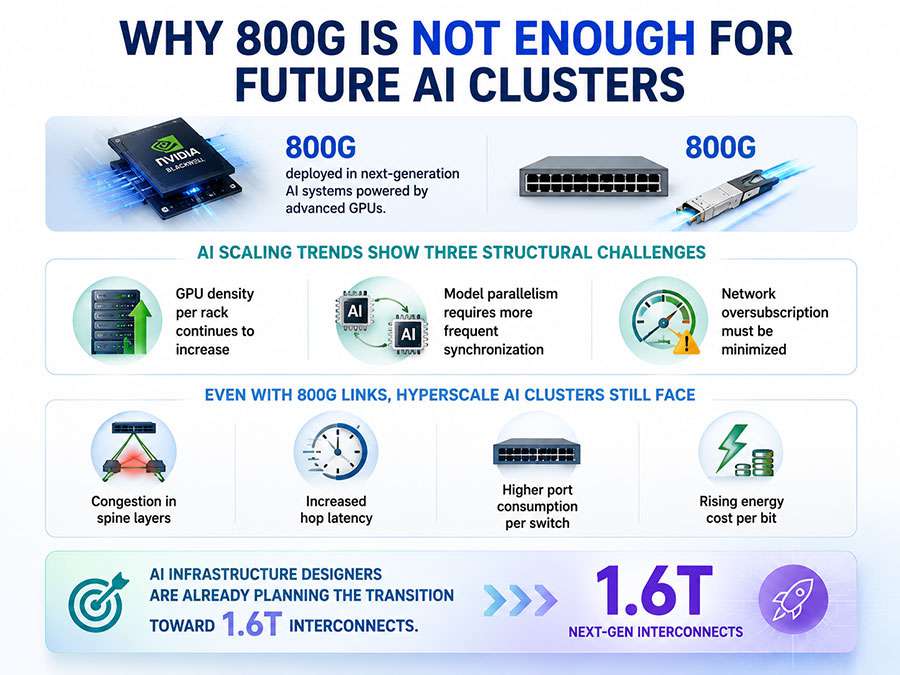
800G networking is currently being deployed in next-generation AI systems powered by advanced GPUs such as NVIDIA Blackwell.
However, AI scaling trends show three structural challenges:
GPU density per rack continues to increase
Model parallelism requires more frequent synchronization
Network oversubscription must be minimized
Even with 800G links, hyperscale AI clusters still face:
Congestion in spine layers
Increased hop latency
Higher port consumption per switch
Rising energy cost per bit
As a result, AI infrastructure designers are already planning the transition toward 1.6T interconnects.
1.6T (1.6 Terabits per second) represents the next-generation optical interconnect standard designed for ultra-large AI fabrics.
2× bandwidth of 800G
Reduced switch port count per cluster
Lower network hop complexity
Improved energy efficiency per bit
Better scalability for trillion-parameter models
With 1.6T links, AI data centers can:
Reduce fabric oversubscription
Flatten network topology
Improve GPU utilization
Support larger distributed training jobs
In practice, 1.6T enables AI clusters with significantly fewer network bottlenecks and higher training efficiency.
In ultra-large GPU clusters, 1.6T will primarily be used for:
GPU server uplinks
High-density ToR switching
Intra-cluster aggregation layers
C-LIGHT is developing next-generation high-speed interconnect solutions, including:
1.6T OSFP-XD DAC (short reach, ultra-low latency)
1.6T AOC solutions for high-density GPU racks
Early-stage 1.6T optical module ecosystems
At the aggregation and spine layers:
1.6T reduces the number of required switch ports
Improves bisection bandwidth
Simplifies large-scale AI fabric design
C-LIGHT supports AI backbone evolution with:
800G OSFP 2DR4 and 800G OSFP 2FR4 modules
Transition-ready 1.6T optical architectures
DWDM-based scalable backbone solutions
For multi-building AI campuses:
1.6T enables higher capacity per fiber pair
Reduces long-haul link cost per bit
Supports hyperscale AI cloud expansion
C-LIGHT DWDM and coherent-ready solutions provide a foundation for:
400G / 800G / future 1.6T DWDM systems
MUX/DEMUX optical transport platforms
Long-distance AI cluster connectivity
AI networking evolution follows a clear progression:
400G → Mainstream AI infrastructure
800G → High-density AI clusters
1.6T → Ultra-scale AI supercomputing fabric
Existing clusters: 400G DR4 / FR4 backbone
New deployments: 800G OSFP / 800G QSFP-DD
Future systems: 1.6T OSFP-XD ecosystem
C-LIGHT provides full lifecycle support:
400G DAC / AOC / optical modules
800G high-density AI interconnects
Research and deployment roadmap toward 1.6T solutions
Next-generation AI models require:
Larger parameter sets
More distributed training nodes
Faster synchronization cycles
Network bandwidth must scale proportionally.
Industry roadmaps indicate:
800G becoming mainstream baseline
1.6T emerging as next IEEE/industry milestone
Continuous improvement in PAM4 and SerDes technologies
AI data centers face extreme power density challenges:
40kW–100kW+ per rack
Rising cooling demands
Increasing cost per watt
1.6T reduces:
Number of transceivers per cluster
Total power consumption per bit
Cooling overhead per rack
C-LIGHT provides a full-stack high-speed interconnect portfolio designed for AI evolution:
AI storage and training network connectivity
800G OSFP / 800G QSFP-DD DAC
800G 2DR4 / 2FR4 optical modules
High-density AI fabric optimization
OSFP-XD ecosystem planning
Ultra-high-speed DAC/AOC architecture research
DWDM scalability for AI interconnect evolution
CWDM/DWDM MUX/DEMUX systems
Compatibility testing for NVIDIA / Broadcom / Intel platforms
BER, eye diagram, and reliability validation services
These capabilities ensure that AI operators can smoothly transition from 400G → 800G → 1.6T without redesigning their entire infrastructure.
1.6T networking is not just an incremental upgrade—it is a structural shift in AI data center architecture.
As AI models scale toward trillion-parameter systems, only ultra-high-speed interconnects can support the required:
Bandwidth density
Low latency synchronization
Efficient GPU utilization
Large-scale distributed computing
While 400G and 800G remain the foundation of today’s AI infrastructure, 1.6T defines the future of hyperscale AI computing.
With a complete roadmap spanning 400G, 800G, and next-generation 1.6T interconnect technologies, C-LIGHT enables AI data centers to build scalable, efficient, and future-ready networking architectures for the next decade of artificial intelligence.
Q1: What is 1.6T networking for AI data centers?
Answer: 1.6T networking refers to next-generation high-speed network connectivity capable of delivering 1.6 Terabits per second (Tbps) bandwidth through a single network link.
It is designed for ultra-scale AI data centers that require massive data exchange between:
GPU servers
AI accelerators
Network switches
Storage systems
Compared with 800G networking, 1.6T provides:
2× higher bandwidth
Higher network density
Reduced port requirements
Improved bandwidth efficiency
1.6T networking is expected to become a key infrastructure technology for future AI clusters and hyperscale computing environments.
Q2: Why is 1.6T networking important for AI data centers?
Answer: AI workloads are becoming increasingly communication-intensive.
Modern AI applications such as:
Large Language Model (LLM) training
Mixture of Experts (MoE)
Distributed AI inference
Large-scale GPU synchronization
require continuous high-speed communication between thousands of computing nodes.
As GPU clusters grow larger, network bandwidth becomes a major limitation. 1.6T networking helps AI data centers:
Reduce communication bottlenecks
Improve GPU utilization
Support larger AI models
Increase training efficiency
Q3: Why is 800G networking not enough for future AI clusters?
Answer: 800G networking is currently an important solution for advanced AI infrastructure, but future AI clusters continue to push bandwidth requirements higher.
Large-scale AI deployments face challenges including:
Increasing GPU density
More frequent synchronization between nodes
Higher east-west traffic volume
Greater network congestion
Although 800G improves AI connectivity, ultra-scale AI systems require additional bandwidth expansion.
1.6T networking provides a path to overcome these limitations by increasing bandwidth capacity while reducing network complexity.
Q4: What are the advantages of 1.6T optical interconnects?
Answer: 1.6T optical interconnects provide several advantages for next-generation AI networks.
Higher bandwidth density
More data can be transmitted through fewer network links.
Lower network complexity
Higher-speed connections reduce the number of required ports and cables.
Better energy efficiency
More bandwidth per connection helps reduce power consumption per bit.
Improved scalability
AI clusters can expand without requiring complete network redesigns.
These advantages make 1.6T optical technology suitable for future AI fabrics and hyperscale data centers.
Q5: Where will 1.6T networking be used in AI data centers?
Answer: 1.6T networking will be used across multiple layers of AI data center architectures.
GPU Server Layer
GPU server uplinks
High-density AI rack connections
Ultra-low latency interconnects
Leaf-Spine Network
AI fabric backbone
High-bandwidth switch connections
Large cluster aggregation
Data Center Interconnect (DCI)
Multi-building AI campuses
Large-scale cloud infrastructure
Long-distance AI cluster communication
Q6: What is the difference between 800G and 1.6T networking?
Answer: The main difference is bandwidth capacity and network scalability.
| Feature | 800G Networking | 1.6T Networking |
| Bandwidth | 800Gbps | 1.6Tbps |
| Application | Current high-performance AI clusters | Future ultra-scale AI clusters |
| Network Density | High | Higher |
| Port Requirement | More ports needed | Reduced port count |
| AI Scalability | Advanced | Next-generation |
800G will continue supporting current AI infrastructure, while 1.6T is designed for future AI systems requiring extreme bandwidth and efficiency.
Q7: What optical technologies enable 1.6T AI networking?
Answer: 1.6T networking requires advances in optical modules, electrical interfaces, and system architecture.
Key technologies include:
Advanced PAM4 signaling
High-speed SerDes technology
OSFP-XD optical platforms
Next-generation DAC and AOC solutions
High-density optical modules
Future 1.6T solutions will build upon the evolution from:
400G → 800G → 1.6T optical interconnect
to support increasingly large AI computing infrastructures.
Q8: Will 1.6T networking become the future standard for AI infrastructure?
Answer: 1.6T networking is expected to become an important milestone in future AI data center evolution.
As AI models move toward:
Trillion-parameter scale
Larger GPU clusters
More distributed computing
Higher bandwidth requirements
Data centers will need faster and more efficient interconnect solutions.
The future AI networking roadmap is expected to evolve through:
400G for mainstream AI infrastructure
800G for high-density AI clusters
1.6T for ultra-scale AI supercomputing fabrics
1.6T will play a critical role in enabling the next generation of AI computing systems.
For any questions, please contact us by email or WhatsApp.
Email: sales@c-light.com
WhatsApp: +86 132 6656 7067